

Do Mercedes-Maybachs And The Regular Benz/AMG Models Use The Same Engines?
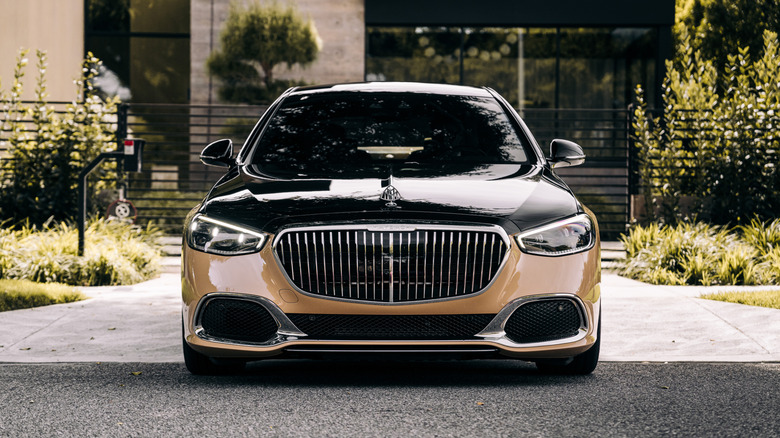
The Mercedes-Maybach nameplate carries real weight in the super-premium luxury car market. This sub-brand's name dates back to Wilhelm Maybach, who partnered with Gottlieb Daimler in the 1880s and helped build the world's first gas-powered motorcycle before either company existed.
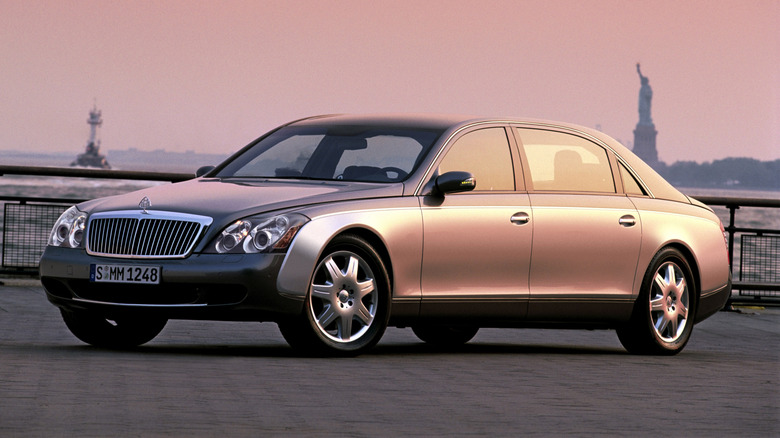
Maybach's modern revival began with the name being stamped on the 2002 Maybach 57 and 62, both super-luxurious full-size sedans based on the W140 S-Class chassis from the '90s and with the 550 horsepower Mercedes M285 5.5-liter twin-turbocharged V12. This was a more powerful version of the Mercedes 5.5-liter twin-turbocharged M275 V12 you could get in the 2002, 493-horsepower W220 S 600.
By the end of 2012, the Maybach badge went into hiding, and it wasn't really brought back until Mercedes turned it into a trim level with the previous generation of Mercedes models, starting with the S-Class in 2015. The GLS followed in 2019, and the SL joined most recently, debuting in 2025 as a 2026 model. Yes, there's an EQS Maybach too (2024 model year debut) — the automotive equivalent of a tree falling in an empty forest. Moving on.
Nowadays, Mercedes-Maybach models are more directly tied to their Mercedes counterparts. Where a Maybach's chassis carries a V8, it's the same core engine sold in the standard Mercedes AMG lineup. The V12 is a different story: Mercedes no longer builds it for any regular S-Class or AMG model, so the Maybach S 680 is the only new Mercedes-Benz you can buy with twelve cylinders. Here is everything you need to know about the engines that power Mercedes' finest.
Current Mercedes Maybach engine palette
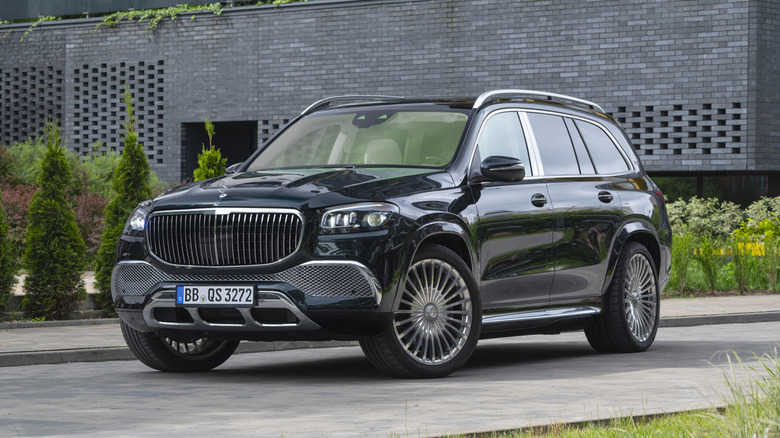
As previously mentioned, the non-BEV Maybach glow-up can now be had on the Mercedes S-Class, the SL, and the GLS. The Maybach GLS (GLS 680) and the Maybach SL (SL 680) can only be had with a V8, while the S-Class can be equipped with either a V8 (S 580) or a V12 (S 680). The SL680 is based on the SL63 AMG, meaning that it carries the M177 4.0-liter V8 with 577 hp, AWD, and a nine-speed automatic transmission.
The GLS 680 uses the M177 EVO 4.0-liter engine, and its power has been pushed to 603 horsepower with the 2027 facelift. This is the same engine architecture you can get in the regular 530 horsepower Mercedes S 580 and the 2027 Mercedes AMG GLE 63 S and GLS 63. So on paper, the AMG and Maybach versions of these cars often share their engine. However, the difference comes down to tuning and what the car is designed to excel at.
Where AMG models chase traditional performance car characteristics with an aggressive throttle response, Maybach versions of the same engine are tuned for smoothness. The one Maybach engine that isn't shared with any current AMG models is the V12 in the S 680. Mercedes builds the 6.0-liter twin-turbo M279 V12 exclusively for the Maybach S 680 and its armored S 680 Guard version, since the V12-powered S65 AMG and S 600 have both been discontinued.
That V12 lineage runs deeper than just the Maybach, though. The M279 descends from the earlier M275 AMG, and Mercedes also built a related engine, the M158, specifically for Pagani's multi-million-dollar hypercars. The last time a Mercedes-AMG used a V12 was with the 2019 S65 AMG V12 Final Edition, and that engine was the M279, which you can now only get in the Maybach.
Why do Maybach models use Mercedes parts and engines?
Engine sharing across different automakers is rather normal. This can be seen within the Volkswagen Group, where cars like the Audi RS6 use the same engine architecture as the Porsche Panamera (high-performance trims), the Bentley Continental, and the Lamborghini Urus. This helps to reduce development costs and allows for easier servicing plans and company maintenance.
In the Mercedes Maybach case, we see that the differences between a Maybach and a Mercedes are slimmer than what they used to be. The Maybach 57 and 62, although also loosely relying on Mercedes engines, were different enough. You only need to lay your eyes on a Maybach 62 next to a W140 S-Class to know that. The latest generation of Maybach models are, in large part, regular Mercedes models that were upgraded to the Maybach trim.
This is also what BMW is likely to do with Alpina, and the reason has to do with costs and financial feasibility. Developing a new car, and especially a new engine, for a low-production super luxury car that few people buy is not something automakers can justify. In other words, this is likely the only way you can see a Maybach logo on a Mercedes, as any other way of doing it would prove to be too expensive.