

Before Mercedes-Maybach, Wilhelm Maybach Helped Build The First Gas-Powered Motorcycle
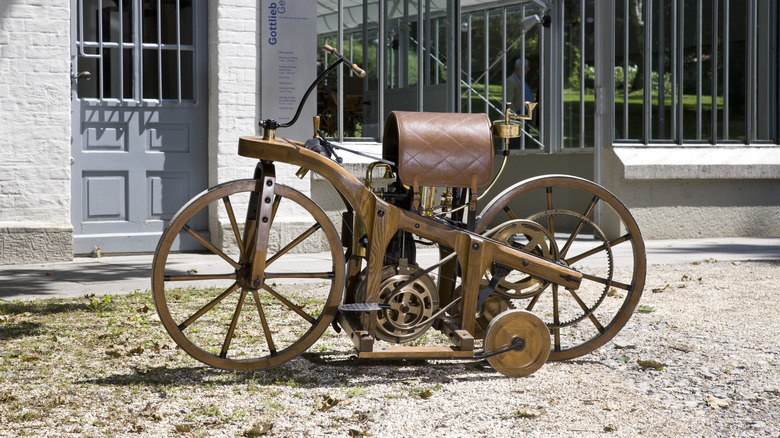
Wilhelm Maybach's name lives on as part of the Mercedes-Benz sub-brand for super-lux vehicles like the 2027 Mercedes-Maybach S580 ultra-luxury sedan and the in-your-face 2027 Mercedes-Maybach GLS680. Yet, Maybach himself came from pretty humble beginnings, and the first vehicle he helped to build in 1885 reflected that: It was originally called the Reitwagen, which means "riding carriage," but it's better known today as the world's first motorcycle.
Maybach's path to that point started in Heilbronn, Germany, where he was born in 1846. Both his parents passed away by the time he was 10, and Maybach eventually ended up in an orphanage. While there, he began working at a local machine shop, eventually meeting an engineer sent to inspect the shop. That engineer was Gottlieb Daimler. Despite the 12-year difference in their age, the two began a long-time working friendship that would last until Daimler died in 1900.
An early project was the "grandfather clock" engine that they began developing in the mid 1880s. Looking a bit like a big timepiece because of its tall, narrow shape, this upright, single-cylinder motor was a major advance in terms of both engine speed and power. Placed in a two-wheel wooden frame in 1885, the outcome was a motorbike capable of traveling up to about 7.5 mph. It did have what are described as jockey wheels as well, which operated sort of like training wheels. Anyways, it wasn't only the first motorcycle ever. According to Mercedes-Benz, it also was the "first functional road vehicle with a combustion engine."
More about Maybach and Daimler's developments
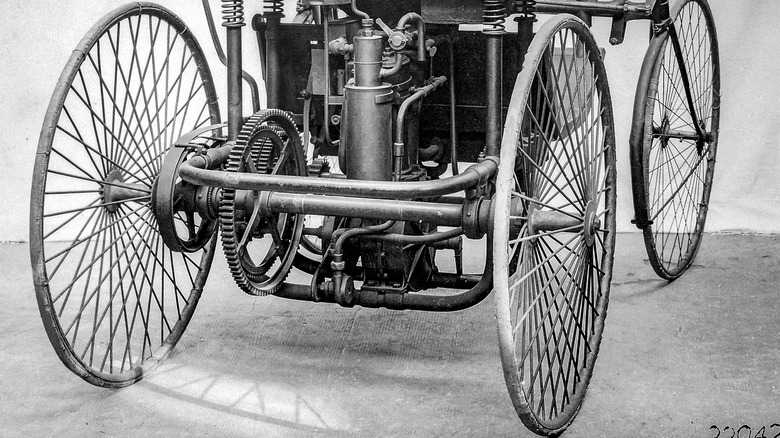
Now, it's not always clear who did what in the partnership. But it appears that Maybach handled the practical engineering while Daimler came up with the ideas -– and often took the credit by only putting his name on the patents. The world's first two-cylinder V-configuration engine, which would play its part in the history of Harley-Davidson's V-Twin, is a great example. Mercedes-Benz itself gives sole credit to Daimler and points out he registered the patent for it in 1889. But other sources split the honors or claim the motor was designed by Maybach.
Then, we come to the Stahlradwagen — aka, the steel-wheeled carriage. Unsurprisingly, Maybach and Daimler had previously tested their engine in a horseless carriage. Here, the results were promising enough that one or both of the two developed a dedicated chassis specifically to carry the motor. Some sources say it was Maybach, and others that it was both of them. Either way, this is sometimes considered the first four-wheeled vehicle with its own purpose-built new chassis – instead of being constructed around a pre-existing horseless carriage, for instance.
And it was while working for Daimler-Motoren-Gesellschaft (DMG) that Maybach invented the honeycomb radiator and — again according to Mercedes-Benz — the world's first modern automobile. The 1900 Mercedes 35 PS was created at the behest of Emil Jellinek, who represented DMG in the French Riviera. He thought he could drum up more business with better, faster cars, so Maybach built him one. Jellinek would go on to name it after his daughter, Mercédès, meaning Maybach sort of invented Mercedes-Benz, too. So, Mercedes was really only returning the favor by reincarnating the modern Maybachs.