

Here's How Much A 2021 Genesis G90 Has Depreciated In 5 Years
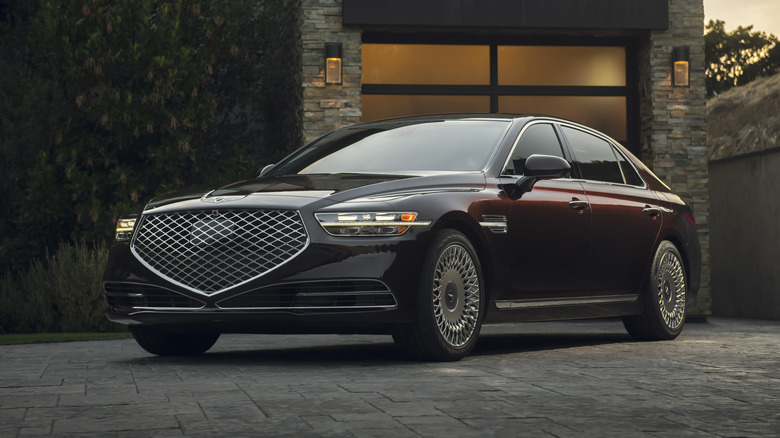
When Hyundai launched its Genesis luxury division for the 2017 model year, it followed a familiar path for Asian automakers: offer more value and similar luxury to the Germans. Honda, Toyota, and Nissan took the same path. Along with the midsized G80 sedan, the G90 helped Genesis plant an upscale flag in the U.S. market. Today, the least expensive G90 has a 2026 model year MSRP of $94,195. That's a far cry from the $69,050 sticker for the base G90 in 2017.
For someone thinking Toyota Camry-money while still surrounded by opulence, a used G90 may be the ideal solution, thanks to the wonders of depreciation. The 2021 edition sits squarely in the middle of the G90's model-year history. This puts it in that five-year sweet spot, balancing relative newness with plunging resale values. The 2021 model year also benefits from the revised front end that debuted in 2020 (in other words, even though the car is half a decade old, it doesn't look too old).
If you believe the professional prognosticators (iSeeCars and CarEdge), you should expect roughly 50% depreciation over five years. However, the market suggests you can save even more. We'll dive into what dealers are asking for a 2021 Genesis G90 to get a more real-world view. And because the G90 is hardly the only luxobarge on the road, we compare its depreciation against the Mercedes-Benz S-Class and the Lexus LS 500, which was once in the same upstart shoes as the G90. All MSRPs mentioned here include factory destination charges.
Depreciation for the Genesis G90
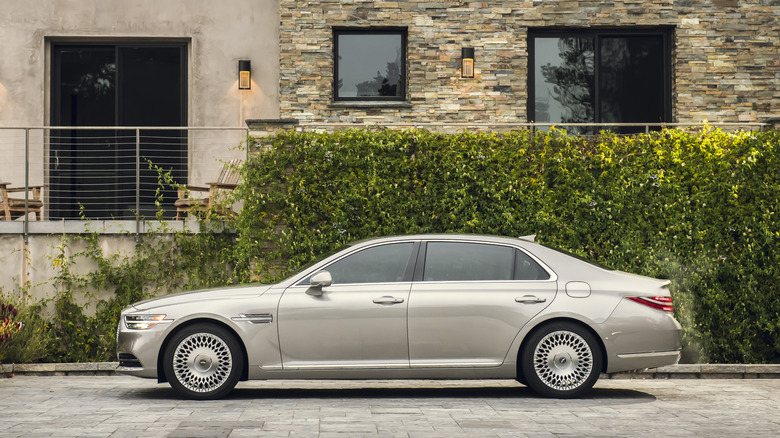
According to iSeeCars, the G90 loses 52.7% of its original value over five years. Meanwhile, CarEdge projects a 48.2% depreciation rate over the same period. While iSeeCars' number is more of a crystal-ball look into the future, CarEdge uses the site's current market pricing instead of a more generalized estimate. Either way, both numbers are relatively close. We can average the two and use 50% as an approximate guide. That means the entry-level 3.3T Premium trim, with a 2021 base price of $73,995, should be available for around $37,000.
Today, a used example with a clean history (no accidents or title brands) and average mileage (close to 65,000 miles) lists for about $35,000. Admittedly, few units have these specifications, but the resale market offers interesting insights. The dealer's listing price matches iSeeCars' five-year depreciation projection. The Genesis G90 also makes the Insurance Institute for Highway Safety (IIHS) list of the safest new cars you can buy.
Comparing Genesis G90 depreciation against competitors
With depreciation confirmed for the G90, it's time to look at how value loss hits the other luxury flagship sedans. The base price for a 2021 S 500 was $110,850. iSeeCars says that the vehicle has lost 55.4% of its value over five years. This works out to a resale value of about $49,400. Using the good-condition and average-mileage parameters, the marketplace shows pricing around $47,100 (though availability is limited). That's 57.5% depreciation. On a percentage basis, the loss of value is greater than with the G90, but it's still $12,000 more than its Genesis counterpart.
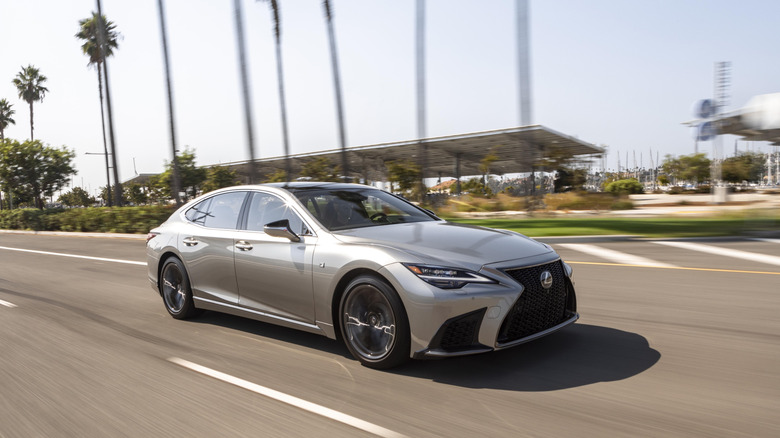
The Lexus LS 500 flips the depreciation script compared to competitors. Its 2021 starting MSRP of $77,025 is somewhat closer to the G90's starting price, but an iSeeCars estimated five-year depreciation rate of 42.4% is far lower than that of the Genesis or Mercedes. Shopping for a used 2021 LS 500 means spending about $47,000, which translates into a 39% loss of value over half a decade.