

New AI That Detects Body Language And Eye Contact At Las Vegas Crosswalks Likely Won't Help Prevent Pedestrian Deaths
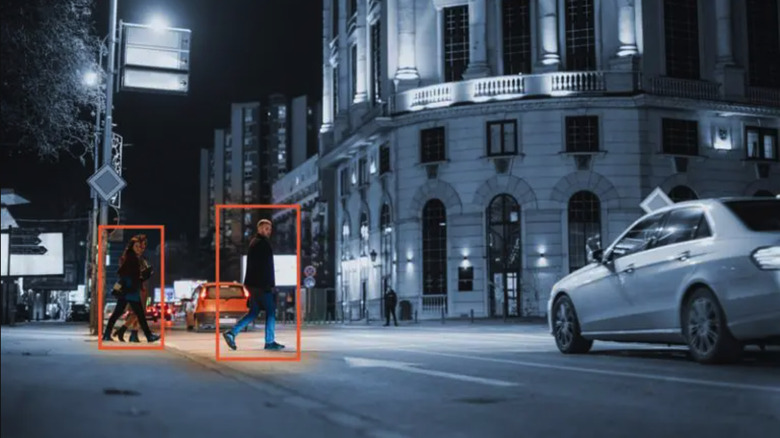
If pressing a button is too difficult a task for initiating a street crossing, there's now an AI solution for that too. A new intelligent AI camera system was activated at 16 Las Vegas intersections in mid-August, KLAS and Fox 5 News reports, which should automatically detect when a pedestrian wants to cross the street and illuminate them as they cross. The latest and greatest AI technology is supposed to help increase pedestrian safety, but prior studies have shown that won't be as helpful as its saying it will be.
The pilot program launched in Las Vegas is the third launched by Intelligent Security Systems, made here in the U.S. of A. ISS, as the company refers to itself, offers multiple AI solutions from facial recognition (used in arenas and venues) to underbody detection on your vehicles, as well as your favorite, ALPR cameras. Las Vegas is sporting the company's latest system, SecurOS Soffit. This software utilizes AI to detect a human's body movements and facial expressions while approaching a crosswalk area. The AI then quickly determines that the human would like to cross and illuminates the pedestrian while they cross the street. There are no other things utilized to inform a driver that this is happening, just a very brightly lit human walking along a crosswalk.
ISS is convinced that this AI crosswalk lighting solution should be enough to alert drivers of a human's presence as they are crossing a road. But these sorts of things already exist in their own way, without AI involvement (like buttons and lit crosswalks), and those are still not enough to help markedly reduce pedestrian traffic fatalities. According to traffic safety organizations it's not even considered a top solution for reducing pedestrian fatalities at all. In reality it's probably a cheaper solution.
Effective methods to reducing pedestrian traffic fatalities involve separating cars and humans
NHTSA points out in its own Pedestrian Safety literature that the top causes of pedestrian traffic deaths are linked to a driver's speed, alcohol, vehicle type, distraction, and roadway design. Illuminating a pedestrian as it crosses would not be an effective tool against a driver's speed, a drunk driver or any sort of distraction because a driver has to be paying attention to see what they are driving towards, which isn't in the latter cases.
Vehicle type is not a quick-fix solution and would require cooperation from both automakers and government regulations to make vehicles smaller. And with roadway design, that too would require similar efforts on the government's part, as well as a whole lot of money to bring changes to life.
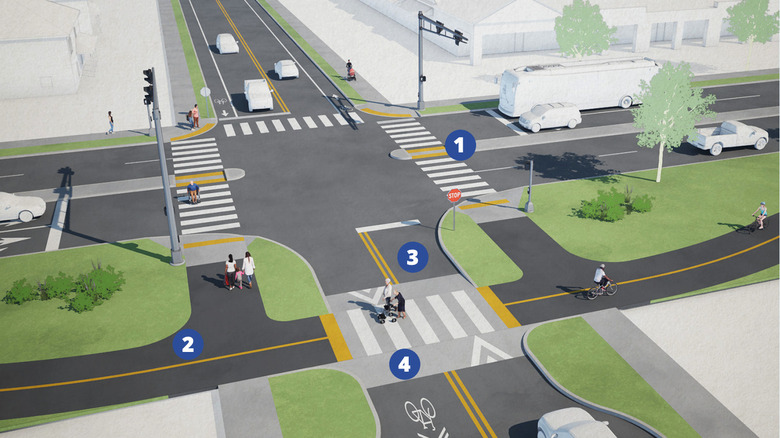
On the U.S. Department of Transportation's Federal Highway Administration's (FHWA) Intersection Safety page, its Pedestrian Safety section has a link complete with fact sheets and illustrations of safer intersections. Not one solution listed in the FHWA's documents mentions lighting up pedestrians. In fact, most of these solutions involve major redesigns for crossings, and ways to separate the pedestrian from motor vehicles in an obvious way whether with dedicated lanes separated by markers or bollards, raised pedestrian crossings whether the sidewalk is raised or in bridge form.
That same methodology and thought process is further demonstrated in the literature provided on the Insurance Institute for Highway Safety (IIHS) Fatality Facts 2024 page for Pedestrians. Actual helpful safety solutions are "measures that separate vehicles and pedestrians, such as sidewalks, refuge islands, overpasses, underpasses and barriers." It does add that increased illumination can be effective, especially as the IIHS reported in 2024 that 73% of all deaths happened between 6 p.m. and 6 a.m., but lighting would fix only a very small piece of this particular death data pie.
Are we scanning faces for traffic or scanning faces for data?
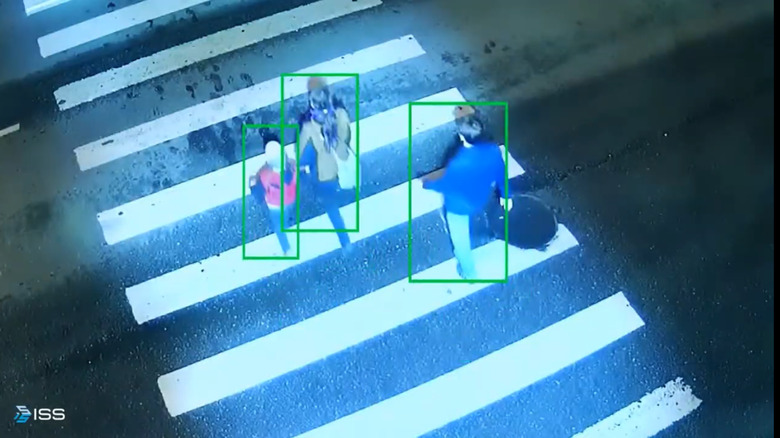
As of August, ISS's SecureOS Soffit AI crossing cameras are installed in three cities: Las Vegas, Dublin, Ohio, and Kodiak, Alaska. Jalopnik reached out to ISS in hopes to connect with a human to gain more insight on what types of crosswalks this program was used for and how the cameras initiated thus far have fared in the three to six months they have been running. We have yet to receive a response.
There's another big question no one from the media or ISS has yet to answer in all of this. Is the ISS software collecting data and if so, what is it doing with that data? We've seen what kinds of data has been collected by most ALPRs and Flock especially. But Flock, for all of its obvious glaring problems, has in some ways been weirdly transparent about what its products do, what data it collects, where it goes, etc. ISS in comparison doesn't have much on its site about its data usage at all. And for a company that uses AI to scan faces to detect if they want to cross the street, but also sells facial recognition technology (albeit separately), any remotely intelligent human has to be wary about where the data is going and how its being used. Like every other surveillance-type AI-driven software, it was implemented in an area where the people paying taxes didn't vote for it or agree to it. So the least these companies can do is be transparent about where locals faces will be stored, if they're storing them at all.
Sure, the software is supposed to help save pedestrian lives, but does it really need to scan a face to do it?