

How Average MPG Changes When You Put A Convertible's Top Down
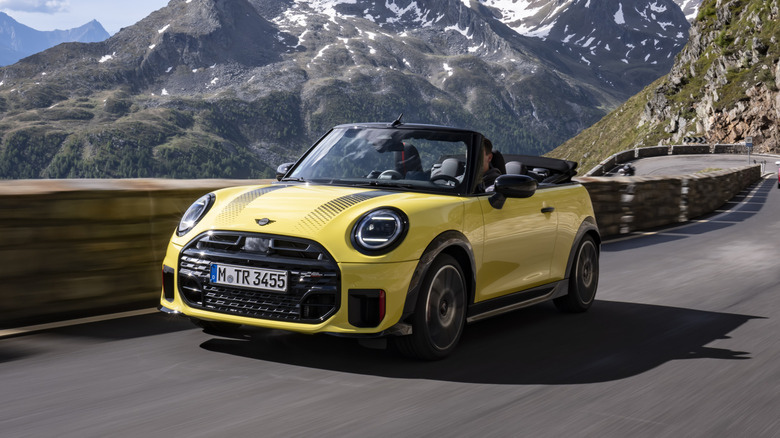
Fuel economy may not be the first thing on your mind when you're cruising around in a convertible on a beautiful spring day. But whether that foldable top is down or not does impact how much fuel you burn. Granted, the difference isn't huge, often coming down to a difference of just about 14%. But it all comes down to aerodynamics, causing you to lose a few miles per gallon with the top down.
A convertible with the top up is simply a smoother object that shoots through the air more efficiently, whereas that same car with the top down is a bit of an aerodynamic nightmare. Imagine a closed-top car as a football — smooth and able to slice through the air in a perfect spiral — whereas an open-top car is the same football but with a huge hole cut in the side. Good luck spiraling that thing gracefully. Yes, modern convertibles like the Mercedes-Benz CLE450 Cabriolet have windscreens and wind deflectors to smooth things out — not just for the sake of fuel economy, but also occupant comfort. Even so, physics are physics, and a difference in aerodynamics is unavoidable.
Top-down testing
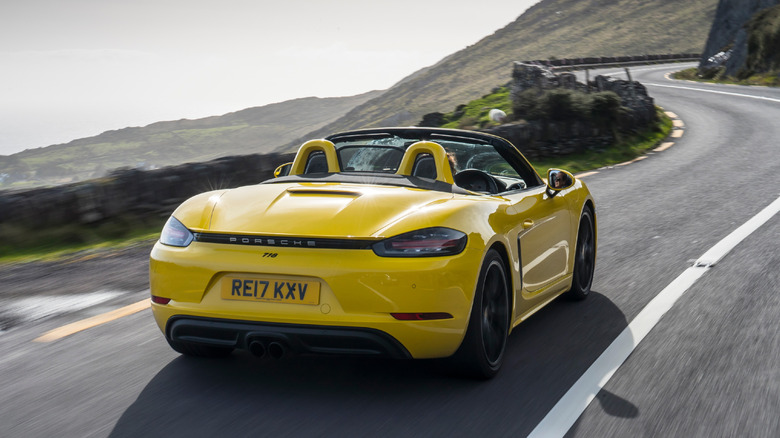
Losing mpg with a convertible's top down isn't just theory. Cars.com once measured how having the top down affected the fuel economy of a 2012 Mercedes SLK350. With everything else held equal, having the roof off made efficiency drop from 31.7 mpg to 27.3 — a difference of 4.4 mpg, or almost 15%. The Fast Lane Car on YouTube, meanwhile, conducted a similar test using a 2016 Mini Cooper S Convertible and logged a difference of 5.1 mpg (37.9 mpg with the top up and 32.8 with it down, for a delta of about 13%).
In a real-world scenario, however, there's an argument to be made that leaving the top down subconsciously causes drivers to go slower, leading to potentially better fuel economy. As a convertible owner, the all-encompassing wind and noise of going above 55 mph with the top down is so intense that I do routinely find myself driving slower. Perhaps that's why the Mazda MX-5 is the least driven car in America – and why Jeremy Clarkson, as per The Times, argued that all convertibles feel the same above 30 mph. "The whole experience is so dominated by the elements and the wind that you don't really notice any handling deficiencies or holes in the torque curve." Perhaps all that wind will help blind you to that 14% hit in fuel economy, too.