

The Sherman Tank Calliope Strapped 60 Rocket Tubes To A WWII Medium Tank's Turret
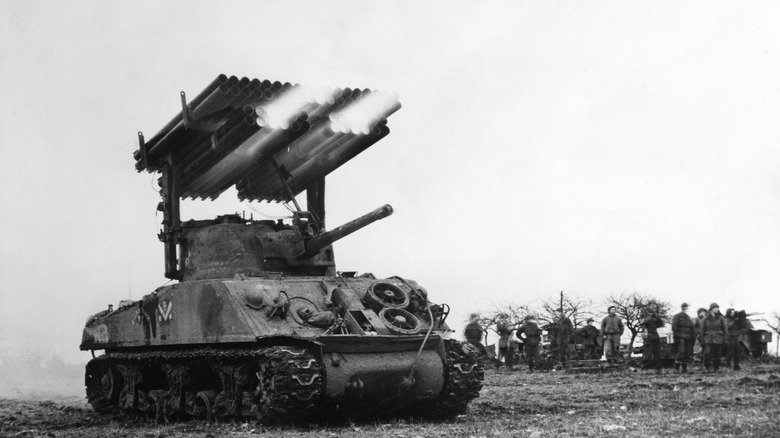
Thanks to many documentaries, dramatic movies, and gratuitous video games, the typical member of the public knows a few things about World War II. One of those things is the sometimes spine-tingling mechanical rattle and report of an approaching tank (and its armored cohorts). What's more sinister than a tank? How about a tank that fires an indiscriminate screeching barrage of rockets? Not exactly the more personal message that a signed, sealed, and delivered high-explosive love letter from a 76.2-mm main gun sends, but still devastating and outright wild.
That's what Allied forces in WWII set out to do when they took a more rocket-y approach to the existing M4 Sherman Medium Tank. Granted, the Sherman wasn't the most capable tank of the war on its own. Far from it, really. That didn't stop the United States from building tens of thousands of Sherman tanks, or the military from fitting the plucky, 68,000-pound killing machine with a T34 Calliope rocket system. This configuration was deafening and destructive, with a weapons array capable of firing rocket-propelled ordnance nearly two and a half miles away.
Sending the Sherman to war with a big, honkin' rocket system
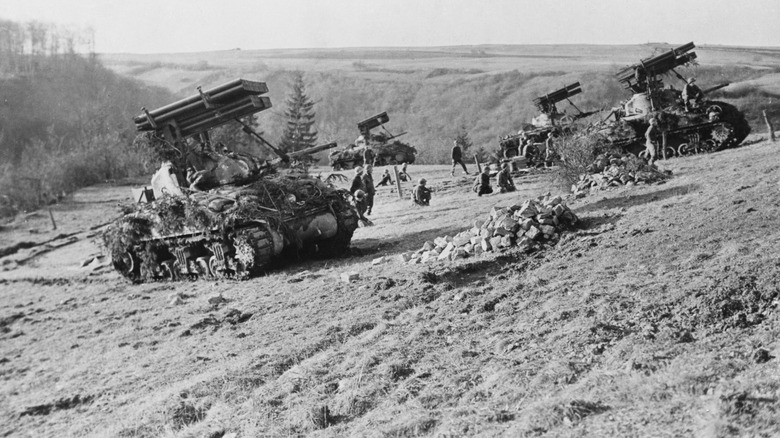
By 1944, the United States had landed at Normandy as part of the D-Day invasion, securing a vital access point to Nazi-occupied Central Europe. The 500-horsepower M4 Sherman Medium Tank was an instrumental part of that push. Although outgunned and outmuscled by German bruisers like the Tiger, King Tiger, and Panther tanks, the Allies chose to give the Sherman more firepower. The result was the M4 Sherman "Firefly," which packed the British 76.2-mm, 17-pounder main gun as opposed to the standard Sherman's 75-mm package.
This helped, but it's far from the only time the Sherman got an upgrade to take the fight to the Axis Powers. As if to add an element of nightmarish hellfire to the plentiful Sherman, the United States Ordnance Department took 60 114-mm rocket tubes loaded with fin-stabilized M8 rockets and mounted them in an array on the M4's turret. That ridiculous-looking contraption constituted the T34 Calliope, a 1,840-pound addition of sky-shattering mayhem for the M4A1, A2, and A3 tanks. No Firefly, though. Every one of the Calliopes featured the standard, non-Firefly 75-mm main gun.
As a weapon system, the Calliope wasn't, well, super accurate. Not individually, that is. Instead, the rocket system could fire a volley of rockets over a wide area, saturating and suppressing battle spaces. If that wasn't enough, the Sherman-mounted rocket system produced a deafening cacophony of noise that had a negative impact on enemy troop morale. That wall of racket, along with its appearance, is reportedly where the T34 got its nickname, "Calliope." The moniker references the steam-whistle organ you'd find beckoning potential visitors to fairs and circuses in the 1800s.
Not the first (or only) time rocket power hit the front lines in WWII
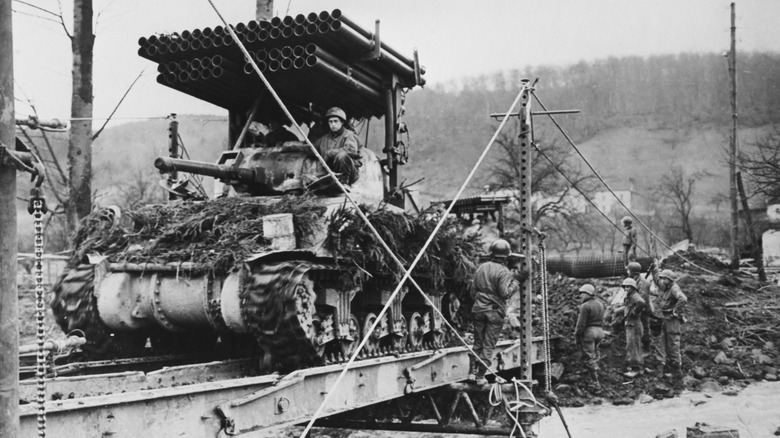
Over the course of the Calliope's lifespan, the military produced several variants of the rocket system. The rocket-bearing Sherman's crew members raised some concerns about the system, including the usability of the M4's 75-mm main gun with the launcher installed. That resulted in the T34E1, which added an arm to the main gun, allowing it to maintain its range of elevation even with the array of tubes riding above it. The E1 also adopted a more quickly detachable setup than the original T34, with the T34E2 adding provisions for firing a larger 183-mm rocket.
The Americans weren't the only ones to think of using a multiple rocket launch system for area suppression, either. On the Eastern Front, the Russians used their Katyusha rocket launcher to some success against the Germans. In its first practical battlefield deployment in 1941, the Katyusha fired rocket barrages at the train station in Orsha, Belarus.
The Red Army's screaming rockets, while not exactly pinpoint accurate, destroyed multiple trains and caused significant enemy casualties. Though you could debate the overall effectiveness of this period's multiple rocket launch systems, one thing's for sure: they're a pretty interesting bit of WWII technology. Not unlike the well-preserved German military motorcycle uncovered by a drying Danube River.