

Subaru's Smallest Production Car Was Its First To Be Sold In The US, Here's Why The Microcar Failed
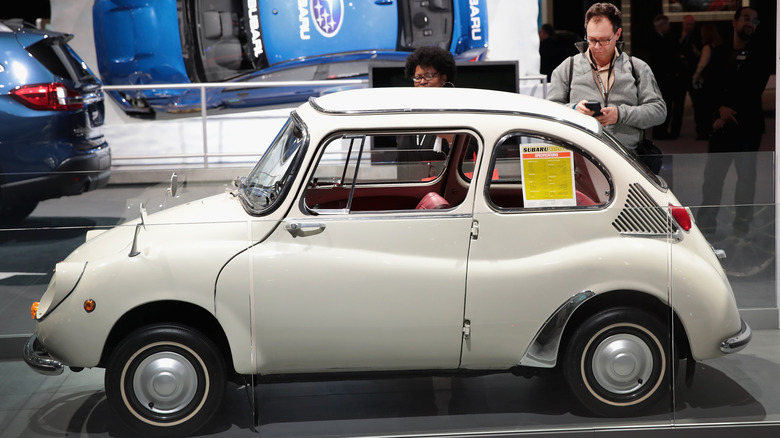
According to Consumer Reports, the 1968 Subaru 360 was a disaster. That car — with a displacement of, as you might guess, 360cc (from a two-stroke engine) — offered a miserable 16 horsepower. CR's rebuke had more to do with the car's safety than its power train. But the magazine was comprehensive in its slagging, so the engine still came in for a thorough chiding.
And rightly so. At a curb weight of 993 pounds (driver not included), we're talking about an engine that would be pathetic for the power-to-weight ratio of a decent modern Kawasaki. The 360 was attempting to shove 62 pounds per horsepower. A 296cc Kawasaki Versys delivers 39 horsepower and weighs 386 pounds, for a horsepower-per-pound output of 9.9.
It's fairer to compare the 360 with its contemporary rival from Volkswagen, as Consumer Reports did, pitting the 360 versus the Beetle, with its far more prodigious 1.5-liter lump of air-cooled, steroidal muscle. After all, the 1968 Volkswagen Beetle offered a mighty 53 horsepower. At 1,742 pounds it could fly to Interstate speeds in a tidy 14.5 seconds.
Meanwhile, Consumer Reports' testing found that it took 37.5 seconds to get to Interstate speed in the Subaru. And by Interstate speed, we mean 0-50 mph, not 0-60. That weak straight-line performance might have been excusable in an age when acceleration was generally leisurely. But Consumer Reports made it clear that the little Subaru would probably not rank among any modern kei car Americans would actually want to buy.
Big in Japan
Subaru kei cars were a hit in Japan. The company launched its first model in 1958, shortly after legislation capped kei car output at 360cc. Between 1958 and 1971 Subaru was the dominant player in kei car production. But the 1968 360 wasn't ready for prime time in the States. Consumer Reports' review says that while swerving to simulate an emergency maneuver, "the car's outside rear wheel tucked under as the car's rear end hiked up, causing sudden violent oversteer. The front wheels lost their cornering bite almost simultaneously." If your goal was to steer around a potential accident, the magazine said, "the result would very likely be an accident."
Apparently the fact that it featured a fully independent suspension did the car zero favors. The Subaru's drum brakes, according to CR, could stop the car efficiently — but its soft front dampers would allow so much dive that the little 360 would pitch alarmingly forward during hard stops.
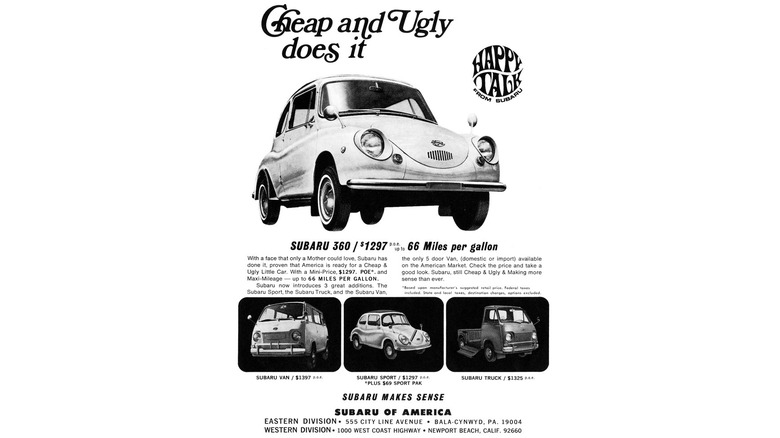
None of this apparently mattered to the 360's first American fan, Malcolm Bricklin. (Who later brought the Yugo to America by the hundreds of thousands, so there's that.) Bricklin, an importer of scooters, decided to branch out to importing Subarus, bought the licensing to import Subarus into the U.S., and quickly set up dealers across the East Coast and in California. He shamelessly aped Volkswagen's iconic ads by teasing the 360's homely attributes — while touting a stunningly low $1,297 sticker price (the equivalent of $12,445 today). Then the Consumer Reports piece came out, and most 360s remained glued to dealer lots two years later.
A 360 sold for $48,000 on Bring a Trailer last year
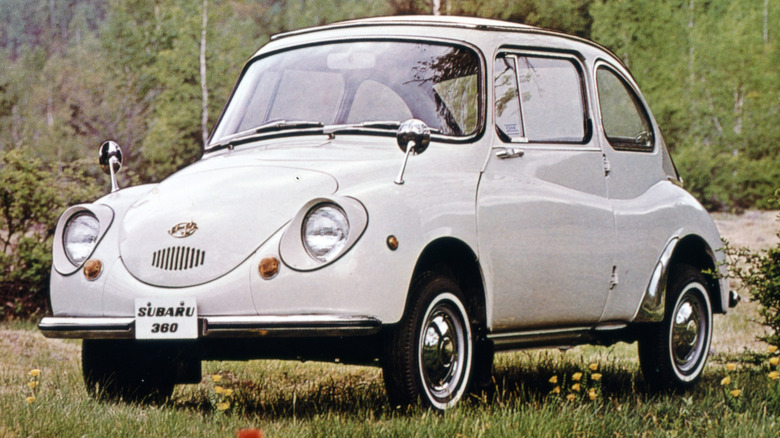
We cannot account for capitalism. We're just here with the facts. About a year ago a 1968 Subaru 360 rang in at $48,000 in an auction on Bring a Trailer. During the height of the pandemic, in 2021, Hagerty wrote that no car in the history of its pricing tracker had shot up as fast, jumping from a 360 in excellent condition selling for about ten grand in 2020, just before the onset of the Covid-19 pandemic, to an astonishing $44,300 a year later.
A lot of collector car prices soared during the pandemic, then fell back to some kind of more reasonable baseline. The 360s selling on BaT since that $48,000 whopper last year are mostly moving at $14,000 and $20,000. Still, you might more wisely chase the rarest of 360s, and while it came in multiple body styles the Sambar van and the pickup are the rarest formats to, uh, lust for. Just this month a Sambar van sold for $15,500 on Bring a Trailer, and it has a claimed (hold onto your non-existent seat belts!) 25 horsepower.
No, just because they're now cute and collectible doesn't make the 360s any safer today — or any quicker. Hemmings notes that the drawbacks of ownership include the fact that "acceleration and top speed are rather humble," and drivers and their passengers risk "becoming a bug splat on an SUV bumper."
None of which has much to do with modern Subarus, by the way, or what Consumer Reports currently thinks of the carmaker. The twee 360's ignominious debut aside, Consumer Reports now gives Subaru lots of love and its top score for mainstream automotive brands.