

Who Made The Geo (And Chevy) Tracker, And What Are These Tiny SUVs Worth Now?
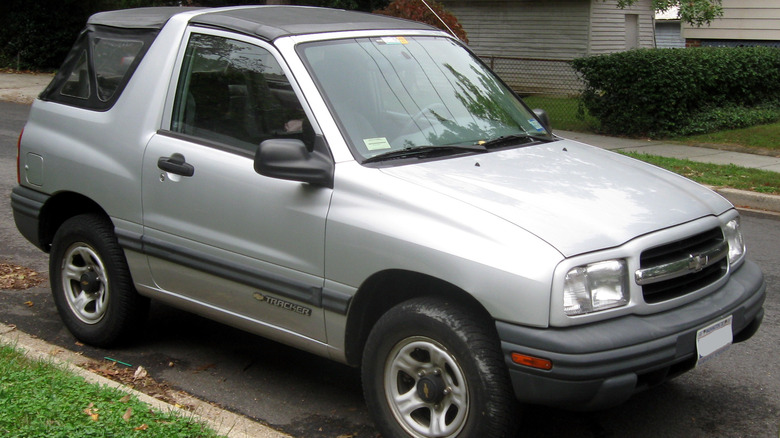
The Geo Tracker is a curious little off-roader that debuted in the very late 1980s. It was the product of a partnership between both Suzuki and General Motors, a relationship that began back in 1981, when GM purchased a 5.3% stake in Suzuki. The idea behind this partnership was that both could be mutually beneficial to the other, with GM gaining from Suzuki's experience in successfully producing small, inexpensive cars, while Suzuki could benefit from GM's global distribution, manufacturing, and financial resources.
Eight years into the relationship, the Geo Tracker would hit factory floors, and, specifically, it would be built at the CAMI plant in Ingersoll, Ontario. CAMI, or Canadian Automotive Manufacturing, Inc. was a plant co-owned by key players of the GM umbrella and Suzuki, so it was the perfect base from which to build the Tracker. Production began in April 1989 and ultimately continued until 2004 through the Tracker's many guises.
Fast-forward to today, and the little off-roader has defied all odds to become something of a cult classic. It's surprisingly capable on the rough stuff, owners praise how wonderfully cheap they are to run and maintain, and the simplistic nature and diminutive stature stands as a fresh and appealing alternative to the garish over-sized, tech-laden SUVs we're all so used to today. While rough and ready examples will change hands for $3,000 or less, and most average specimens fetch between $5,000 and $10,000, truly cherished examples can occasionally command figures in excess of $20,000.
Further exploring Tracker values
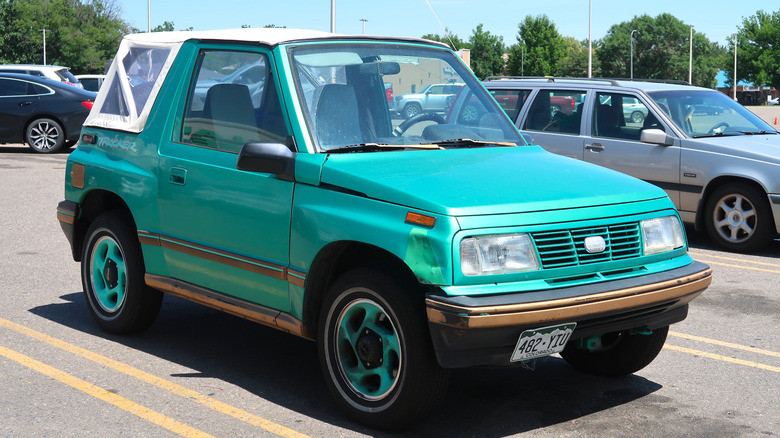
As always, low-mileage examples that have somehow escaped neglect and modifications over the years are the cars that collectors later come to covet. These are the cars that command the most money, and with numerous examples in such condition claiming over $20,000 in recent years, that occasionally sees the Tracker selling at double its original MSRP.
Equally, though, really well modified examples can command similar money. A thoroughly refreshed example with a cute paint job and mountain-climbing tracks recently managed $20,000 at auction, which goes to show factory standard isn't always the only way to command big money. Still, it's worth mentioning that modified examples — think big wheels and cheap lift kits — often sit toward the bottom of the market, so this tracked example is the exception, not the rule.
Most super-cheap examples seem to be disappearing from the market, and, instead, it's the presentable but not perfect cars that make up the majority. Such cars are perfect for daily duties, weekend drives, and general enjoyment, and $10,000 is an ample budget for acquiring a Tracker or Sidekick in such condition today. Buyers love that the Geo Tracker can be both cheap and cheerful, and as interest in the marque grows while rough examples continue to disappear, it's likely that values will stay strong and possibly even continue to grow.
A lesson in badge engineering
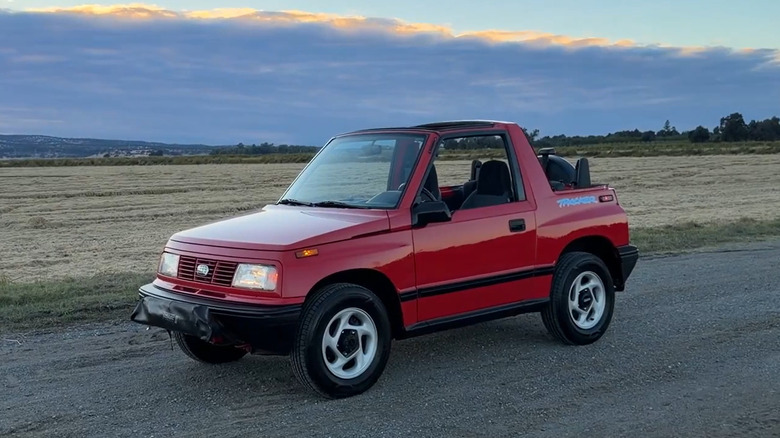
The diminutive Geo Tracker is famed for being a lovable little off-roader. We've already explained that much, but it's also a great example of how badge engineering can be used to tailor the same model for multiple markets. Depending on what market it was sold in, and at what time, the Geo Tracker was also known as the Suzuki Sidekick, Suzuki Escudo, Chevrolet Tracker, GMC Tracker, Asüna Sunrunner, Pontiac Sunrunner, Suzuki Vitara, Santana 300, and Mazda Proceed Levante. So, with very little changing from model to model, the Geo Tracker and its extended family stands as an excellent example of just how lazy car rebadging can be.
Among these many variants, it's likely that the Asüna Sunrunner would be the scarcest, thanks to a short production run spanning just two model years in the early 1990s, before becoming the Pontiac Sunrunner. It's tough enough finding previously sold examples, let alone any currently for sale, but the Sunrunner's scarcity doesn't appear to bring it any more value — just more intrigue for enthusiasts.