

Volvo Used Compressed Air To Spin A Turbo For Lag-Free Boost, But It Didn't Catch On
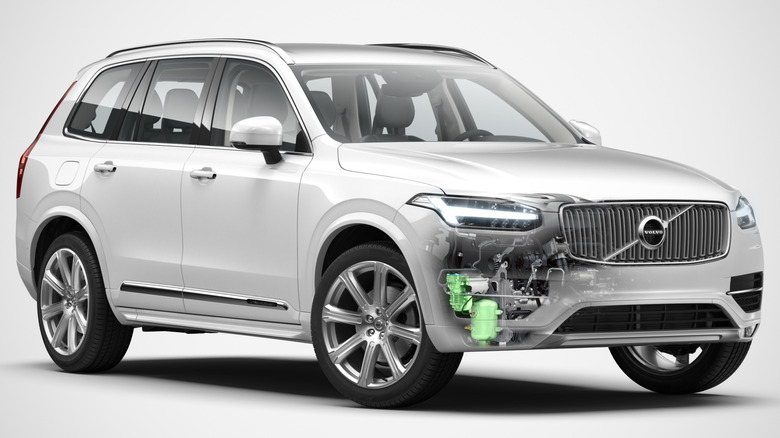
Turbo lag has annoyed drivers for pretty much as long as turbocharged cars have been around. Step on the accelerator pedal, wait for a moment to let the boost build up, and only then do you get the speed and power you requested. It used to be a hassle, but modern boosted engines have largely tamed the issue with variable-geometry turbos, sequential turbocharging, and even electrical assistance (48-volt mild hybrid systems).
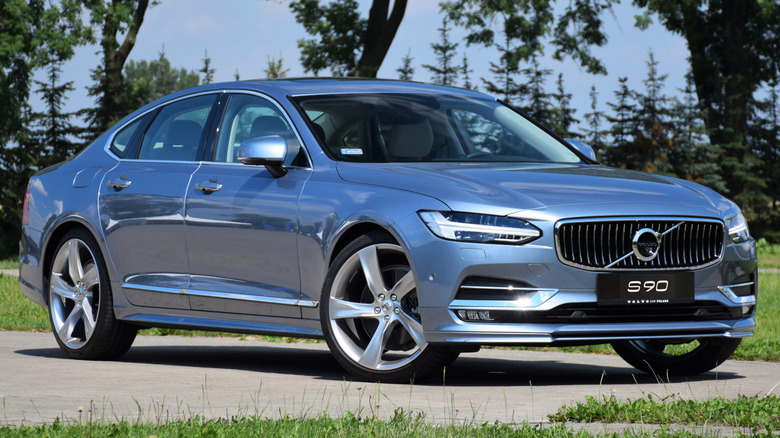
Volvo, on the other hand, came up with a pretty bright idea in 2015. Dubbed PowerPulse, this system debuted in the diesel-powered Volvo S90 for the 2016 model year, and used an electric compressor, a small air tank, and a valve to give the turbo an instant shot of compressed air when the driver stomps the accelerator. PowerPulse was a clever, relatively lightweight solution to turbo lag that eliminated the need for a mild hybrid system, but it didn't break into the mainstream, and Volvo eventually moved on.
How did Volvo's PowerPulse system work?
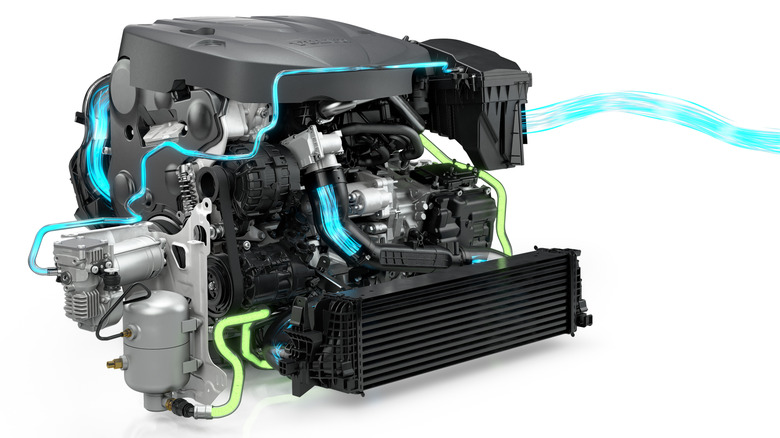
A turbocharger has a turbine in it that's spun by the exhaust gases of the engine. Once the turbine spins at a sufficient speed (usually above 1,200 to 1,500 rpm), the turbo pulls in compressed ambient air and routes it towards the engine's intake manifold. Below that threshold, however, the phenomenon of turbo lag manifests, as the exhaust gases don't possess enough energy to spin the turbine. This leads to a delay in power delivery during sudden acceleration at low speeds.
Volvo's 2.0-liter D5 diesel engine already came fitted with a pair of sequential Borg-Warner turbos to mitigate turbo lag — a sequential setup features a smaller turbo to quickly supply boost at lower speeds, and a larger turbo that takes over at higher speeds — with PowerPulse serving as an added shot in the arm. PowerPulse used an electrically driven compressor that pulled air from the engine's airbox and stored it in a 0.53-gallon tank at around 12 times the normal air pressure at sea level. When the driver depressed the accelerator, a magnetic valve would release a short burst of that compressed air into the exhaust manifold, which would rapidly accelerate the smaller high-pressure turbo.
According to Volvo, PowerPulse could spike the turbo's speed from around 20,000 rpm to 150,000 rpm in just 0.3 seconds, creating sufficient boost in time to supply the acceleration requested by the driver. The carmaker also said that the PowerPulse-equipped D5 could deliver twice as much power within the first second of acceleration from a standstill than the engine's non-PowerPulse version.
PowerPulse was smart, but electrification won out
PowerPulse was not only ingenious in its operation, but carried several advantages. The complete system weighed just around 22 pounds (mild hybrid systems add 33 to 132 pounds), and its compressor was compatible with Volvo's existing electrical architecture. PowerPulse also negated the need for a 48-volt mild hybrid system, which many of Volvo's rivals were beginning to adopt at the time. This meant Volvo also didn't have to bother with a bigger alternator, extra wiring, or an auxiliary battery, making PowerPulse significantly cheaper than a mild hybrid setup.
However, PowerPulse was not without its limitations. The small tank could store enough compressed air for only two rapid consecutive bursts before needing to recharge, which took a couple of seconds. More importantly, the auto industry was all-in on electrification at the time, and electric turbochargers and hybrid power trains could produce a similar effect to PowerPulse without relying on a finite reservoir of compressed air. Not to mention, PowerPulse was a diesel-only technology that debuted just months after Volkswagen's Dieselgate scandal broke out. The regulatory perception of diesel cars was in the doldrums, further accelerating the push for hybrid and electric cars.
Volvo used PowerPulse in diesel versions of the S90, V90, V90 Cross Country, and XC90 from 2016 onward, depending on the market. PowerPulse was retired by 2020, with Volvo eventually doing away with diesel engines entirely, and stands as yet another novel and relatively elegant automotive technology that couldn't make it big.