

5 Facts About Air Force One That We Swear We Didn't Make Up
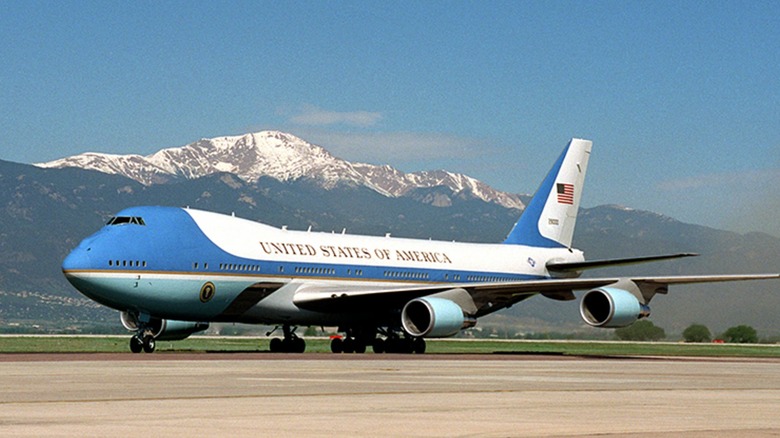
While we love our performance cars and ridiculous engineering projects, when it comes to sheer mechanical overkill, nothing on four wheels can match the flying fortress known as Air Force One. Technically, Air Force One isn't a single specific plane, but rather the radio call sign assigned to any United States Air Force aircraft carrying the sitting President of the United States. In modern practice, however, the designation almost exclusively refers to a pair of heavily modified Boeing 747-200B aircraft, bearing the tail numbers 28000 and 29000, designated internally as the VC-25A.
These customized widebody jets are not your standard commercial airliners. They are three-story, 4,000-square-foot airborne palaces engineered to weather nuclear war, operate as command centers during global crises, and carry the commander-in-chief anywhere on Earth without stopping. Maintained by the Presidential Airlift Group at Joint Base Andrews in Maryland, these giant birds represent the pinnacle of American aerospace engineering — every inch of the aircraft is customized to ensure the executive branch stays functional at 45,000 feet.
There are plenty of interesting things about Air Force One, like that its iconic livery was co-designed by a legendary car designer. From plumbing logistics like six lavatories to mid-air operational quirks like aerial refueling, the VC-25A is anything but a typical aircraft, so here are five facts about it that we swear we didn't make up.
The lavatory-to-passenger ratio means nobody has to wait in line
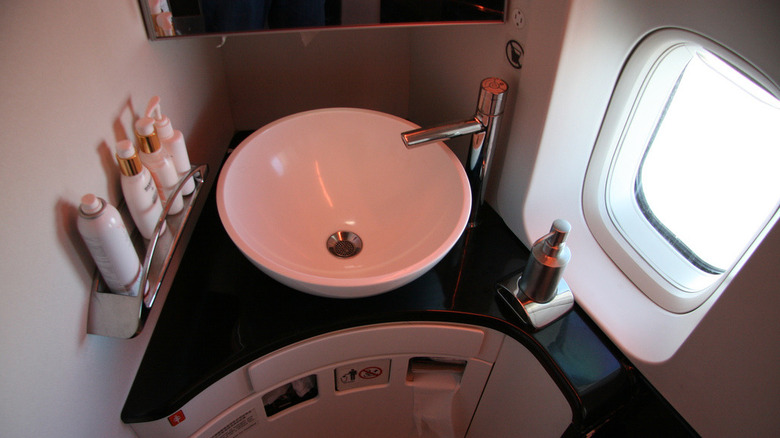
When you pack up to 102 people – including the president, executive staff, Secret Service agents, guest dignitaries, and a full press corps — into a flying three-deck platform for transcontinental flights, basic human logistics becomes a real engineering concern. This brings us to a surprisingly common question regarding the aircraft's internal layout: how many toilets are actually on board Air Force One?
The VC-25A features a total of six lavatories distributed across its three interior levels. To put that into perspective, a standard commercial Boeing 747-300 typically has 13 lavatories for up to 486 passengers. Air Force One carries only a fraction of that capacity, ensuring that nobody from the press pool to the chief of staff ever has to stand in a line.
The president's residential suite, located in the forward section of the nose, includes a private executive lavatory complete with a shower. The remaining five lavatories are spread throughout the mid and upper decks, dedicated for senior staff, Secret Service agents, military personnel, and accredited journalists.
Fighter jets don't escort every flight
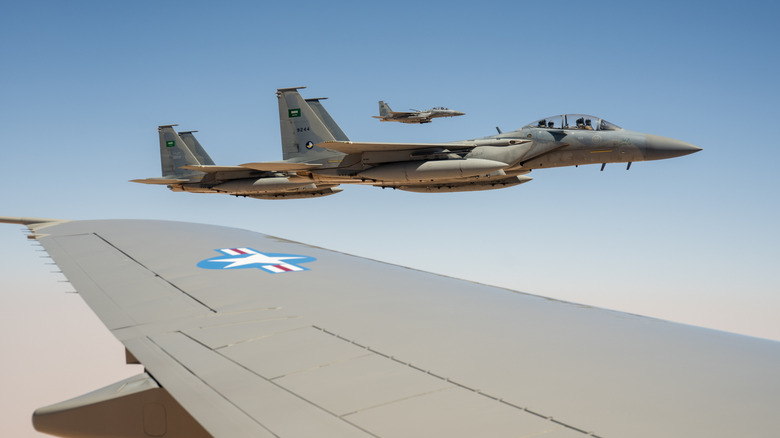
Hollywood would have you believe that Air Force One cruises through controlled airspace flanked by a tight formation of armed F-22 Raptors or F-15 Eagles. However, real-world defense operations documented by Reuters reveal a surprising reality: Air Force One is not always escorted by fighter jets during domestic or international flights.
The VC-25A itself is packed with sophisticated electronic countermeasures, radar-jamming hardware, and missile detection systems designed to counter incoming aerial threats independently. It functions as its own fortified flying platform without needing constant babysitting. That said, fighter escorts are deployed under specific high-risk circumstances. Fighter jets may escort Air Force One during ceremonial flybys, when entering active combat zones, or during national defense emergencies, such as the immediate aftermath of the September 11 terrorist attacks. Furthermore, while visible fighter jets are rare during routine transit, Air Force One is constantly monitored by ground-based NORAD surveillance systems and military command units.
Additionally, an army of support assets — including massive C-17 Globemaster transport aircraft carrying the presidential limousines (the "Beast"), motorcade assets and communication gear — moves ahead to destination airports to secure the surrounding airspace and ground perimeters long before the president touches down on the tarmac. This invisible security envelope provides far greater protection than a few jets could.
The onboard galleys serve gourmet meals, but not for free
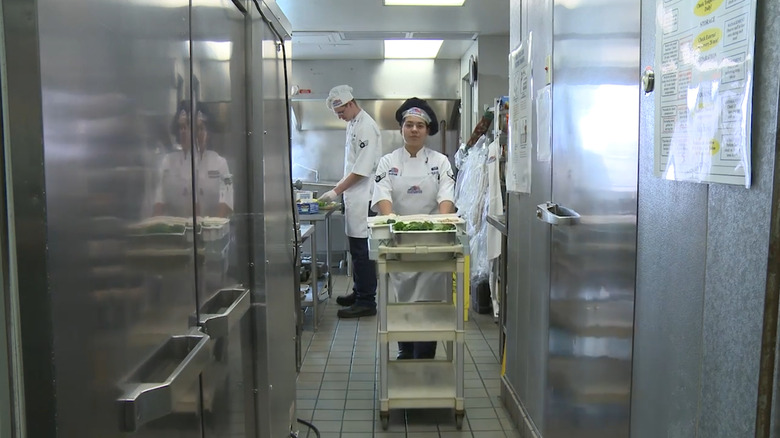
Airplane food is notoriously terrible, but when you are traveling aboard the president's personal flagship, TV dinners simply will not do. Air Force One houses two massive, state-of-the-art galleys engineered to cook high-end meals for up to 100 passengers during long-haul flights.
Unlike standard commercial passenger planes that merely reheat pre-cooked frozen meals in tiny convection ovens, Air Force One functions as a full-scale flying restaurant. The dual galleys are equipped with commercial-grade refrigeration units, heavy-duty ovens, microwave banks, and extensive food preparation areas. Trained chefs from the U.S. Air Force handle all culinary duties, preparing gourmet dishes completely from scratch. The onboard freezers and food storage capacity allow crew members to store up to 2,000 meals before departing Joint Base Andrews, ensuring total self-sufficiency even during prolonged international trips.
Whether the president requests a fresh steak, gourmet seafood, or a late-night pizza, the culinary crew delivers five-star service. Every plate leaving those galleys must meet strict presidential security standards while satisfying dozens of demanding appetites in transit. All this good food comes at a cost, though. Regardless of who you are, if you eat on Air Force One, you pay for your meal. Given the five-star fare, that can add up quickly.
Air Force One has virtually unlimited range
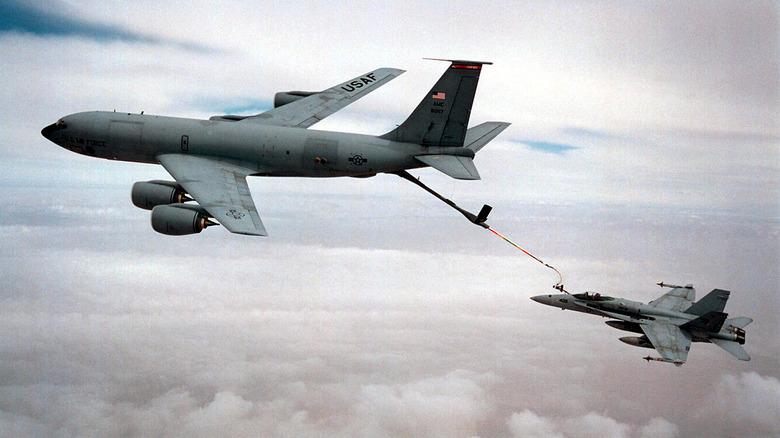
Under standard operational parameters, a Boeing 747 burns a gallon of fuel per second. A fully loaded Boeing 747 can travel roughly 7,600 miles – enough to fly nonstop from Washington, D.C. to Tokyo. However, during times of major international crisis or nuclear threat, landing at an airport to refuel isn't just an inconvenience; it is a major security risk. That is why Air Force One is equipped with a feature virtually no commercial jet on Earth possesses: in-flight refueling capability.
The VC-25A features a prominent receptacle built directly into its nose cone. This allows the giant widebody jet to receive fuel from a flying tanker, such as the KC-135 Stratotanker, at high altitudes. Fuel is transferred through a rigid boom lowered from the tanker to the nose hatch of Air Force One, pumping thousands of gallons of aviation fuel per minute directly into the plane's internal tanks.
In theory, this gives Air Force One unlimited range. But such refueling is a risky proposition and reserved only for emergencies. As long as engine oil levels remain stable and food supplies last in those massive lower deck freezers, the president can remain airborne indefinitely during an emergency, operating from the safety of the sky. Knowing that the president's mobile command post can literally stay aloft forever if ground command bases fall is the ultimate airborne contingency plan. It is an astounding demonstration of aerospace engineering that turns civilian Boeing architecture into a self-sustaining airborne military fortress.
It's built to withstand nuclear threats, with an operating room on board
Beyond its impressive physical dimensions and gourmet dining, the true marvel of Air Force One lies in its hardened defense electronics and emergency medical hardware. The aircraft contains 85 phone lines, multi-frequency radios, secure satellite communications, and over 238 miles of reinforced wiring threading through its structure.
To protect these vital communication networks from the effects of nuclear detonation, the VC-25A is shielded against electromagnetic pulse (EMP) — a nuclear detonation releases a massive wave of electromagnetic energy that fries unshielded microchips, avionics, and power grids instantly. Air Force One's skin, windows, and critical flight systems are electromagnetically shielded. The aircraft effectively functions as an airborne Situation Room capable of directing military strikes while flying through hostile environments. Despite all these countermeasures, as we have recently learned, presidents sometimes prefer to sneak off Air Force One.
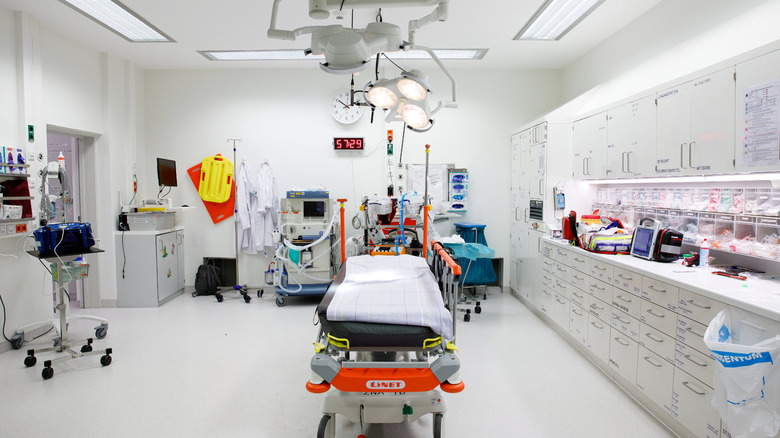
Furthermore, if a medical emergency occurs on board, Air Force One contains a fully functional emergency operating room. Located on the main deck, the medical suite includes a fold-down surgical table, critical care monitoring equipment, defibrillators, emergency medical supplies, and a fully stocked pharmacy. A dedicated board-certified military physician and a nurse travel on every single flight with the president. In extreme situations, the medical team is equipped to perform emergency lifesaving surgeries. Combined with its self-contained baggage loaders and retractable airstairs that eliminate dependence on airport ground crews, Air Force One stands as one of the most self-reliant and technologically formidable aircraft ever built.