

George Washington Carver And Henry Ford Teamed Up To Try Plant-Based Plastic Car Bodies
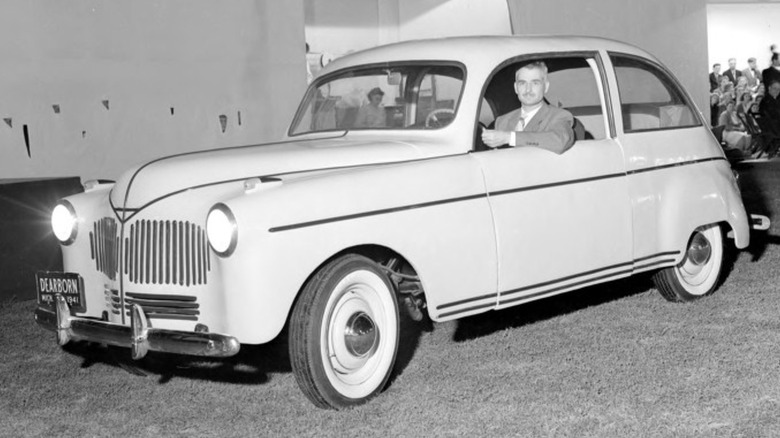
For some odd reason, George Washington Carver's many scientific and agricultural advances are usually boiled down to a single word: Peanuts. It can give the impression that he wasn't a serious scientist. Yet, Henry Ford certainly took him — and his ideas — seriously. In fact, Ford chose Carver to help develop a soybean-sourced plastic that could be used to make car bodies.
Now, exactly how much of an actual team they were is a bit unclear. History describes the relationship between Ford and Carver as one of deep "mutual admiration," but the former was known as a hardcore racist and antisemite who enjoyed eating weeds now and then, and the latter was born to enslaved parents during the Civil War. In one unfortunate description, History mentions that "Carver ... spent a period of time helping to oversee crops at the Ford plantation in Ways, Georgia."
Anyways, one of the things that brought Carver and Ford together was World War II. With steel in short supply even before the U.S. entered the conflict, Ford was determined to replace traditional metal body panels with ones made from bio-materials. This would, according to Ford, further help expand the use of agricultural products by U.S. industries and keep passengers safer than steel body panels. The result was the Soybean Car that was introduced to the public in August 1941 with 14 soybean-plastic body panels, lightweight acrylic windows, and a 60-horsepower flathead V8. However, World War II was also the reason that Ford's Soybean Car never got past the concept stage: Once the U.S. did declare war, all automobile production was stopped. Then, after the war was over, automakers had moved on – well, most of them.
What other cars have plastic body panels?
Before the Soybean Car, GM showed off the Ghost Pontiac, with a body made from clear acrylic plastic, at the 1939 World's Fair in New York. The idea had been to build hype for a new plastic material from a company called Rohm & Haas, but the transparent Pontiac was fully functional.
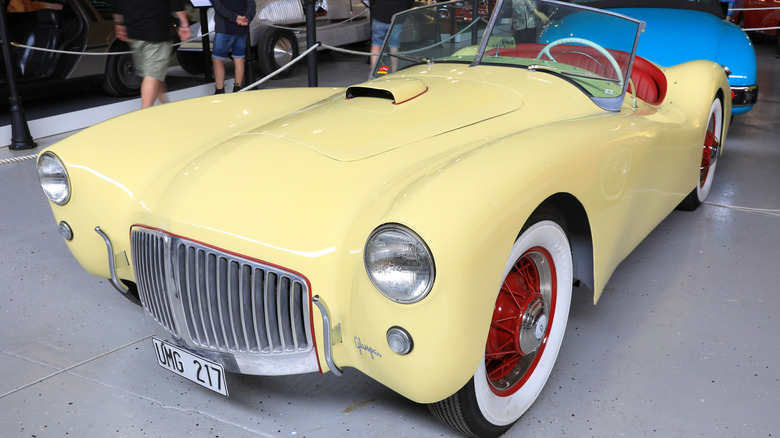
Then there was a sudden rush of fiberglass-bodied cars after World War II — fiberglass being a form of plastic reinforced by glass fibers. So, the innovative Stout Scarab prototype, known as "Project Y," boasted a fiberglass body in 1946. Meanwhile, the first production car with a fiberglass body is generally considered the Glasspar G2 that was originally shown in 1951. These rides are often called kit cars, though, since their fantastic fiberglass bodies were typically paired with a variety of motors, suspensions, and other hardware.
It led to the Kaiser Darrin, which featured a fiberglass body created by the same person who helped design the Glasspar G2, Bill Tritt. The Darrin first debuted in 1952, but production didn't start until 1954. This meant the first fiberglass-bodied Chevrolet Corvette beat it to production in 1953. When the Corvette switched to sheet molding compound 20 years later, it set the modern template for supercars made from exotic, plastic materials that today also include CFRP — carbon fiber reinforced plastic.
In terms of volume production, well, GM really did transform car buying with Saturn, but the brand never seemed to get the hang of making its plastic body panels. That may be one of the many reasons why GM killed Saturn, Hummer, Pontiac, and Saab in 2008.