

How Fast Were The Fastest Muscle Cars, Really? A Look At 5 Top Speeds From The 1960s
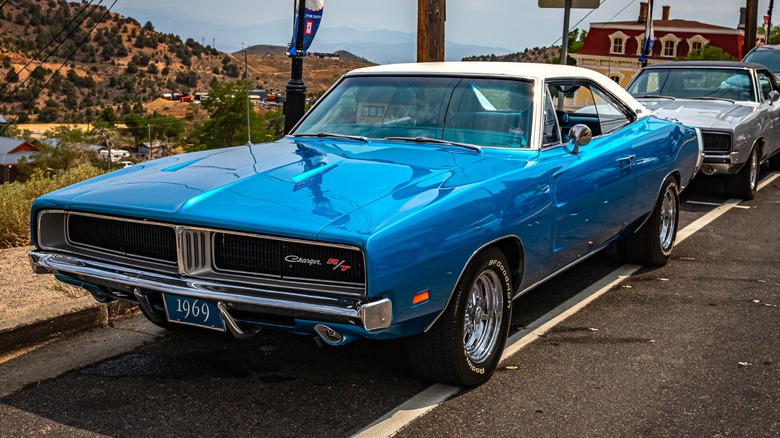
The classic American muscle car formula is brilliant in its simplicity: Take an intermediate-sized, body-on-frame or unibody platform, stuff the largest high-compression big-block V8 under the hood, and sell it to the public with a warranty. The 1960s marked the golden era of Detroit muscle, when manufacturers focused on quarter-mile times, zero-to-60 mph times plummeted into the low five-second range, and the quarter-mile traps were consistently crossed at over 100 mph, on cross-ply tires. These muscle cars weren't built for heady top speed, but rather focused on acceleration on the drag strip.
Aerodynamically, these vehicles possessed the drag coefficient of a brick. Before aerodynamics changed car design after the 1970s, long flat hoods, blunt vertical grills, and recessed rear windows all worked against muscle cars at high speeds. Above 120 mph, the front ends of older cars would wander as air trapped under the chassis unloaded the front suspension. Combined with slow, recirculating ball steering boxes in most muscle cars, which lacked tightness or feel, high-speed stability was practically nonexistent.
Still, verified tests show that despite their blocky designs, many legendary muscle cars like the Ford Torino Talladega 428 Cobra Jet and Dodge Charger R/T 426 Hemi could easily exceed 130 mph. But while most of the cars in this list hit heady top speed numbers based on big-block brute performance alone, several small-block muscle cars were notably faster than their big-block rivals despite having less power. You might also bring up legendary models like the Shelby Cobra, Chevy Corvette, or AMC AMX, but these were all classified as sports cars, and the goal of this article is to focus on the fastest popular everyday muscle cars.
1969 Chevrolet Chevelle SS 396 (L78): 128 mph
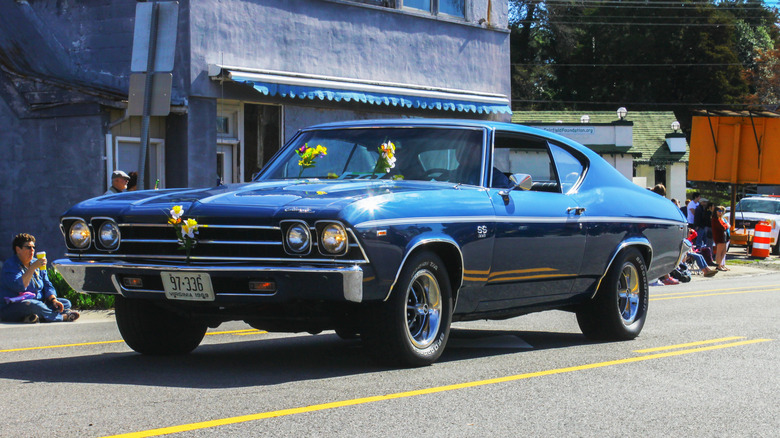
Chevrolet's intermediate A-body platform reached a mechanical high point in 1969 with the optional 396 cubic inch L78 big-block V8. Although dealers sometimes ordered special COPO 427 variants in minuscule numbers, the L78 was the highest output regular production (RPO) big block available to the average Chevelle buyer in the '60s. It started with solid lifter cams, large valves, and a 780 cfm Holley four-barrel carburetor. With a high compression ratio of 11.0:1, Chevy rated it at a heady 375 horsepower.
When hooked up to a Muncie M21 close-ratio four-speed manual transmission and a rear axle with a 3.73:1 final drive, the 1969 Chevelle SS 396 delivered a 0-60 mph acceleration time of 6.7 seconds and cracked the quarter mile in 13.6 seconds at 105 mph, as published in a June 1968 issue of Popular Hot Rodding (via Hemmings). At its top speed of 128 mph, we can imagine the '69 Chevelle SS 396 would have been an unsettling experience. The car relied on a standard recirculating-ball steering gear that required 5.2 turns lock to lock, meaning minor steering wheel movements at speed resulted in almost zero tire deflection.
1969 Ford Torino Talladega 428 Cobra Jet: 130 mph
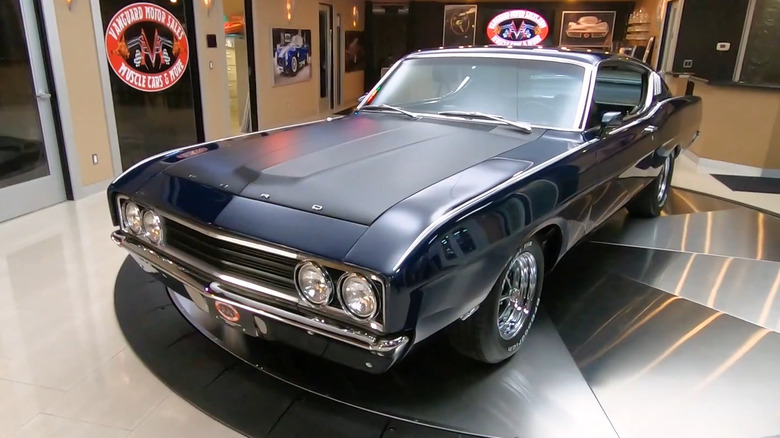
While muscle cars suffered terribly from aerodynamic deficiencies, Ford took a slightly different approach with the 1969 Torino Talladega. Built strictly as a homologation special to allow Ford to run its specialized bodywork in NASCAR, the Talladega was one of the few 1960s street machines engineered to mitigate high-speed stability issues. To create the Talladega, Ford took the standard fastback Torino roofline and shipped the cars to the legendary NASCAR team, Holman-Moody. The factory front end was cut off and replaced with a completely redesigned nose that extended the front of the car by 6 inches. Its rocker panels were also moved up, allowing Ford to lower the ride height by an inch to drop its center of gravity.
Under the aerodynamic hood sat the 428 Cobra Jet V8. Utilizing a long 3.98-inch stroke and a 4.13-inch bore, the Cobra Jet was a torque monster, churning out 440 pound-feet of torque at a low 3,400 rpm. This brute force pushed the heavy fastback from 0-60 mph in 5.8 seconds with an estimated quarter-mile of 14.4 seconds at a speed of 101 mph (via Hemmings). For reference, Car and Driver testing showed Ford's own Mustang Mach 1 Cobra Jet had a 14.3-second quarter-mile time with the same 428 Cobra Jet engine, but the site estimated its top speed at only around 115 mph thanks to a shorter 3.91 final drive ratio.
Because of its slippery exterior profile, the Torino Talladega required significantly less horsepower to overcome aerodynamic drag than its blunt-nosed competitors. Paired with a SelectShift Cruise-O-Matic C6 automatic transmission and a tall-legged 3.25:1 final drive ratio, the street Talladega can smoothly glide to a top speed of 130 mph, according to Hemmings.
1969 Plymouth Road Runner 426 Hemi: 142 mph
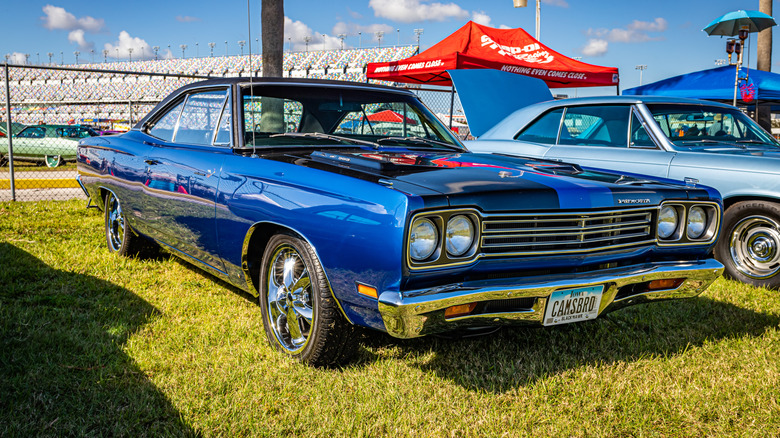
If the stylish intermediate platforms were the premium high-speed tourers, the 1969 Plymouth Road Runner was the stripped-down blue-collar cousin. Built on the B-body platform, the Road Runner omitted carpeting and other frills in its base configuration to save weight and cost, which made it one of the most popular cars of the 1960s. When its option sheet was ticked with the 426 Hemi and the A-833 four-speed manual transmission, the Road Runner became a mechanical battering ram.
These manual-shift Hemi Road Runners all came equipped with the legendary Chrysler Track-Pak. The package swapped out the standard rear end for a massive 9.75-inch Dana 60 differential packed with 3.54:1 gears and a Sure-Grip limited-slip unit. In a testing session, Car and Driver clocked the 426 Hemi Road Runner hitting 0 to 60 mph in 5.1 seconds and dispensing a quarter mile run in just 13.54 seconds at 105 mph. While the 3.54 gearing offered a better compromise for high-speed running than the drag-centric 4.10 gears, it still dictated the car's absolute top speed, which, according to Hagerty, was 142 mph. The real terror at these speeds, however, lay in its braking system. Standard stopping power came from heavy cast-iron drum brakes all around, often without assist.
1969 Chevrolet Camaro Z/28: 142 mph
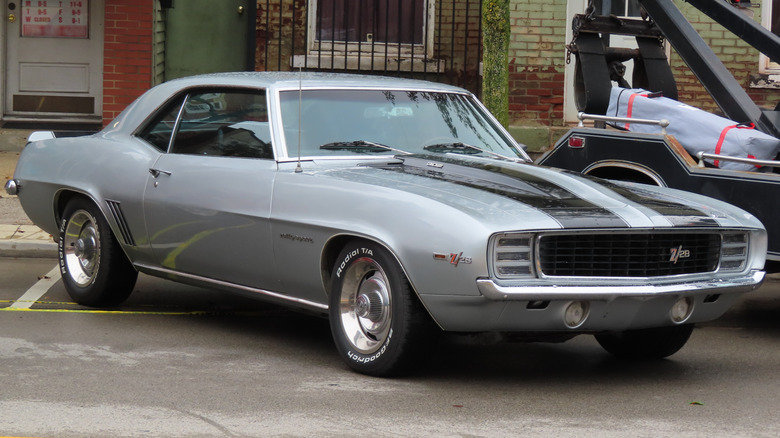
In a world of big-block V8s, the Chevrolet Camaro Z/28 was an overachiever with its 302 cubic inch V8. The homologation special Camaro Z/28 utilized a V8 designed specifically to meet the 5.0-liter displacement limit set for SCCA Trans-Am racing. Chevrolet created this unique high-revving engine configuration by dropping a short stroke 283 crankshaft into a 327 cylinder block. While classic big-block muscle cars relied on massive displacement to produce heavy low-end torque, the Z/28 took the opposite approach. Its short stroke, forged steel crankshaft, high 11.0:1 compression ratio, and mechanical lifter valvetrain allowed the engine to breathe efficiently at high revs. Chevrolet officially advertised the 302 V8 at a modest 290 hp at 5,800 RPM.
With a redline of over 7,000 rpm, coupled with tall rear axle gearing, the Camaro Z/28 had a mechanical advantage over the larger muscle cars, especially with a close-ratio Muncie four-speed manual fitted. According to Hemmings, the factory 302 Camaro turned in a quarter-mile time of 15.12 seconds at 94.8 mph. While these drag strip figures were slightly slower off the line compared to tire-shredding 427 or 454 big block muscle cars due to a lack of low-end torque, the Z/28 made up for it with a higher top speed. A road test published in the June 1968 issue of Road & Track put the official number at 142 mph (via Curbside Classic).
1968 Dodge Charger R/T 426 Hemi: 156 mph
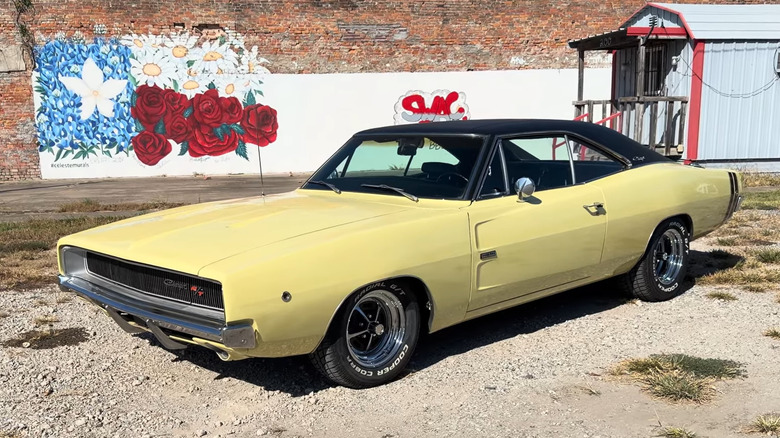
The second-generation Dodge Charger featured the iconic Coke bottle-shaped profile and a sinister hidden headlight grille. It is counted among the 10 greatest "coke bottle" style muscle cars of all time. But from an engineering standpoint, that beautiful, deeply recessed front grille and tunneled flying buttress rear window sail panels were an aerodynamic disaster at triple-digit speeds. Beneath that lift-prone sheet metal sat Chrysler's ultimate engineering achievement: the 426 Hemi. Unlike the tamer wedges of the era, the Hemi featured massive cast-iron cylinder heads and hemispherical combustion chambers. The engine option cost roughly 20% of the Charger R/T's sticker price, delivering an impressive 425 hp and 490 lb-ft of torque.
When Car and Driver instrument tested the 4,035-pound Hemi Charger, they recorded a blistering 0-60 mph time of 4.8 seconds, and a quarter mile run of 13.5 seconds at 105 mph. Car and Driver estimated its top speed at 156 mph under perfect conditions. While the Charger R/T might be the fastest muscle car of its time, it would be unfair not to mention the Dodge Charger Daytona and Plymouth Superbird as well. Their NASCAR counterparts were developed to race at over 200 mph, but the top speeds of their road-going homologation-special cars were never officially tested. However, it is safe to assume that these machines could easily reach 140 to 150 mph, putting them among the fastest muscle cars of the era.