

How Does Jeep's Wrangler Compare To The Gladiator?
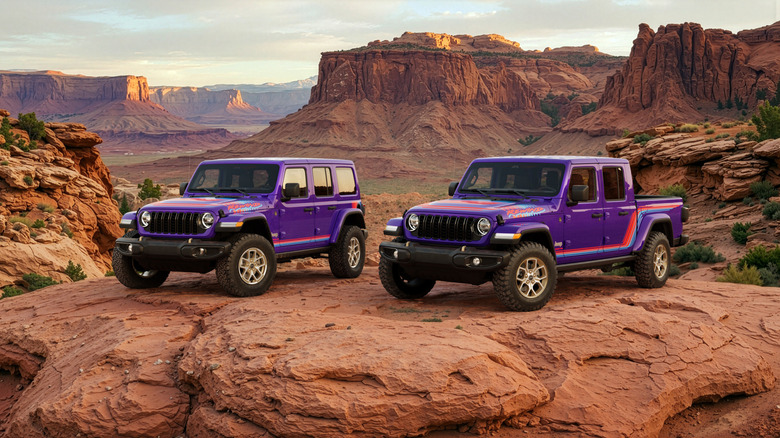
On the face of it, the Jeep Wrangler and Jeep Gladiator have a lot in common. They look remarkably similar, both inside and outside, plus both take motivation from the Pentastar V6 too, but under the skin, there is plenty to separate one from the other.
This article dives into the differences between these two models, from pricing and drivetrain differences — like the Wrangler going V6 and manual – to towing capabilities, interior space, and performance figures. To keep things easy to follow, it's the base models we've compared here, so while we thoroughly enjoyed blasting a Wrangler Rubicon 392 in the snow, such hemi-powered excellence isn't delved into here.
It's worth noting that the differences here are not meant to highlight one model as better or worse than the other, as what becomes immediately clear is that, despite being so alike, the two models cater to quite different audiences. While the transmission and towing capability differences clearly highlight the Gladiator as a better workhorse, and its interior space perhaps more suitable to growing families, the Wrangler still shines as a more accessible Jeep product, with a lower starting price.
Construction and pricing differences
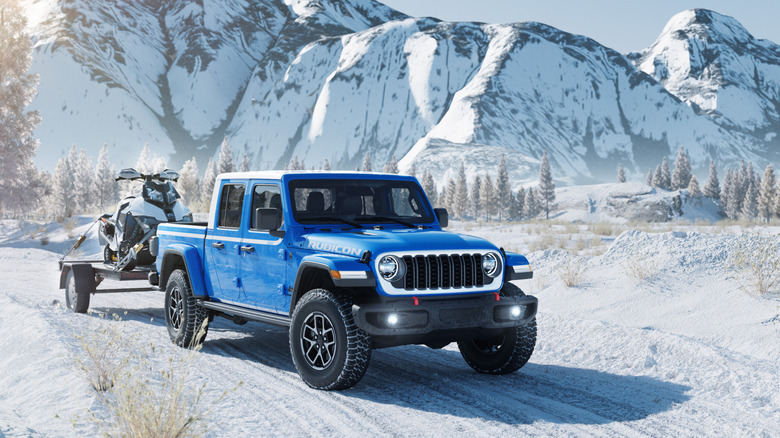
Visual details are, of course, where these two Jeep models differ the most. To point out the obvious, the Wrangler is an SUV, apparently, while the Gladiator is a pickup truck. The Wrangler boasts a 96.8-inch wheelbase in 2-door guise, whereas the Gladiator enjoys a 137.3-inch wheelbase; and not all of that space goes to the bed, either.
The different body styles and wheelbase dimensions create a number of differences inside too, such as more headroom for both front and rear passengers in the Gladiator, and noticeably more leg room for rear passengers too. Oh, and the fact that while the Wrangler only seats 4, the Gladiator manages to squeeze in 5.
All of that size comes at a cost though, and that cost is weight. In base guises, the Wrangler tips the scales at 4,003 pounds, while the Gladiator weighs in at 5,050 pounds, so the difference is significant. In terms of performance is that, while neither Pentastar-equipped models is what anyone might call brisk, the Wrangler certainly delivers sharper performance. Expect 60 mph to be dispatched within 6.1 seconds, while the truck requires 1.1 seconds longer.
When it comes down to dollars and cents, the Gladiator commands a slight premium, with its base grade selling for $41,815 to the Wrangler's $38,030. Likely an easy jump up in price to justify for many, but a difference close to $4,000 nonetheless.
Drivetrain and towing comparison
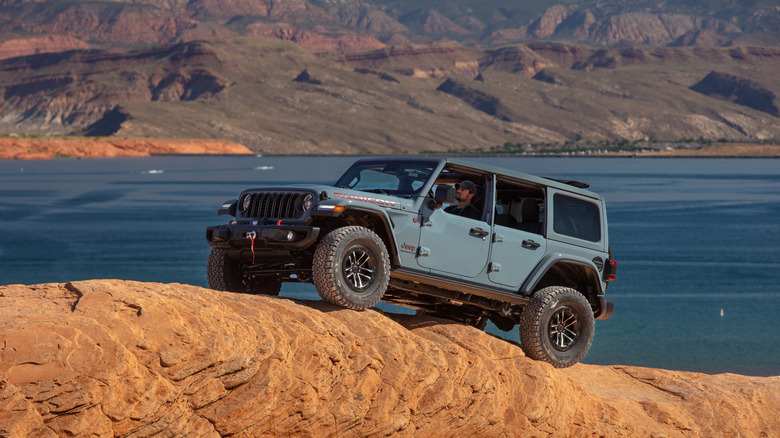
Clearly geared more toward towing and hauling, the Gladiator's peak torque, all 260 pound-feet of it, comes in slightly earlier than the Wrangler, at 4,400 rpm. In comparison, the SUV peaks at 4,800 rpm instead. The Gladiator also comes standard with a tow hitch, while that's an optional extra with the Wrangler. Naturally, the Gladiator can also tow significantly more, with a 4,500-pound capacity, in comparison to the Wrangler's 2,000-pound limit.
Neither is immensely efficient, using the tired-and-tested 285-horsepower 3.6-liter Pentastar V6 as standard. Still, neither are what you'd call gas guzzlers either, both returning a respectable 19 mpg combined with the base engine in place. It is worth noting that the Wrangler manages an extra single mpg on the highway, returning 23 mpg to the Gladiator's 22, but even to long-distance drivers, such a difference would never lead to any genuinely substantial fuel savings.
One of the key under-the-skin differences can be found hooked up to the aforementioned Pentastar V6, as while the Wrangler makes do with a 6-speed manual, the Gladiator instead benefits from an 8-speed unit — a $2,500 option on the Wrangler. Again, this reflects how the Gladiator is better-geared toward towing and hauling, as one might expect from a truck, with more gears enabling the Gladiator to provide more low-end torque.