

The 1957 Corvette Achieved One Horsepower Per Cubic Inch, But It Wasn't The First
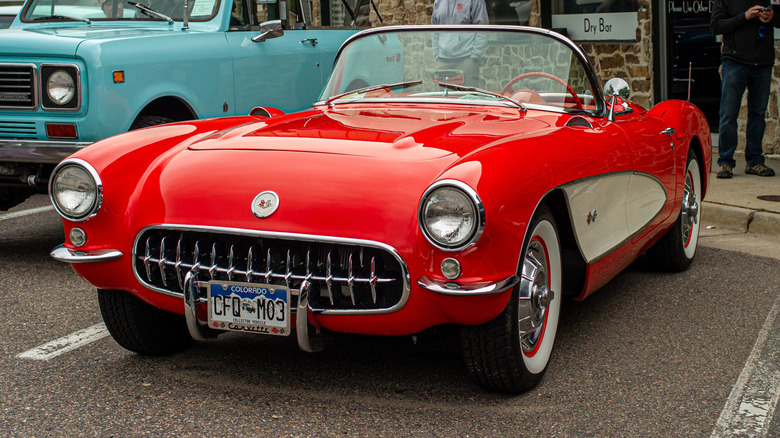
The Chevrolet Corvette has been a strongly evocative car across its eight long generations. But even with an ever-expanding list of impressive cars, such as the 1,250-horsepower Corvette ZR1X, Chevy will always look back at 1955 with great fondness. That's when the Corvette really started to come into its own as a performance model with the addition of a 195-hp, small-block V8, along with the introduction of a three-speed manual gearbox.
Following a redesign in 1955, the 150-hp, 3.9-liter Blue Flame six-cylinder engine, which debuted with the original 'Vette back in 1953 was discontinued, leaving the V8 and three-speed gearbox as the lone offering. Further improvements also followed in 1956 when the 4.3-liter (265 cubic inch) mill gained more power thanks, in part, to a redesigned camshaft that allowed it to put out between 210 and 240 horsepower. The V8 was again improved for the 1957 model year when Chevrolet increased the displacement to 283 cubic inches (4.6 liters), resulting in 220, 245, 250, 270, and 283-horsepower output levels.
Granted, a top output of 283 hp for a performance model may sound a bit disappointing today, but back when the 1957 Corvette launched, it was fairly respectable. Thanks to that output, the 283 cubic-inch V8, which used a Rochester Ramjet port injection system developed by Zora Arkus-Duntov and John Dolza, also grabbed the headlines for giving the Corvette exactly one horsepower per cubic inch.
Until that time, hitting the one horsepower per cubic inch mark had been nearly impossible for automakers. So, the 1957 Corvette finally achieving the feat was a big deal. But this wasn't the first time a car had achieved one horsepower per cubic inch. That honor belongs to the 1956 Chrysler 300B, which stole a march on the rest of the market.
The Chrysler 300B helped set the mold for performance cars
Bragging rights are an indissociable part of the car industry, and that held true even back in the '50s. Then, like now, Chrysler was too often playing catch up sales-wise and in the shadow of its huge competitors Ford and General Motors. Chevrolet had only introduced the Corvette in 1953, while Ford made the news for dominating the grueling Carrera Panamericana road race in Mexico between 1952 and 1954 with the Lincoln Capri.
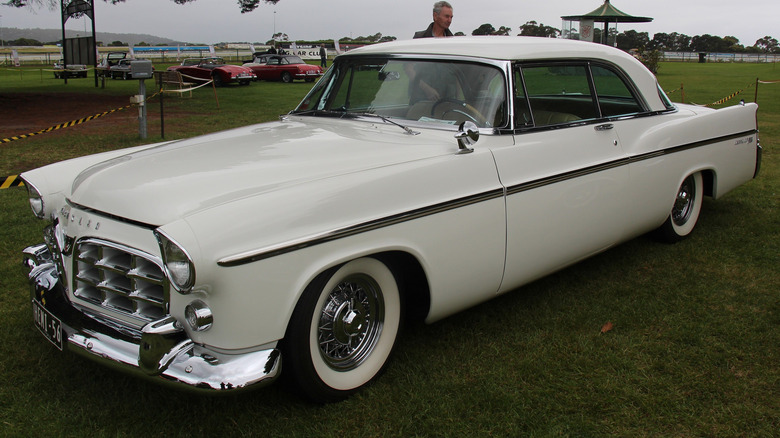
Not to be outdone, Chrysler came up with a headline-grabbing car of its own, the C-300, in 1955. The luxury coupe was purpose built for road homologation in order for Chrysler to meet regulations and be allowed to go racing in NASCAR. The big news, however, was the unleashing of the beastly 331-cubic-inch FirePower Hemi, which generated an astounding 300 hp and in the process earned the Chrysler C-300 the title of the first American production car to hit 300 horsepower.
The following year, the Chrysler 300B arrived with an even larger variant of the engine, which was now displacing 354 cubic inches (5.8 liters). It made 340 hp in standard guise, but buyers could select a more powerful version rated at 355 horsepower thanks to a higher compression ratio of 10.0:1 (the 340-hp version had a compression ratio of 9.0:1).
This output not only made the 300B the first car to produce 1 horsepower for every 1 cubic inch of displacement, but it also meant that it was the fastest stock car at the time of its launch, with a top speed of 139.37 mph.
The 1957 DeSoto Adventurer Hardtop also pulled off the feat
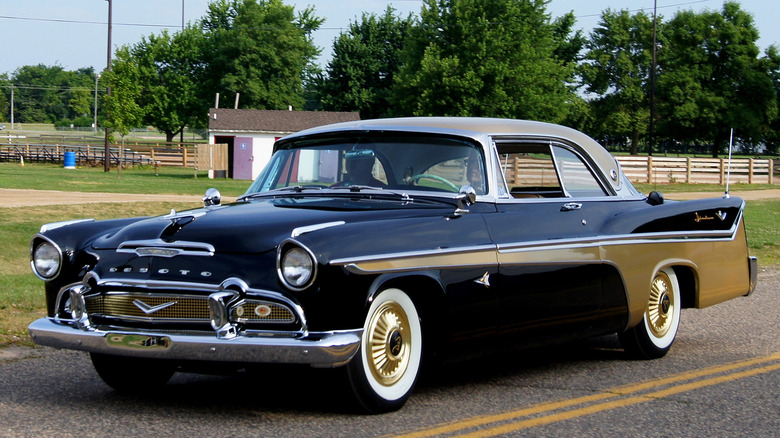
Following the success of the C-300 in 1955, DeSoto, which fell under the wider Chrysler umbrella at the time, wanted a piece of that action. So, it launched the Adventurer, a two-door hardtop based on the DeSoto Fireflite Sportsman Coupe. But whereas the Fireflite used a 330-cid Hemi engine with 255 horsepower, DeSoto teamed the Adventurer with an enlarged version that had a displacement of 341.4 inches.
The engine also, among other things, adopted a more aggressive camshaft and high domed pistons that helped raise the compression ratio from 8.5:1 to 9.25:1. The result was an output of 320 horsepower, granting 0.938 horsepower for every cubic inch. As a result, the Golden Adventurer as the coupe has often been called, could hit a top speed of 144 mph.
But DeSoto wasn't done trying, as the engine's displacement grew to 345 cubic inches during the 1957 model year, bringing a corresponding increase in power to 345 hp. With that, the 1957 DeSoto achieved a power-to-displacement ratio of 1:1, just like the Corvette.
Ford also managed to cross the threshold that same year with the NASCAR-prepped supercharged Thunderbird, which produced 1 horsepower per cubic inch, thanks to a racing version of its unique Y-Block engine with 340 hp and a 312-cubic-inch capacity. But considering the Thunderbird had forced induction, you could say it was a pretty unfair fight.