

There Are Die-Hard Slot Car Fans Out There Keeping The Hobby Alive
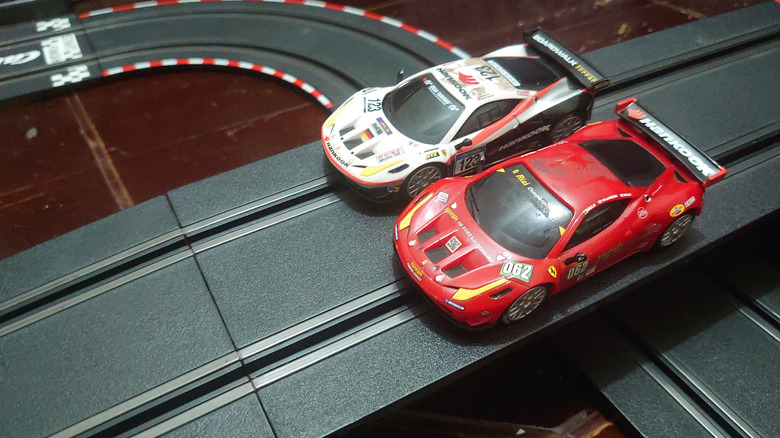
Slot car racing is a hobby that means different things to different people. For many, it's a connection to childhood memories of Christmases spent racing around the living room floor, but slot cars can also be indulgent engineering projects, competitive racing machines, and detailed scale replicas of their favorite real-world racing cars. For some slot car enthusiasts, the appeal isn't necessarily just about the cars, but instead painstakingly recreating awesome replicas of famous race tracks. It's this broad appeal that helped slot car racing achieve its commercial heyday in the 1960s, in addition to helping the hobby survive long afterward too, in the hands of dedicated fans.
The early-to-mid 1960s represents the golden age of slot car racing, with public race tracks rapidly cropping up. In fact, by 1963, there were an estimated 3,000 commercial slot car racing tracks in the U.S. alone — a statistic which no doubt influenced the Wall Street Journal's reported valuation of the hobby's market at $100 million that same year. However, fast-forward to the late '60s, and the slot car market had almost completely collapsed. By the 1970s, only a few hundred of those 3,000 tracks remained operational. Clearly the decline in the popularity of slot car racing was steep in those years, yet here we are almost five decades later, and the hobby is still alive. Today, slot car racing is supported by a far-smaller number of commercial raceways, regional clubs, and organizations, like the United Slot Racers Association (USRA).
Understanding the hobbyists that keep slot car racing alive
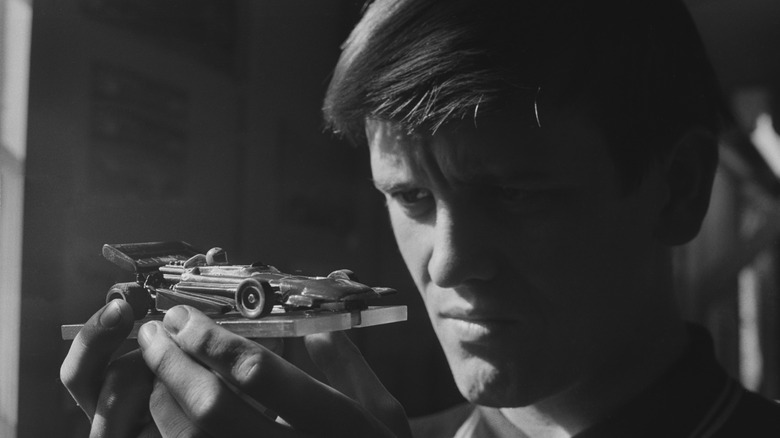
The USRA describes itself as being "run for the racers and by the racers," which demonstrates the hobby is far more community-led these days than it is retail-led. The sanctioning body hosts tournaments and championships with national interest, in addition to maintaining technical regulations and connecting track owners with racers, manufacturers, and distributors. Die-hard fans keep the hobby alive at lower levels, too. The USA Slot Car Racing Tracks directory lists the location and details of various clubs and tracks across the U.S.. Whether those clubs and tracks are private or commercial does not matter — owners and operators can simply complete a form to have their facilities listed freely online for other enthusiasts to easily locate. For reference, the site currently lists 47 commercial spots, and 25 private locations, operating across 30 different states.
It's this kind of community spirit that keeps a hobby alive. Dedicated fans would clearly rather spend their own time, money, and effort operating a track, club, or website that feeds the hobby, than see it die down and become just another antiquated hobby keeping a dying number of fans busy in their own homes.
Slot cars and their collectibility today

As with any hobby, slot car racing can get expensive. While a starter set might only cost roughly the equivalent of a cheap night out, or a new video game at $50-75 — with used cars or tracks commanding even less — there are some collectors who will pay frankly ridiculous amounts to obtain their individual slot car holy grails. For example, one enthusiast paid more than $200,000 for a slot car track hidden within a Porsche 917 body, while the most paid for a singular slot car currently stands at £7,750, or roughly $10,435. The car in question was a Scalextric-made C70 Type 59 Bugatti, and given that real-world Type 59 Bugattis grace the likes of Ralph Lauren's Louvre-worthy car collection, we can't say we're surprised to see scale models commanding significant sums too.
Perhaps more relevant though is the cheaper end, as it's these cars and kits that are more likely to inspire the next generation of die-hard fans. Notable brands like Carrera even develop kits for the youngest enthusiasts out there, with Mario Kart slot car kits selling for under $40.