

What's The Difference Between A Camper And An RV?
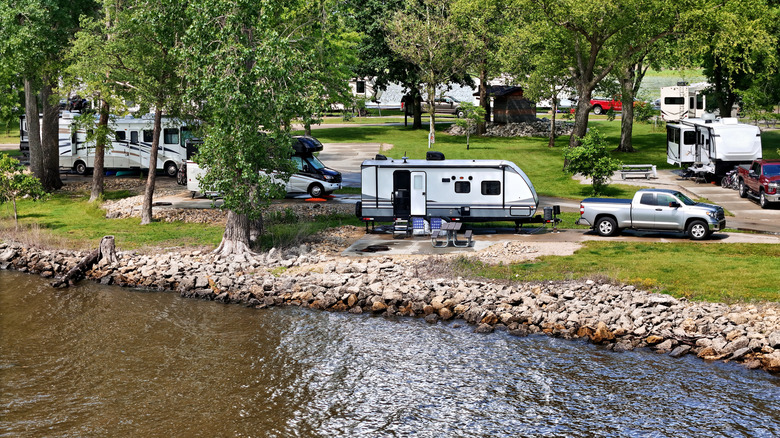
You don't necessarily need a special kind of vehicle to hit the road for overnight adventures. Learning how to camp in your car like a pro can be a good alternative for some people. But you're likely to enjoy more comfort and convenience in a camper or a recreational vehicle (RV). And, yes, there's a difference between the two: the former can't be driven independently, while the latter can.
Older sources may boil this down to the fact that one has a drive system and the other doesn't, but that definition comes up short today. Ex-Tesla engineers have created a camping trailer with its own electric motor. Yet, it would technically remain a camper because you still can't drive it on its own. Generally speaking, campers can be smaller and less expensive than RVs. Campers often come with fewer creature comforts, too — although that's not always a negative, as it can allow for a closer-to-nature approach to camping.
The tricky part is that, on another level, a camper is an RV. The RV Industry Association says that an RV is "a vehicular-type unit primarily designed as temporary living quarters ... that either has its own motor power or is mounted on, or towed by, another vehicle." A truck with a camper in its bed fits the definition, but it's not the same as the sort of RV we're comparing those campers to. Those are also known as motor homes, and they come with their own set of distinctive traits.
What's the difference between different kinds of campers and RVs?
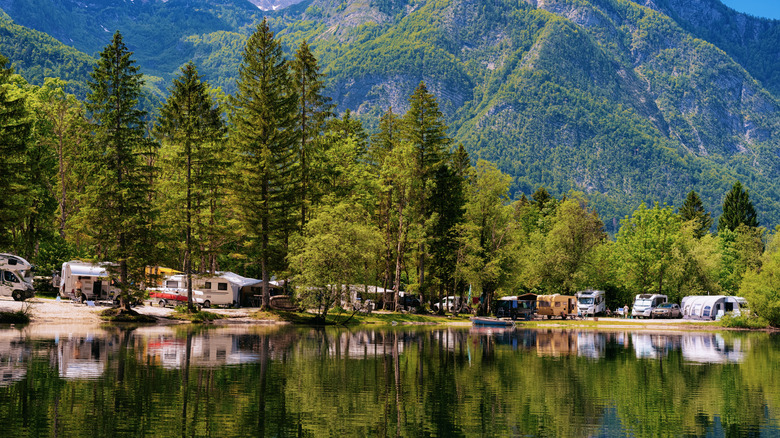
The traditional motor home RVs come in three different classes. The largest ones are Class A motor homes built on the same sort of frame as a commercial truck or bus, with a length of about 26 to 45 feet. Class B motor homes are built on a van (not minivan) chassis and are the smallest of the lot. Sometimes called camper vans, these machines are 17 to 24 feet long. Splitting the difference between Class A and Class B in terms of size are the Class C motor homes. They're usually 21 to 35 feet in length and ride on heavy-duty truck platforms.
Campers, though, are usually distinguished by how they're towed or how they look. Here, the larger choices are basically boxes once again. The very biggest are fifth-wheel trailers, requiring specialized hitches to handle lengths of between 22 and 40 feet. Conventional travel trailers of 10 to 35 feet can make do with traditional hitches. That goes for variants like popup campers that unfold to their full dimensions at a campsite, or tiny teardrop trailers designed to be towed by cars rather than trucks. Don't take that at face value, though; you should always follow manufacturer guidelines before attempting to tow anything, and never tow a trailer without checking these three numbers first.
Which is right for you?
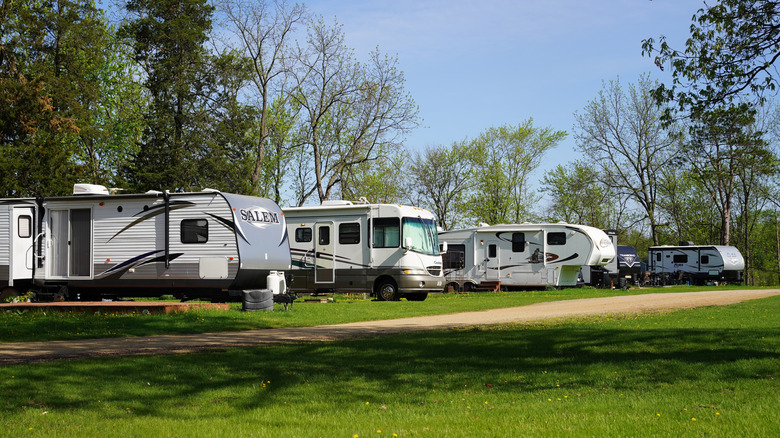
The essential difference between RVs and campers is also an important key to their use cases. If your adventure is going to include driving to other locations from your camp site, it may be best to use a camper trailer that you can simply unhitch and leave behind. The process is simpler than ever thanks to modern hitch assistance technology, such as Ford's Pro Trailer Hitch Assist.
There are a lot of variables involved, but towing a trailer can often be more fuel-efficient than driving an RV, too. Part of that has to do with the relative size of each — remember, RVs are typically larger than conventional campers — and that opens up further benefits if you're on a budget. For instance, the smaller campers, often with fewer features, are generally less expensive to insure. The same basic reasoning explains why trailers often require less (and less costly) maintenance.
On the other hand, some drivers find trailers to be dauntingly hard to maneuver and prefer motor homes as a result. Plus, you can still use a motor home to tow a "regular" car or SUV. Then, if you plan to leave the campgrounds for extra driving, you can bring along a ride with better fuel efficiency than the kind of big truck or SUV typically used for towing a trailer. Some folks also enjoy the extra level of safety you can enjoy from motor homes, since you can get from the cab of a motor home into your living quarters without going outside.