

Violate The Unspoken Rules Of Parking Lots At Your Car's Peril
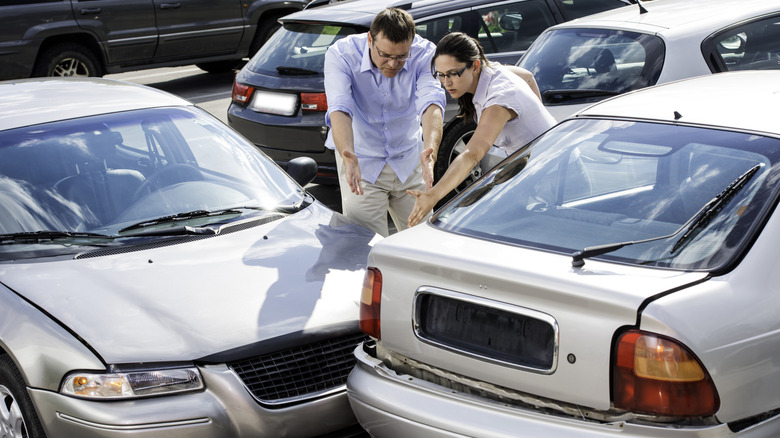
The actual, government-enacted laws covering parking lots can be tricky enough. That's partly because the lots themselves are often on private property, and partly because traffic laws in general will vary from state to state. So it's only natural that the unspoken and unwritten laws can require some explaining as well.
They can certainly be important to know. First off, many accidents happen in parking lots. The National Safety Council's "Safety Huddle" reports there are more than 50,000 parking-lot crashes each year in this country, and they lead to injuries in at least 60,000 people. Moreover, those same crashes kill about 500 people annually. Following the rules — spoken or not — can then mean less risk to both vehicles and lives.
Breaking the rules can also put you at risk for more than merely accidental damages. Trying to find parking can be a tense, frustrating experience that can quickly lead to parking rage — which is comparable to road rage. As a U.S. Department of Justice guide on Aggressive Driving puts it, "Parking tends to trigger territorial and competitive behavior, which can lead to confrontations." The results can range from the annoying, like someone giving you the finger or calling you an ignorant cow of hell, to downright damaging if someone decides to key your car, for instance. In a worst-case scenario, you get shot dead.
Today is about helping avoid outcomes like those. After all, these popular parking lot rules may not be on your state's books, but reading them can still keep you out of trouble
Unspoken rules of driving in parking lots
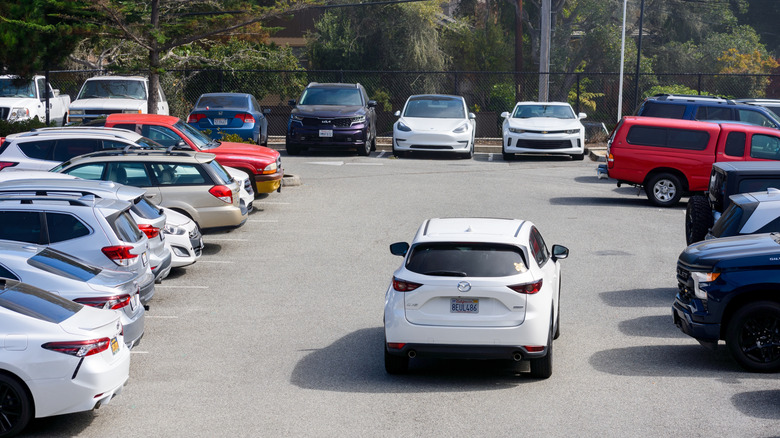
We can break down parking-lot guidelines into two basic scenarios. When you first get to the lot and start looking for a parking place, or when you're leaving the space and making your way back to the public road, you need to know the etiquette of driving in parking lots — and this can be separate from rules for the parking process.
For starters, many parking lots may not have posted speed limits. The National Motorist Association recommends staying under 15 mph in those cases. Yes, it can make for slow going, but don't be tempted to send your passenger out to "reserve" a spot while you wait to get there. This is another no-no among the parking pros.
So is a failure to use your turn signals, particularly when you want to indicate you're ready to pull into a spot. Otherwise, folks may not realize if or why you've stopped and run right into you. It's worth pointing out that — overall — some 2 million crashes a year can be connected to a failure to use turn signals. Looking at the statistics a different way, indicating with your signals can decrease your chance of being in an accident by up to 40%. Note that you really should use blinkers all the time, even in dedicated turn lanes.
Also, you know those directional arrows often painted on the parking-lot pavement? They're not merely suggestions. Following them helps keep the flow of traffic moving quicker and more safely. They can help prevent the kind of head-to-head car meetings you might get with two-way traffic, too.
Unspoken rules about parking in parking lots
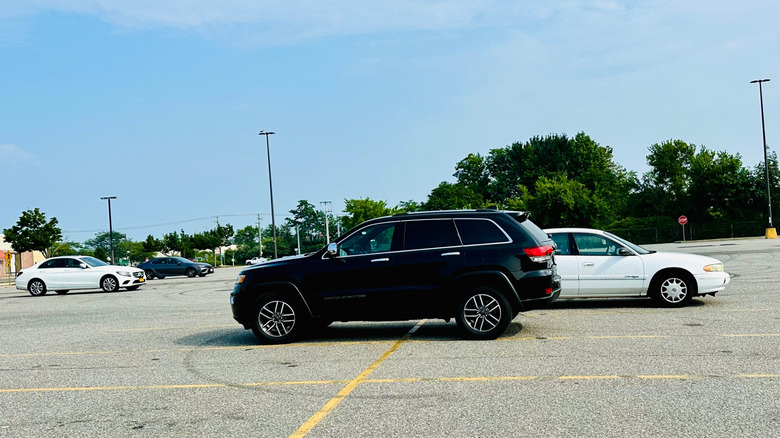
The standard parking space in the United States is roughly 9 feet wide and 18 to 20 feet long. It may sound like plenty of room, but a full-size pickup like the Ford F-150 can measure close to 8 feet by 20 feet (depending on the configuration). So simply fitting into a spot can be a challenge.
Yet you should always park your vehicle completely within a spot's yellow lines. That means don't park with your wheels on a line or your bumper hanging over one, and please don't be that driver who takes up four separate spaces at a time.
And do not try park where you shouldn't. This can be a ticket-able offense, especially if you're one of those jerks who parks in a spot reserved for people who need accessible parking. It's amazingly common. Some research says that 74% of people have witnessed a driver unlawfully park in one of those spaces. Of course, we've also seen one man in the U.K. park in a legal space only to have the council transform it into a handicapped spot around him.
Meanwhile, when you're unparking your car, you should always double-check your mirrors and blind-spots before pulling out. And to be clear, some groups still recommend that you physically turn and look with your eyes instead of counting on your rear-view camera or other ADAS. In fact, the National Safety Council recommends first walking completely around your vehicle to check for potential hazards, then relying on your eyes and mirrors when you're in the driver's seat. Where appropriate, you should pull through into the spot ahead of you so your car is parked facing outward.