

3 Signs The Synchronizers In Your Manual Transmission Are Failing

There is a distinct joy in driving a manual transmission vehicle. It's the mechanical handshake between the driver and the machine, the tactile click of the gate, the perfectly rev-matched downshift, the total command over your engine's power band. But that mechanical symphony depends on a few unsound, deeply stressed brass rings hidden deep inside your gearbox: The synchronizers. When your synchronizers are healthy, they do the heavy lifting of matching gear speeds silently and instantly. When they start to fail, your once crisp driving experience rapidly devolves into a stressful, noisy, and expensive nightmare.
Before diving into the symptoms of failure — crunch or grinding during shifts, stubborn resistance, and popping out of gear — let's first understand what these little components do. In a modern constant mesh manual transmission, all the forward gears are constantly spinning on the main shaft, even when you are in neutral. When you move the shift lever, you aren't sliding massive gears back and forth; instead, you are sliding a splined component called a shift sleeve (or slider) onto the side of the gear you want to change. The catch? The shift sleeve and target gears are spinning at entirely different speeds. If you try to force them together, the metal teeth would violently smash against each other.
That's where the synchronizer ring comes in. Typically made of brass, bronze, or lined with composite carbon materials, the synchro acts like a tiny specialized clutch. When you push the shifter towards a gear, the shift fork pushes the sleeve, which in turn presses the synchro ring against a matching cone on the side of the gear. The resulting friction forces the gear and main shafts to match speeds, allowing the sleeve to smoothly glide over the synchro and lock onto the gear.
The dreaded crunch or grinding during shifts
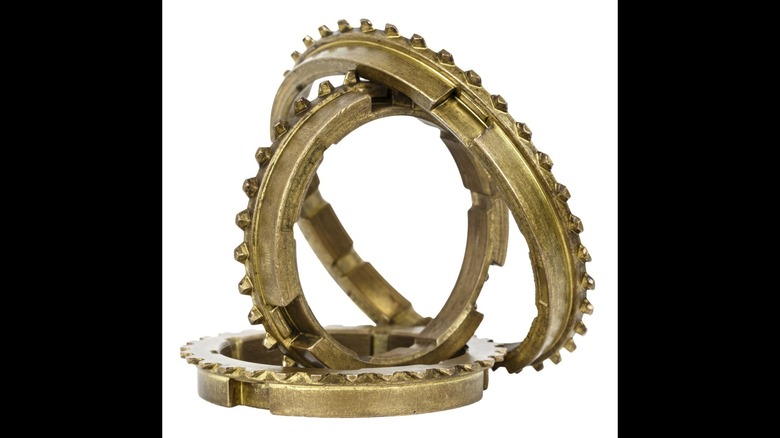
Because synchro rings rely completely on friction to do their job, they are inherently wear items. Rush your shifts, skip your fluid changes, or abuse your gearbox, and they will wear out quicker. One way of recognizing a failing synchro is the grinding sound during gearshifts. The quintessential textbook symptom of a failing synchro, it starts as a subtle, momentary notchiness or a light click in the shifter lever, but quickly graduates to a violent metal-on-metal grind that you can distinctly hear and feel on your palms.
If your transmission shifts smoothly into third, fourth, and fifth gears but emits a horrific crunch only when you try to grab second gear, you have a bad second gear synchro. Because lower gears are subjected to larger and more frequent downshifts, their synchros work significantly harder while downshifting and may fail first. That said, there are other potential reasons your gearbox makes a grinding sound, like a worn-out clutch that doesn't completely disengage the engine from the transmission while shifting gears, or a low transmission fluid level.
A gear lever that fights back
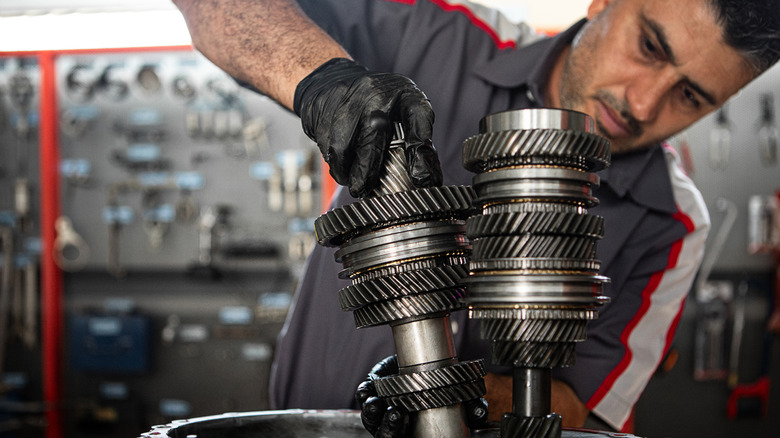
A healthy manual transmission should require minimal effort; the lever should feel like it's being gently pulled into the gate once you break past the initial resistance. When a synchronizer begins to fail, the mechanical "blocking" function of the synchro assembly goes haywire. If the synchro cannot equalize the speeds, the components won't align. The dog teeth on the sleeve hit the dog teeth on the gear head-on, rather than interlocking smoothly.
When a synchronizer begins to fail, that smooth action vanishes, replaced by stubborn, frustrating resistance. You push the lever towards the next gear, and it hits a metaphorical brick wall. You have to physically muscle the car into gear, or hold heavy pressure against the lever for what feels like an eternity until it finally accepts the shift. In the enthusiast world, we call this notchiness, and mechanically, it's your gearbox staging a protest. The notchiness you feel at the shifter is the resistance of the gear cone and synchronizer ring failing to align.
Stiff shifting can sometimes be a red herring. Before you blame your synchronizers, you need to rule out problems like a dragging clutch.
The ghost in the machine: popping out of gear

Few things will raise your blood pressure more than driving on the highway, stepping on the gas pedal, and watching your shift lever violently snap back into neutral on its own accord as the engine revs to the sky. This phenomenon is known as popping out of gear, and it's naturally a safety hazard.
Inside the transmission, the teeth on the shift sleeve and the dog teeth on the gear are engineered with a very slight specific angle – often called a reverse taper or undercut. Under load (when accelerating or decelerating), this specific geometric shape actually pulls the sleeve tighter onto the gear, ensuring it stays locked in place. However, when a synchronizer wears out, it can't reliably guide the shift sleeve into full engagement with the gear, which can cause the transmission to slip out of gear and drop into neutral.
Correctly diagnosing worn-out synchros
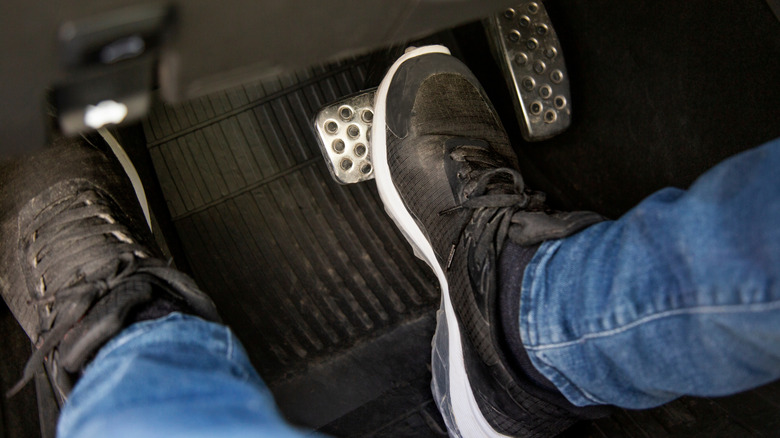
A truly telling diagnostic test for failing synchros is to pay close attention to how your gearbox behaves during a downshift versus an upshift. When you upshift, the engine RPM naturally drops, which actually helps the next gear slow down and match the transmission's output shaft. The synchro still has to work, but it's getting a helping hand from the natural deceleration of the engine's rotating assembly. When you downshift, the opposite occurs. The synchronizer has to violently accelerate the heavy clutch disc and input shaft up to a much higher speed to match lower gear speed. If your car upshifts relatively quietly but gives you a hard time, grinds, or completely refuses to engage when you attempt a standard downshift, your synchronizers are toast.
Transmissions are important — just ask these great cars that were ruined by them, contrasting with the following five nearly indestructible transmissions. Synchros are an essential part of manual transmissions, helping smooth gearshifts by matching shaft speeds. A worn synchro can be identified by grinding and crunching noises while shifting, hard gearshifts, or gear popping into neutral. If you are looking to get a manual car, don't forget about the five worst manual transmission habits when keeping synchros in mind.