

The Chrysler Conquest Wasn't Really A Chrysler, It Was Mitsubishi's Last Rear-Drive Sports Car
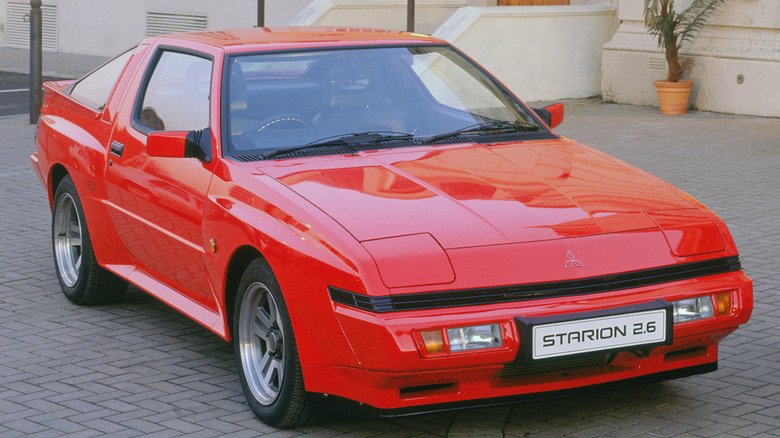
The front-engine rear-drive coupe was a Mitsubishi staple for decades until the Starion's death in 1989. The three-diamond brand's incredible Starion sports coupe ran a short life from 1982 to just 1989, making a big impact in that time before fading away in favor of rally-inspired all-wheel-drive machines the following decade. With four-wheel independent suspension and a large 2.6-liter four-cylinder engine, this car was an instant success on racetracks. Sales were steady, buoyed by badge engineering a captive import called the Conquest for Chrysler, Plymouth, and Dodge dealerships, but never matched its contemporaries.
The underappreciated Radwood-era sports car is still available for peanuts compared to the Mustangs, Supras, RX-7s, and Porsche 944s it was favorably compared against in its day. The box-flared wedgy design is among the most anachronistically exciting to see today, and the car was extremely technologically advanced compared to its contemporaries, making it something of a cult classic in 2026. The Starion got its flowers in its day, but is often left out of the current conversation, and that's a shame.
Mitsubishi Starion (and its siblings) sales peaked just shy of 20,000 units in the mid-1980s, but dramatically fell to fewer than 2,000 units in 1989. It was a technological powerhouse, but economic turmoil in the U.S. and Japan's inflationary bubble economy of the late 1980s meant the customer base dried up right as the price was increasing. Through its entire run the Starion was more expensive than its competitive set (save the Porsche), and got its sales numbers clock cleaned by the larger and heavier Nissan 300ZX. Perhaps the biggest problem the Starion faced was bungled branding and an unserious marketing strategy. In a way the car was responsible for its own downfall, but we'll get more into that later.
The Japanese import cap and the Chrysler influence
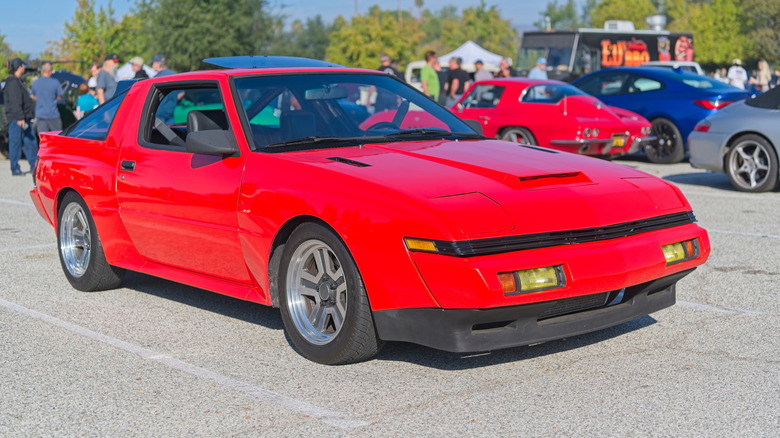
Mitsubishi didn't really begin developing its own dealership presence in the United States market until 1982, with the model as its flagship. By 1980 the company was already producing about a million cars per year and on a growth trajectory, so expanding its North American reach was a logical progression. Mitsubishi was already a known quantity in the U.S. as it had a working relationship with Chrysler from the early 1970s. The Mitsubishi Galant, for example, was sold in the U.S. as the Dodge Colt.
Following a 1970s fuel crisis and the rapid growth of higher-quality fuel-efficient Japanese cars, Detroit's Big Three were in trouble. President Ronald Reagan negotiated a four-year "voluntary export restraint" on Japanese vehicles, allowing Detroit time to retool while Japanese automakers invested in American manufacturing to circumvent the cap. We don't have time to debate whether the Big Three used the time Reagan bought to properly compete with Japan, but by the mid-1980s, when the agreement lapsed, Chrysler was importing over 100,000 badge-engineered Mitsubishi products annually, and the American company had purchased a 15% stake in Mitsu.
Things came to a head over the Starion/Conquest, as Chrysler wasn't given the level of input in the creation of the car it wanted, and Mitsubishi was forced to compete with itself for market share. The companies formed a joint venture, Diamond Star Motors, with a new plant in Illinois, to develop the next-generation Mitsubishi sports car. By this point Mitsubishi was in such a strong position it was considering a bid to absorb Honda.
The all-wheel-drive obsession
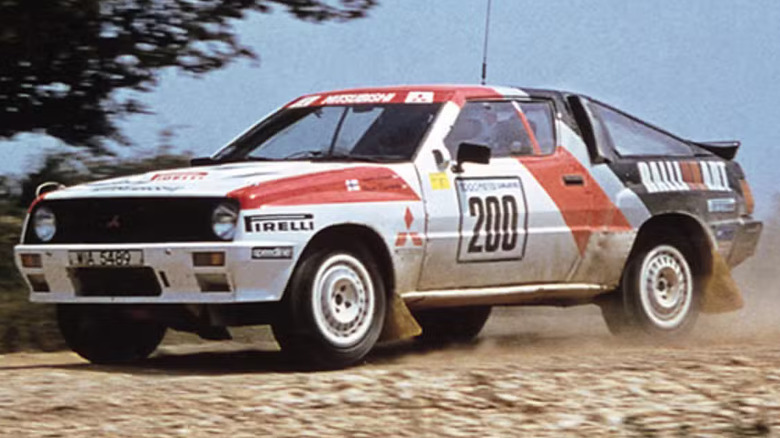
In a somewhat ironic twist, the Starion may have been responsible for its own downfall, as Mitsubishi started using the chassis to experiment with sports cars with four driven wheels in preparation to make a run at the World Rally Group B class in the late 1980s. The conceptual homologation special was unveiled at the 1984 British Internaional Motor Show with a commitment to build 200 identical units. The Japanese brand was dedicated to making its debut in 1987, using the '85 and '86 seasons as shakedown before a full-on assault. As it happens, the deaths of Henri Toivonen and co-driver Sergio Cresto at the 1986 Tour De Corse forced the FIA to act and Group B as a category was canned for the 1987 season, taking Mitsubishi's rally efforts with it. At least temporarily.
The technological hurdles cleared in the preparation for a Starion rally program gave Mitsubishi the confidence to push forward with the now-iconic Galant VR-4 and eventual Lancer Evolution. The experiment with four-wheel drive also caused Mitsubishi to shift its focus for future sports cars. The shift from rear-wheel drive to front-drive-based passenger cars was well underway at the company, and the economies of scale using a FWD-based AWD platform for a sports car could make it much more profitable. Thus the Starion's Eclipse successor would be based on the successful Galant instead of a stand-alone rear-driver, offering similar turbocharged four-wheel-drive thrills to the proposed Starion Group B homologation special at a lower price.
If it weren't for the Starion Group B program, the Mitsubishi we know today might be an entirely different entity, for better or worse. There's no telling if the Starion would have been competitive in the series, but the rules changed and it was game over.