

5 Formula 1 Drivers To Get Race Bans (And What They Did)
Formula 1 is replete with rules and regulations that teams and their drivers must follow to the letter, else fines and penalties follow. In rare cases, when a driver either breaks the rules or causes issues on track, the frustrating fines and penalties are forgone, and instead they are dished out with an altogether more troubling suspension or ban from the race. A race ban is exactly that — when a driver will have to sit out the following event. For a team or driver chasing down a championship win, even just one missed race could mean the difference between being champ and falling completely out of title contention.
The seriousness of a race ban means they are not dished out all too frequently. Examples highlighted below from storied drivers such as Kevin Magnussen, Romain Grosjean, Eddie Irvine, Nigel Mansell, and even the mighty Michael Schumacher, have been handed out due to ignoring the FIA's rules or in response to dangerous on-track behavior. Here are those five examples, listed in reverse chronological order.
Kevin Magnussen: single race ban in 2024
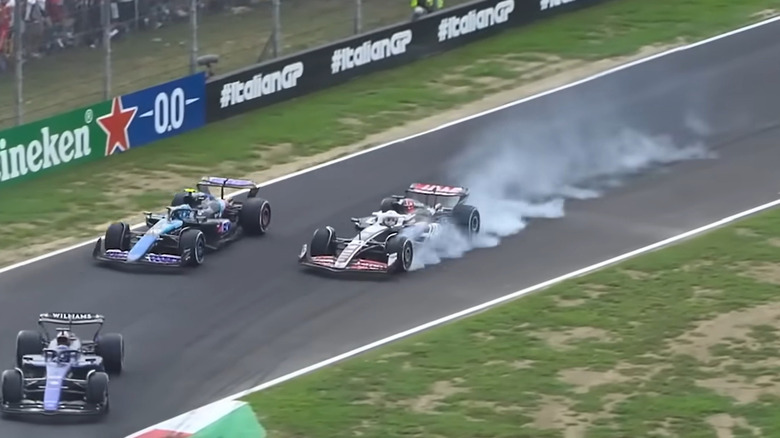
The then-Haas driver managed to collide with rival Pierre Gasly's Alpine during the 2024 Italian Grand Prix. And while that in itself only earned the driver a 10-second penalty, previous mishaps resulted in Magnussen racking up a total of 12 points on his Super License. How F1 drivers earn these licences largely depends on past performance and points scored in accredited championships over three years, ensuring each license-holder is suitably experienced in addition to being a proven talent.
Drivers need a Super License to compete in Formula 1, and when necessary, the FIA can dish out penalty points against any driver's license. Those points remain for 12 months, and if 12 points are attributed to any one license within that period, a race ban is the prize. The last race ban in Formula 1 came in 2012, and with Super Licenses introduced in 2014, Kevin Magnussen became the first driver to receive a ban through the points system. The incident that led to the final points being attributed to Magnussen's license was a messy overtake attempt at turn four of Italy's Monza track. His brakes locked up, resulting in a collision, and the FIA found him "wholly responsible." As per the rules, Magnussen was made to sit out the following race in Azerbaijan.
Romain Grosjean: a single-race ban in 2012
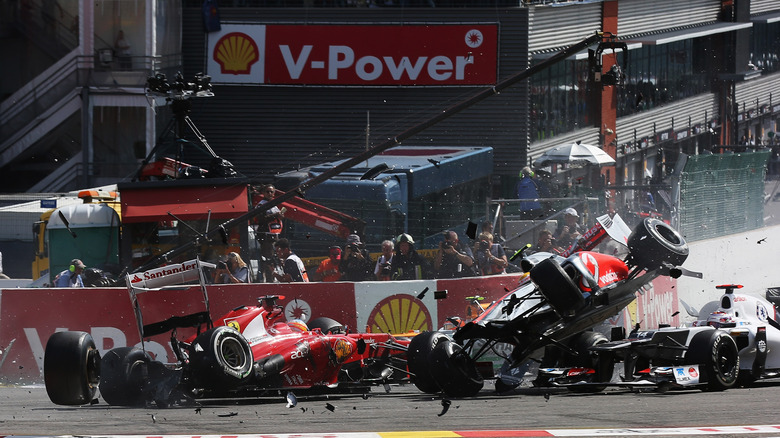
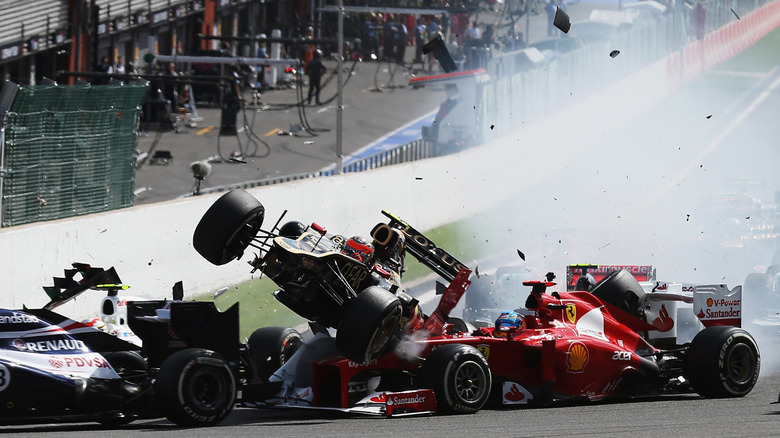
The news of Grosjean's retirement from the world of Formula 1 at the end of the 2020 season hardly came as much of a surprise after he suffered a horrendous, life-threatening crash that year. As far as bad days go, that has to be one of Grosjean's worst, but another day he probably wants to forget took place back in 2012, when a race ban came his way after an incident at Circuit de Spa-Francorchamps in the 2012 Belgian Grand Prix. This was the first race ban dished out in 18 years, demonstrating just how rarely these come about. The incident in question saw Grosjean cross the track at corner one, into the path of Lewis Hamilton's McLaren. Both cars lost control at this point and wound up hitting Alonso and Perez, forcing all four drivers to retire from the race. Other drivers picked up damage too, but were able to continue, at least.
After reviewing Grosjean's driving, the stewards noted he had breached two articles of the sport's formal regulations, in addition to breaching the following rule of the FIA's sporting regulations: It is not permitted to drive any car unnecessarily slowly, erratically, or in a manner deemed potentially dangerous to other drivers at any time. Eliminating the championship leaders from the race certainly didn't help him win any popularity contests either. Consequently, Grosjean was forced to miss the following Italian Grand Prix, and no appeal to the decision was made from his then-team Lotus.
Eddie Irvine: a 3-race ban in 1994
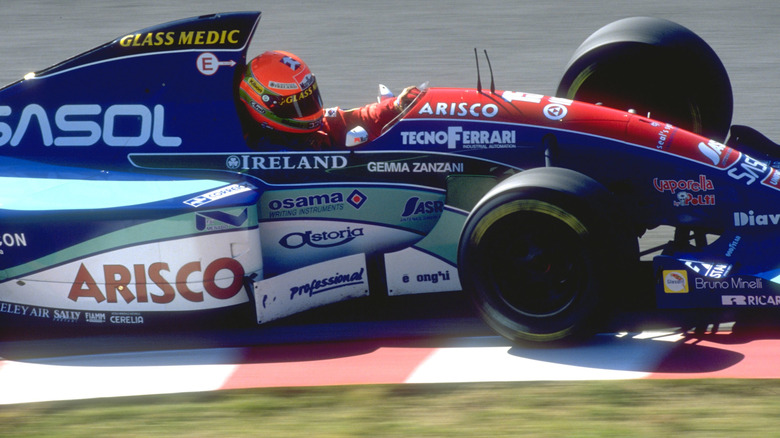
If smashing into the side of Lewis Hamilton hurtling around Spa only nets a driver a single race ban, then what on earth was Eddie Irvine doing in '94 to earn himself a three-race ban? Very much the same, as it happens. The then-28-year-old had only enjoyed three races at this level before the Brazilian Grand Prix of '94. Midway through the race, things were heating up. The engine in Martin Brundle's McLaren failed, and a gaggle of cars was approaching the delayed racer. Among them were Irvine and Eric Bernard. The former swung out to overtake the latter, not clocking that Jos Verstappen was to his side. Dramatically, this sent Verstappen into a full pirouette, where his car then became airborne, but not before his Benetton crashed into both Brundle and Bernard.
That was Verstappen's Formula 1 debut, and later that year, he suffered a terrifying pitstop fire. It's safe to say his introduction to the world of Formula 1 was a little uncomfortable. Back to Irvine, he was handed a single-race ban after the incident. Presumably, Irvine's defence was that he was acting to avoid Brundle's troubled McLaren, and so felt the ban was unfair. As a result, he chose to appeal it. The FIA did not look kindly to this, and so in addition to shutting down the appeal, they also extended it to become a three-race ban, calling his overtake attempt "reckless" (via Independent).
Michael Schumacher: a 2-race ban in 1994
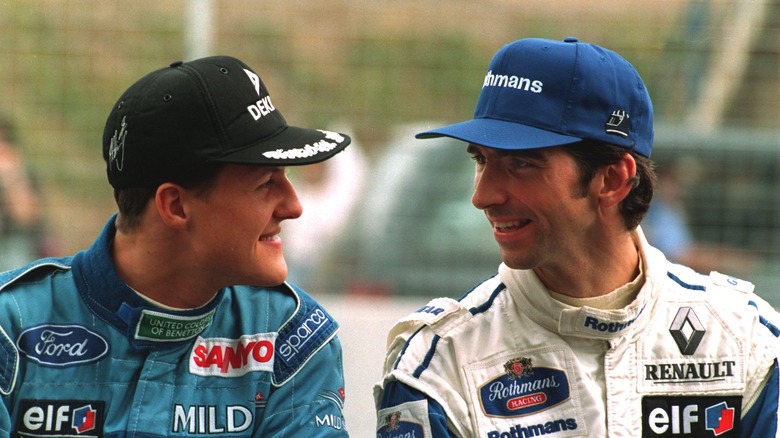
Easily one of the most celebrated and successful drivers of Formula 1, Michael Schumacher made history in his Ferraris. But sadly, not every outing went entirely to plan for the German talent. In the same season that Eddie Irvine managed to earn himself a three-race ban, Schumacher saw himself excluded from two, in addition to losing points from another. Thankfully, this wasn't due to an on-track accident. Instead, Schumacher's race bans came due to a short string of decisions on the track. During the formation lap of the '94 Silverstone GP — a point in which the cars are not racing, and must stay in starting order — Schumacher overtook a dawdling Damon Hill and was awarded a five-second stop-and-go penalty, but his team instructed him not to serve it while they appealed the decision.
For ignoring the penalty, Schumacher was shown the black flag, ordering him to retire to the pits and end his race. As his team was still appealing the decision, they told him to continue after serving the aforementioned penalty. Benetton's plan backfired, and now, for ignoring the black flag, Schumacher was handed a two-race ban. Furthermore, the six points he'd won at Silverstone were also taken from him, and he was later disqualified from the Belgian GP too, following a technical infringement. All that, in addition to the tragic events of Imola earlier in the year, sure makes it sound like a horrific year for Schumacher. However, the German still wound up winning the championship by a single point, following a very controversial final race in Adelaide.
Nigel Mansell: a single-race ban in 1989
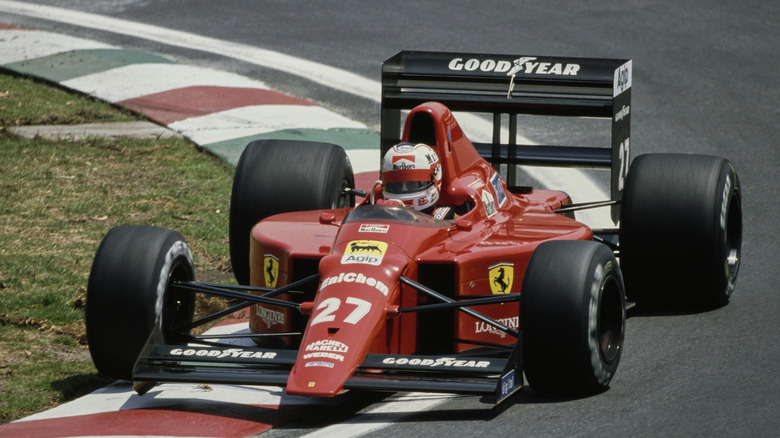
Rules and regulations of Formula 1 were very different in the decades gone by, and while modern-day drivers can be penalized for speeding in the pits, no such limits were enforced back in 1989. With no pit speed limit in place, Nigel Mansell — one of the greatest racing drivers of all-time – came in too hot and overshot his pit garage by a good distance while 20 seconds in the lead at the Portuguese Grand Prix. No problem: Mansell simply reversed from outside the Benetton pit garage and into position beside the Ferrari garage, where he should have stopped in the first instance. Sounds simple, but reversing in the pits was forbidden, and when rejoining the track, Mansell was shown the black flag.
Busy battling away with Ayrton Senna, Mansell claimed not to have seen any of the three black flags that were being waved frantically at him. A first-corner overtake attempt was made, but unfortunately, the lunge saw Mansell collide with Senna, and both were forced to retire. The result for causing a collision while ignoring black flag orders to retire netted Mansell a ban from the following Spanish GP and a $50,000 fine. The race in Spain was only a week away, which gave Ferrari no time to appeal, but Mansell made a threat to walk away from the sport altogether if it wasn't overturned. The ban was not lifted, and Mansell returned for the next race in Japan.