

Why NASA Is Going With Fuel Cells Instead Of Batteries For Energy Storage On The Moon
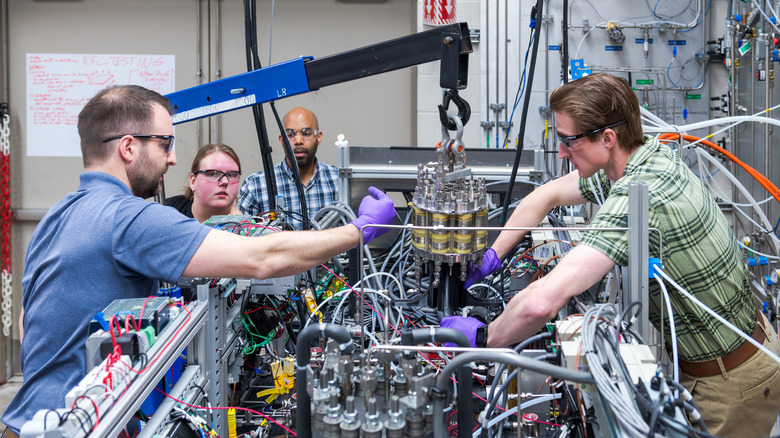
How do you power a home 238,900 miles from any electrical grid? The long-term goal of NASA's Artemis program is to establish a permanent human presence on the Moon, but the task is far simpler said than done. NASA is currently testing regenerative fuel cells for future use on the lunar surface. While batteries are the typical choice to store electricity, the space agency's decision to develop fuel cells was significantly influenced by the conditions on the Moon.
In humanity's only comparable example, the International Space Station uses solar panels to generate electricity and stores excess energy in lithium-ion batteries. However, sunlight is far from abundant on the Moon, with nights lasting two weeks. NASA's fuel cell solution would convert hydrogen and oxygen gas into water, heat, and electricity. The excess water would then be used to recharge the cell by being split into its component hydrogen and oxygen.
A fuel cell would also be more logistically convenient. Despite being as long as a small car and as tall as a person, the current test unit weighs less than a similarly-sized battery. Energy density is important when launch payload costs are measured in thousands of dollars per pound. Dr. Kerrigan Cain, the testing team's lead engineer, said:
"It is an ideal technology for habitats, exploration with rovers, and many of the systems that are envisioned under Artemis. Developing a sustainable, long-term human presence on the Moon requires power and energy storage solutions that fit those needs. Regenerative fuel cells fit into that puzzle perfectly."
Location, location, location
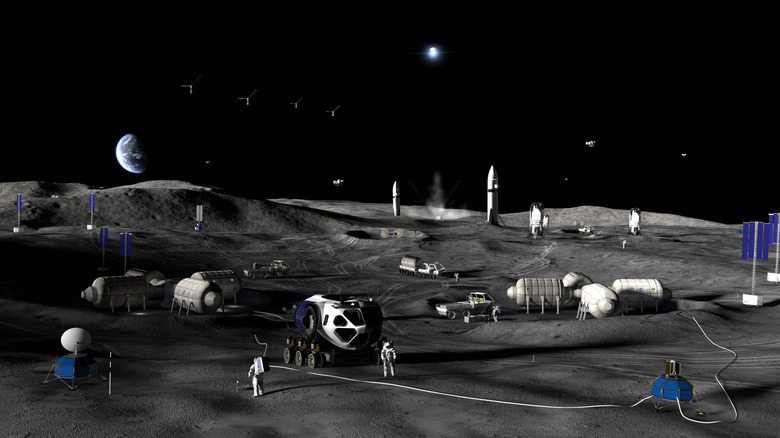
The location of Artemis Base Camp could prove vital for ensuring that a regenerative fuel cell can produce sustainable energy. NASA's planned astronaut outpost will be near the Moon's South Pole, where data indicates that there's water ice. In 2012, NASA researchers estimated that 22% of the Shackleton crater's surface was ice. That ice could be used to keep the fuel cell operational, eliminating the need to supply hydrogen and oxygen from Earth. According to Scientific American, the Apollo missions discovered minuscule amounts of water in lunar soil samples, but it was believed to be outside contamination until 2008.
NASA hasn't put all its eggs in the fuel cell basket. The space agency is also preparing a nuclear reactor for service on the Moon. Transportation Secretary Sean Duffy ordered NASA to develop a 100-kilowatt unit for launch by 2030. For the White House, the presence of a reactor on the lunar surface would be a useful loophole around international treaties preventing any nation from claiming land on the Moon. The United States could declare "a keep-out zone" around the reactor, effectively rendering the area sovereign U.S. territory.