

When Your Road Trip Is Mostly Long Highways, Drowsiness Is Your Biggest Enemy
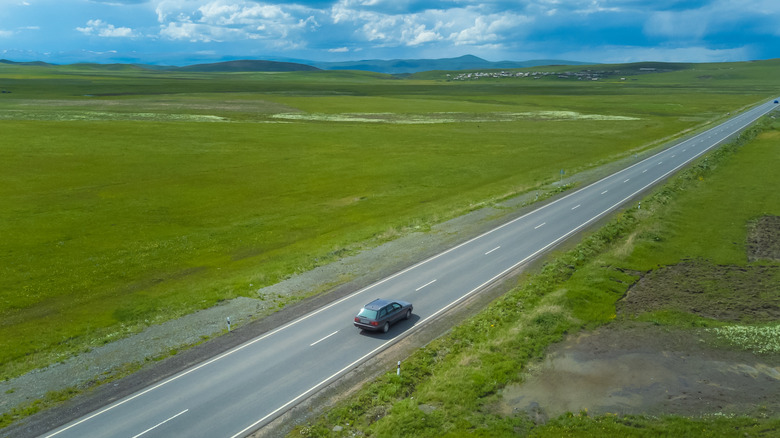
Zoning out behind the wheel or feeling drowsy are not uncommon when you embark on long highway journeys. According to a CDC study, 1 in 25 adult drivers reported falling asleep while driving. Moreover, operating a motor vehicle while drowsy is not helped by monotonous roads, which reduce your brain's overall alertness. Fatigue can also cause your brain to process things slowly. A 2003 study found that drivers showed less fatigue on roads with more varied scenery, including trees, overpasses, farms, and so on, as opposed to roads with a single visual element — such as endless rows of pine trees.
In fact, one of the leading causes behind Highway Hypnosis (or white line fever) — a condition where you enter into a trance-like "autopilot" mode while driving — is driver fatigue, which may occur as a result of sleep deprivation. Going 24 hours without sleep is equivalent to having a blood alcohol concentration (BAC) of 0.10%, according to studies cited by the National Institute for Occupational Safety and Health (NIOSH). That's more than the legal limit for driving set by all 50 states. Lack of sleep can also cause some people to experience brief involuntary moments of inattention, also called "microsleeps," which, according to the National Safety Council (NSC), may only last a few seconds. But at highway speeds, that interval is enough for a vehicle to cover the length of a football field.
Per the NHTSA, an estimated 91,000 police-reported cases registered in 2017 involved drowsy drivers, resulting in an estimated 800 deaths. Worth mentioning is that most of the drowsy-driving accidents occur on rural roads and highways, between midnight and 6 a.m., or in the late afternoon, moments of the day when your circadian rhythm (the body's internal clock) dips.
How to prevent it

According to the Sleep Foundation, commercial drivers, shift workers, people with sleep disorders, and those who are under certain medications are at risk of driving while drowsy. Medicines like muscle relaxants, stimulant diet pills, certain antidepressants, and cough suppressants that contain codeine and hydrocodone are among those that could potentially make driving unsafe, according to the FDA.
The NHTSA recommends that you avoid driving during the aforementioned times of the day. If that's not possible, make sure you're well-rested, because the number one way to avoid driver fatigue is to get a good night's sleep before you start the journey.
However, if it's an overnight trip, you might want to consider taking a break (or perhaps a quick nap) at one of the many roadside rest areas or service plazas, especially if you're experiencing some of the warning signs. These, according to the American Academy of Sleep Medicine, include catching yourself yawning, nodding off, or not remembering much about the last few miles. If you happen to veer off onto the rumble strips, miss an exit, or are tailgating a bit too close to other cars, consider taking a break. Although caffeine is advised, its effects may not last long. What's not advised is to consume any kind of alcohol.
Blasting some nice tunes on the radio (perhaps from this Spotify playlist) might help you stay alert, as will engaging in a conversation with yourself or the passenger, suggests Healthline. And while some of you may not like the overly intrusive nature of driver attention assist, it sure is useful when the car notifies and sometimes takes control when you're actually distracted or drowsy behind the wheel. At least, that's what most Subaru owners told the IIHS.