

Here's Everything We Know About The Crash China Doesn't Want You To Know About
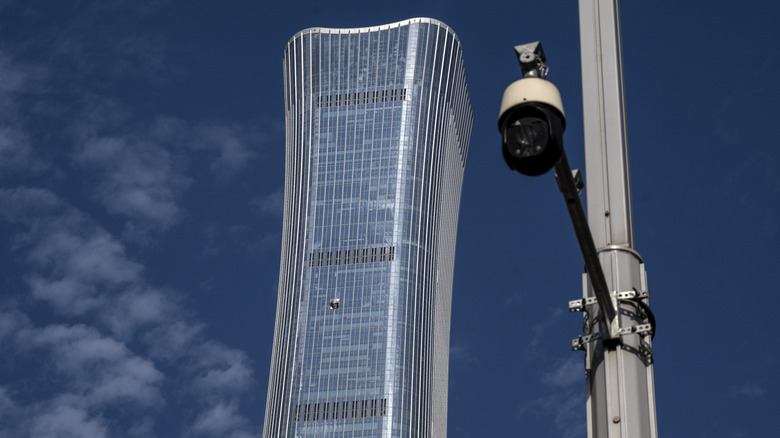
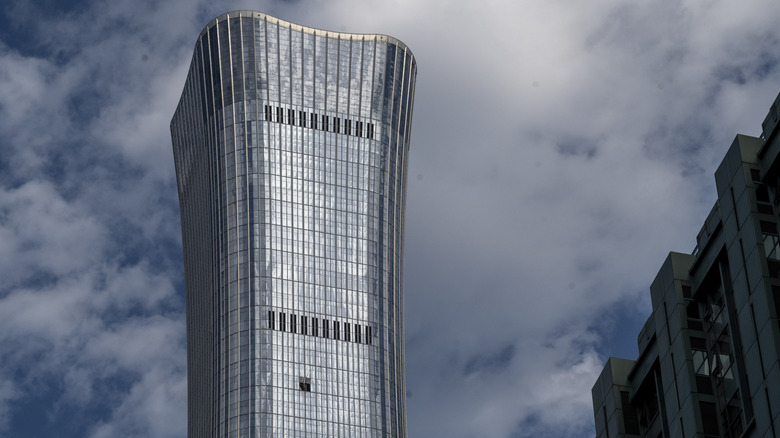
On June 26, a two-seater light aircraft crashed into Citic Tower in Beijing, China. The pilot was killed, and 13 others were injured. Immediately afterwards, the Chinese government told us... virtually nothing. In fact, China went the other direction, pulling down any reference to, video of, or post about the crash. The government scrubbed the internet clean, picked the debris up off the street, boarded up the tower's broken windows, and moved along. Even CCTV, the state's television broadcaster, made no mention of the crash — despite the fact that it was literally across the street.
It's now been about two weeks, and at last, more information is starting to trickle out. The investigation is ongoing and Beijing still seems to want to sweep this all under the rug, but a picture is starting to emerge now. At minimum, this was a catastrophic breach of China's air defenses right in the heart of its capital. At worst, this was an attempted mass murder by a deeply unwell individual.
What we know is that a 66-year-old man identified only as Liu took off in a Sunward Aurora SA60L from Beijing Shifosi Airport about a half-hour before the crash, per Reuters. He was part of a larger formation flight, but eventually split off unexpectedly and ceased communication with air traffic control, per the Financial Times. After that, an incoming Airbus A330 had to take evasive maneuvers to avoid hitting Liu. At 5:55 p.m., he struck the east side of Citic Tower, Beijing's tallest skyscraper. All we know about Liu is that he got his pilot's license in 2021, he was divorced... and his diary was full of suicidal references. A statement from the Chinese government said the crash was caused by "personal reasons," per the BBC.
Questions remain
There's a lot here that is very strange. For one thing, the plane's last recorded signal positioned it nearly four miles from Citic Tower at the very moment of the crash. These signals can often be inaccurate, but that calls into question what its true flightpath actually was.
Bigger than that is the fact that Citic Tower is just a stone's throw away from the central nervous system of China's government. Zhongnanhai, where the Chinese Communist Party's elite live and work, is only another four miles past the tower. For this reason, China has maintained a strict 39-square-mile no-fly zone in that area, per the BBC. Theoretically, that no-fly zone would be enforced by anti-air defense systems. But nothing stopped Liu from reaching the tower.
Lastly, this horrific crash just doesn't seem to have caused very much damage. Despite the government's best efforts, there are still photos and even videos of the incident. But it appears that the impact only broke a few windows; the resulting debris from the plane did further damage down below. Possibly, a lightweight aircraft like this just doesn't have the punching power of the airliners that struck the World Trade Center on 9/11. Since we have no indication of the plane's speed, it's even possible that it was moving very slowly. Even for all that, the lack of carnage is (thankfully) unexpected.
Why did this happen?
That's as much as we know, and anything further is speculation. Could this have been some sort of horrible accident? The answer appears to be no: again, the Chinese government has stated that the cause of the crash was "personal reasons." That does track: any other explanation would have to involve Liu losing control of his plane for several miles while simultaneously losing contact with air traffic control, in such a way that he just so happened to crash into literally the tallest thing he could see.
Was this a terrorist attack? It certainly has the hallmarks of 9/11, though on a much reduced scale. But there has been no manifesto released, no responsibility taken for the attack, and no demands made. Plus, the Zhongnanhai compound was nearby, which might have made for a more tempting political target.
Was this an attention-seeking suicide? The Chinese government stated that Liu's diary was full of suicidal references, and also that Liu suffered from both insomnia and anxiety. But crashing your own plane is one thing; crashing it into a building, and the tallest building in the city at that, is another. That has to be an attempted mass murder. Thankfully, despite 13 injuries, no one but Liu died.
Where it all goes from here
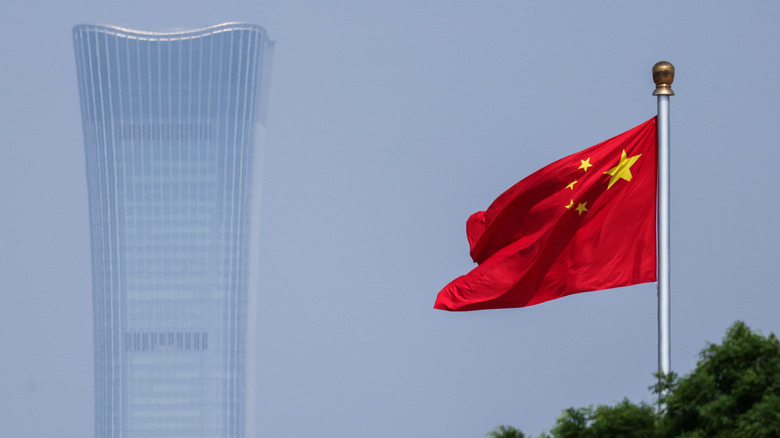
So what happens now? In the short term, Beijing has demanded that light aircraft operators in the area suspend flights for now. How long that lasts remains an open question, as does whether things simply go back to the way they were or if new, stricter regulations are handed down.
In the medium term, expect China to pursue two investigations: one into the crash itself, and another into how the military's defenses were so easily breached. In a time of purging officers, don't be surprised if some more get pushed out over this. That, in turn, has implications for the state of the armed forces' readiness.
In the long term, don't be surprised if we never get a full, official accounting of what happened. CNN points out that there is still no final report on the crash of China Eastern Airlines Flight 5735, a Boeing 737 which crashed in 2022, killing 132 people. If Liu did indeed want to go out in a blaze of ignominy, China may simply deny it to him.