

Metal Balls From Outer Space Invade Australia
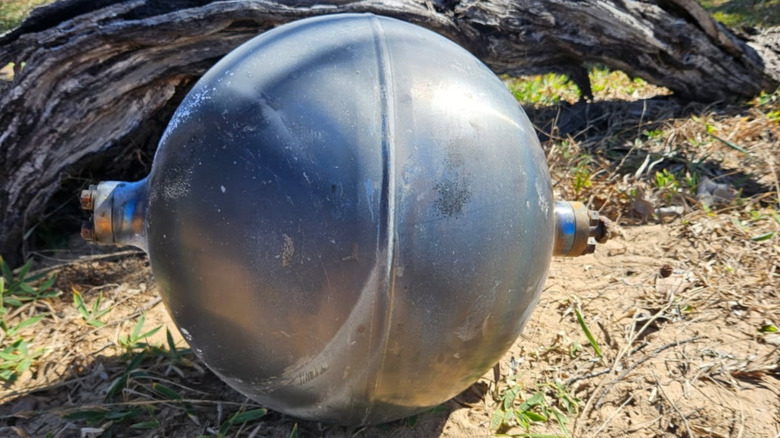
Ever have one of those days when you're invaded by strange metallic objects from beyond our planet? On Sunday, unidentified spheres began appearing in Forrest Beach in Queensland, Australia. And, yes, the Australian Space Agency (ASA) has indeed confirmed that they came from space. Specifically, they appear to be parts from a rocket that have crashed back into the ocean and are now washing up. With more and more mass going into orbit every year, the likelihood of objects falling from orbit keeps increasing. So while no damage has been done to the good people of Australia, that's just because these objects happened to impact at sea. Change the trajectory by just a few degrees, and this would be a very different story.
While the invading balls may harbor no nefarious intent (that we know of), that doesn't mean they aren't dangerous. The ASA says that you should "never touch, move or recover suspected space debris and assume it to be hazardous until advised otherwise." The known objects have all been removed by the government now, but more may be out there. The Guardian writes that they are likely part of the rocket's fuel system, and thus might contain highly toxic chemicals. In addition, those parts are actually referred to as "space balls," conclusively confirming that rocket scientists are nerds.
Whose balls are these?
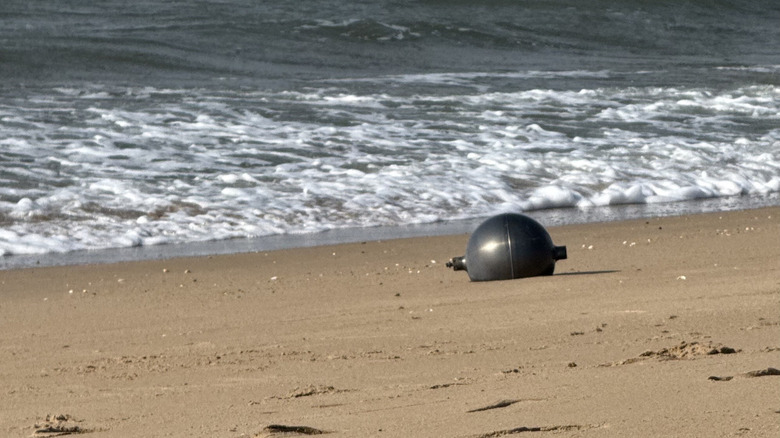
Alright then, who is it inflicting their space balls on poor Australia? The ASA isn't sure yet, but they're working on it. Assuming this is not a race of alien robots, there are two likely candidates in Australia's vicinity: current space power China and rising space power India. The BBC points out that India has a recent history of dumping rocket parts into the ocean, which then wind up on Australian beaches. And Space.com tracked down a couple of recent Chinese launches, which could be the culprits.
One thing we don't know is exactly when these metallic orbs returned to Earth. Given that a lot of them showed up in a small area all at once, it's likely that it was recently; otherwise, oceanic drift would have spread them around. That still doesn't give us a precise date, and it's at least possible that this was from a launch from weeks ago.
Even once the ASA works out who dumped space trash on their shores, there aren't great mechanisms for actually dealing with the issue. China is famous for leaving their rocket stages in orbit, which creates hazards for satellites. The Liability Convention of 1972 does say that one country has to reimburse another if there is damage from their space activity, but this agreement has no enforcement process. And anyway, if toxic rocket parts crash into a city, reimbursement isn't really a good solution. The world needs to modernize its regulation around space activity, accidents, and damage. Maybe a few more balls will get the ball rolling.