

How Ford's 1983 Probe IV Concept Hit A 0.152 Drag Coefficient For Max MPG
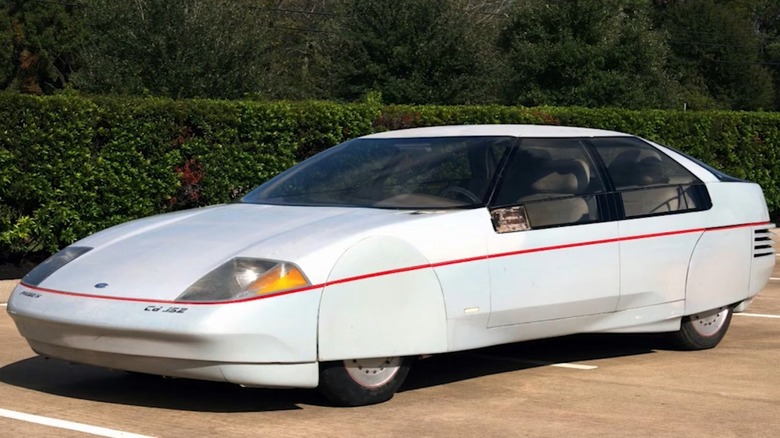
Most of our readers will remember the Ford Probe as that nice-looking two-door coupe that went on sale in 1989. The car rode on Mazda underpinnings that the Japanese automaker developed for the 626 sedan, and it became controversial for being touted as the next Mustang. Before that, however, Ford used the Probe name for a lineup of five series of concept cars with styling inspired by "advanced aerodynamic concepts."
Most notable of these was the 1983 Ford Probe IV — an extension of what could be achieved by further optimizing the previous Probe III's mightily impressive drag coefficient of 0.22. It took Ford engineers two years to integrate the "advanced mechanical features" into the Probe IV with the primary objective of achieving a drag coefficient of below 0.20. For reference, the world's most aerodynamic production cars today rarely dip under that figure. After employing computer simulation and wind tunnel testing to shape the Probe IV's low-profile bodywork, Ford immediately sent a chassis to Ford's Ghia Studios in Turin, Italy, to dress the computer-designed body in steel and Kevlar.
Looking past the raked and flush front and rear windscreens, flush side glass, covered wheel openings, and low-profile hood design, the Probe IV has proven that a four-door family car with seating for four and a 10 cubic feet luggage capacity can still be almost as aerodynamic as a fighter jet or any of the coolest land speed record cars. The concept achieved a remarkable 0.152 Cd in the Lockheed wind tunnel at 55 mph, proved 20% more fuel efficient than a standard car, and required 60% less power to reach 50 mph.
How the Probe IV became so slippery
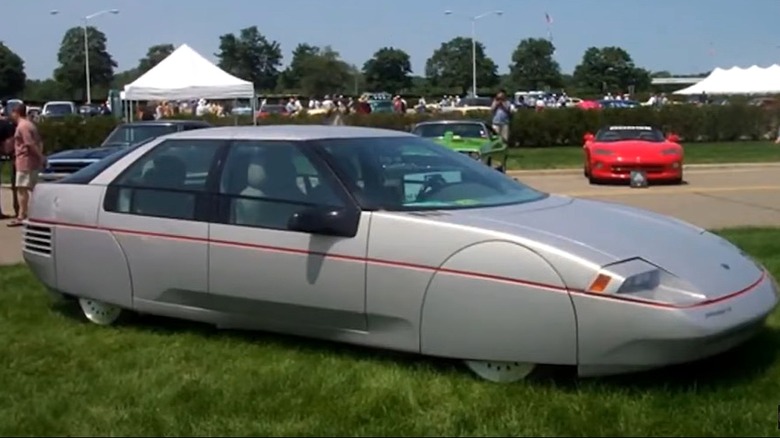
There are unseen forces at play beneath the Ford Probe IV's ultra-slippery body design. It has a rear-mounted cooling system that keeps both the engine and the A/C cool, since installing the radiator in the front would likely increase drag. The sealed underbody further reduces drag, while rear air inlets help channel air more smoothly through outlets in the taillamps. Meanwhile, the Probe IV rides on a computer-controlled air suspension derived from the 1984 Lincoln Mark VII, which can raise the ride height to 6.5 inches or lower the front to about 3.25 inches. As the car moves above 45 mph, there's a speed-sensitive front spoiler that extends in stages as the speed climbs.
Ford also went to Goodyear for a bespoke set of run-flat tires with inner rubber liners inflated separately from the tires, computer-optimized unidirectional tread designs, and a low rolling resistance tread compound. Those tires were a precursor to modern eco tires, which allow drivers to get the most miles out of their tires. Under the hood was a modified 1.6-liter Escort four-cylinder engine with electronic fuel injection. Ford had to tilt the engine 70 degrees forward and lower it by about six inches in the engine bay to achieve a low-profile, 30.7-inch cowl height. More interesting are the twin compressors for the air suspension that draw power from two electric motors.
Ford outdid itself with the Probe V
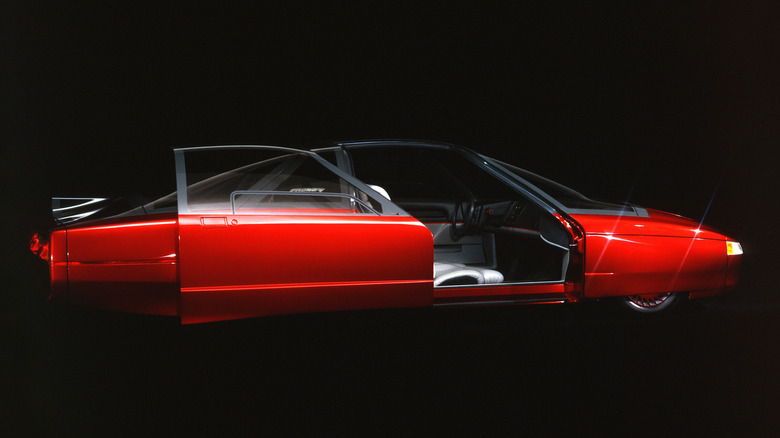
The Ford Probe IV was not the end of the automaker's quest for aerodynamic supremacy. Ford unveiled the Probe V two years later in 1985, and it had more to offer than mere concept car design cues. The Probe V has morphed from a practical four-door to a sportier two-door with a cab-forward design, and Ford gave it swing-out and slide-out doors for good measure. It also relocated the engine from the front to the rear while still offering a four-seat interior, with rear seats that roll up when not in use.
Combined with an all-glass greenhouse and roof, the Probe V achieved a drag coefficient of just 0.137 to beat the Probe IV. For reference, the GM EV1 has a Cd of 0.195, while the Lucid Air has a Cd of 0.197. The only difference is that the Ford Probe concept never entered commercial production as such. Despite that, the Probe program inspired the design of the then-new Ford Taurus that debuted in 1986. The Taurus made do without the exaggerated styling cues and covered wheel arches, but the rounded body helped it achieve a drag coefficient of 0.32.