

What's The Fastest Way To Repair A Flat Tire?

We may receive a commission on purchases made from links.
It would be nice if tires would give you a chance to check your calendar first before they go flat, but tires are not considerate that way. So, what should you do if you get a flat tire and have someplace you need to be? Do you have to go through the trouble of changing the tire, or is there some quick repair you can do alongside the road? The answer is, it depends on the damage, but there are definitely ways to fix your tire yourself.
If it's just a small puncture in the tread area and no belts are showing, by far the fastest way to repair your tire is to just use an aerosol can of liquid sealant like Fix-a-Flat. A quick squeeze of a button and a top off at the air pump down the road, and you can be back on your merry way. Of course, you'll need to get the tire replaced at your earliest opportunity. There are other relatively quick ways to fix your tire yourself, but they involve more equipment. For instance, you could plug the hole with a rubber plug or a patch. This is very temporary and requires a plug kit. And if the problem is just the valve stem, you can replace the valve stem with, again, the proper kit. On rare occasions, twisting the stem with pliers will get it to seal again, but you'll usually need to replace the core or the whole stem itself.
The fastest and easiest way: Fix-a-Flat
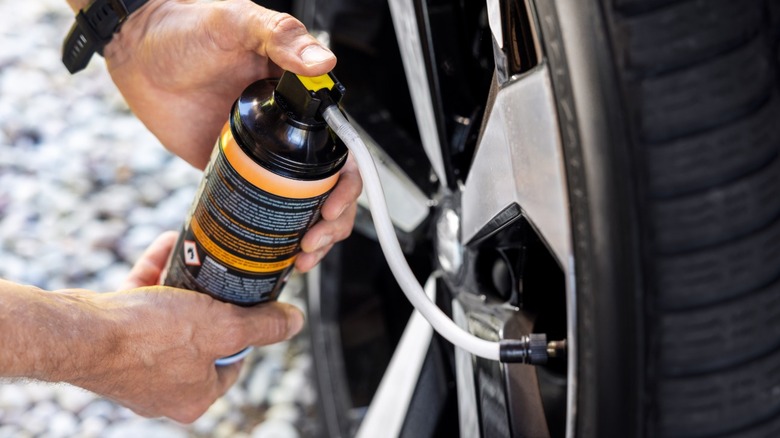
There is no faster way to fix a flat tire than spraying some liquid sealant into it. It is by far the easiest as well — just follow the directions on the can. The fix itself can take less than two minutes, not counting refilling the tire with air a few minutes later. To fix a tire with a liquid sealant like Fix-a-Flat, pull the car over safely away from the roadway and make sure the puncture is touching the road. Shake the can thoroughly for roughly 30 seconds or so. Attach the hose to your tire's valve, then push the button until the can is empty while holding the can fully upright. This won't fill the tire, but it should supply enough air to lift the tire from the rim. It's important to drive the car for a few miles to distribute the sealant. Stop and refill the tire to the right pressure.
This fix is only for punctures smaller than roughly ¼ of an inch and, much like those little donut spare tires, is meant to be a temporary solution so that you can safely get to a tire shop. Keep in mind, many shops will not repair, but will only replace, a tire that has been fixed this way. We should mention that Fix-a-Flat isn't the only game in town as far as liquid sealants go. There are other brands, like Slime, that make their own version. Whatever brand you use, it's a good idea to always have a can in your trunk.
Fixing the valve stem
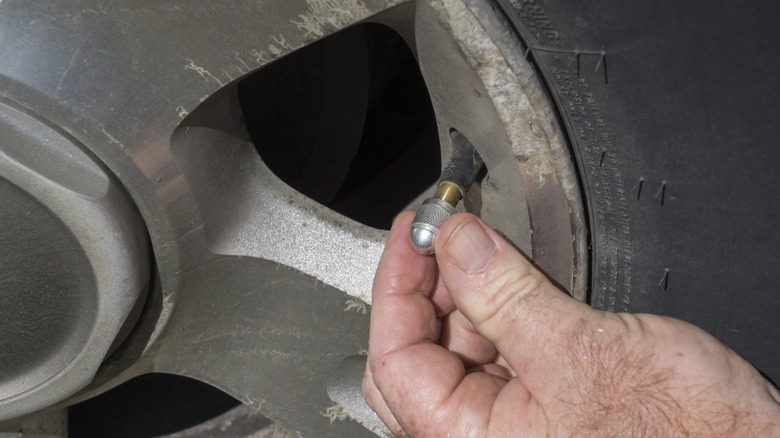
Sometimes the problem is the valve stem itself — the core could be bad, the seal could be broken, or the stem could be cracked or just loose. You can fix these things yourself quickly and easily if you're home and have the tools. However, it's a little different on the roadside. The first step is making sure that the air is indeed leaking from the stem. Lots of mechanics like to spray the tire with soapy water. If bubbles are forming around the base of the stem, that's where the leak is.
If the stem is just loose, you may be able to twist it with pliers or a valve stem key until it tightens back up. Otherwise, you'll need to replace it. Most people don't know that you can just pop the stem out and put a new one in, and there are cheap kits for that, such as this Richcat one on Amazon for $19.99. Depending on the kind of removal tool you have, you'll either work it under the stem, hook it, and pull it out, or you'll screw the tool onto the valve itself and pull it out. Kits also have a part to pop the new stem in, consisting of a tube and a tool to force it through. You can also do all of this with needle-nose pliers, but it will take more effort. If just the center metal core is faulty, screw it out with the valve stem key and screw the new one in. After that, reinflate the tire.
Plugging the hole
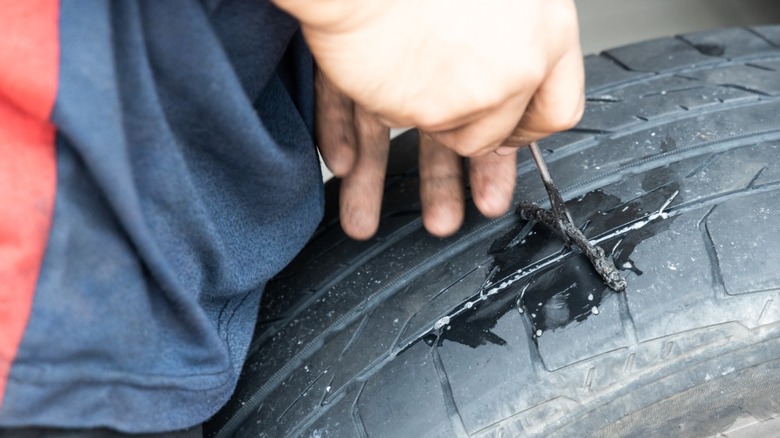
Plugging your tire is one of those fixes that isn't so easy to do on the roadside, unless you carry the tools with you. It's also not quite as quick or easy as using a liquid sealant, but it can be done in just a few minutes. A plugging kit includes a reamer tool, which is used to clean the puncture, an insertion tool, and a plug in the form of a rubber string. The process of plugging the tire itself is very simple. First, use the reamer tool to clean out the puncture by pushing it into the hole, then working it back and forth a few times. Then take the insertion tool and run the rubber plug through the eye at the end of the sharp part. Push the tool about two-thirds of the way through the hole, then pull out. The plug will be stuck in the hole, with some of it sticking out. You'll want to cut off the part that is sticking out so that the plug is flush with the tire.
This type of repair is only for punctures in the tread area (not the sidewall) smaller than ⅛ of an inch. Plugs by themselves are not sanctioned by the industry, and the U.S. Tire Manufacturers Association calls them "unacceptable repairs". That's because plugs without interior patches don't protect the inner liner. Water can get in and cause the belts to corrode. If you do use this method, view it as a very temporary solution until you can swap out your tire.
Plugs with patches are the only permanent fix
The methods we've explained so far are all "fast" ways to repair a tire that can mostly be done on the roadside without taking the tire off the rim, as long as you have the proper tools and parts with you. Unfortunately, fast doesn't always mean permanent when it comes to fixing tires. If you plug a hole in your tire or repair it by spraying some Fix-a-Flat in it, you should get it to a shop sooner rather than later. It is especially risky to drive for a long time on a tire that was repaired using a plug without a patch.
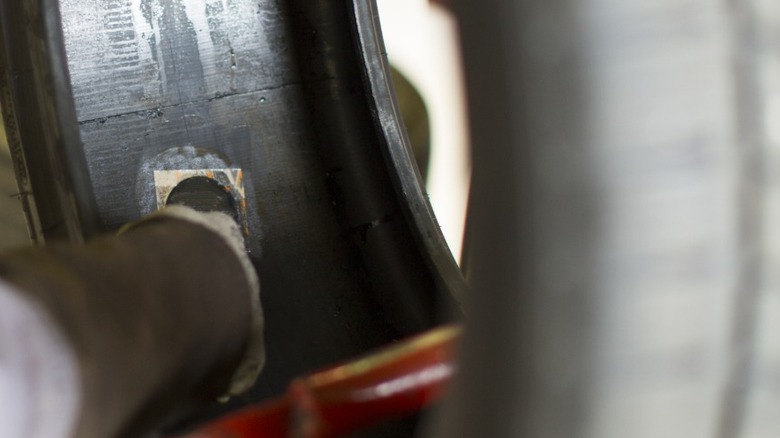
At the shop, the workers can take the tire off the rim and inspect the interior. If they determine that a tire can be repaired, they will generally use a plug and patch combination. You really do need both, as the plug fills the puncture, while the patch placed on the inner wall seals the interior off from the outside. Neither a plug nor a patch by itself can give a tire long-term protection. This isn't really a DIY fix, unless you happen to have one of those tire changer machines standing in your garage. You'd have to "break the bead" (separate the tire from the rim), then put the rim back on. It's not impossible to do yourself, but it's not really worth the hassle in our opinion, unless you have the right machinery.
How fast are these methods compared to just changing the tire?

There's nothing like being stuck on the shoulder of a highway, having to figure out where the manufacturer of your vehicle hid the spare tire, jack, and lug wrench — that is, if your car came with any of that in the first place. In fact, a lot of new cars just come with run-flat tires or a repair kit and air compressor. Supposing your car did come with a spare, how long should it take you to change a tire? If you know what you're doing and you know where the jack is in your automobile, it shouldn't take longer than 15 to 30 minutes. If you find yourself flipping through the owner's manual because the automaker is extra good at hide and seek, it might take you a little longer.
How does that compare with the repair methods we discussed here? Using a liquid sealant takes just as long as the can takes to empty out, so just a couple of minutes. Fixing the valve stem can take less than ten minutes if you have the right tools. You might have to get the car home first, though, unless you happen to have a spare valve stem in your glove box. Plugging a tire can also take only a few minutes, but it might take a little longer the first time you do it. Of course, there are times when a tire can't be repaired, which means changing it is your only option.