

Here's What It Means If You See A Pink Road Sign
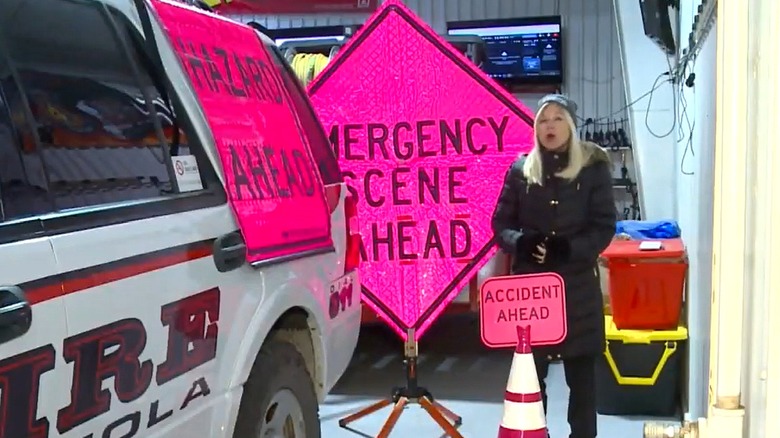
Most road sign colors are so common and everyday that we don't give them a second thought. Highway signs are usually green, for example, yellow signs indicate a warning of some kind, and brown signs can be used to point out visitor attractions and leisure sites. For most drivers, this knowledge will be nothing new, but there is one rarely spotted color that might leave a few drivers stumped.
Fluorescent Pink road signs are among the rarest road signs out there, so it's understandable that some people might not immediately know what the color signifies. Designated by the Manual on Uniform Traffic Control Devices (MUTCD), pink is generally used for incident management signs, which are typically placed near areas of flood risk and used to convey information about an upcoming emergency scene, or to highlight a detour. Adding to that, pink would only be used to highlight an unplanned incident-related detour, such as navigating past a crash site, whereas more typical, perhaps construction-related detours, would be indicated with an orange road sign. In fact, the unusual color and rarity is what makes it effective.
When Reader's Digest asked the Transportation Research Center director at the University of Nevada, Shashi Nambisan, PhD, for more context on the sign, he explained, "Fluorescent pink will get people's attention because we don't use it commonly, so the color indicates there must be some major emergency." She also added that pink is not an approved color for any other type of public road sign, and that it's used "only in the case of emergency signs for incident management."
Reacting to a pink road sign
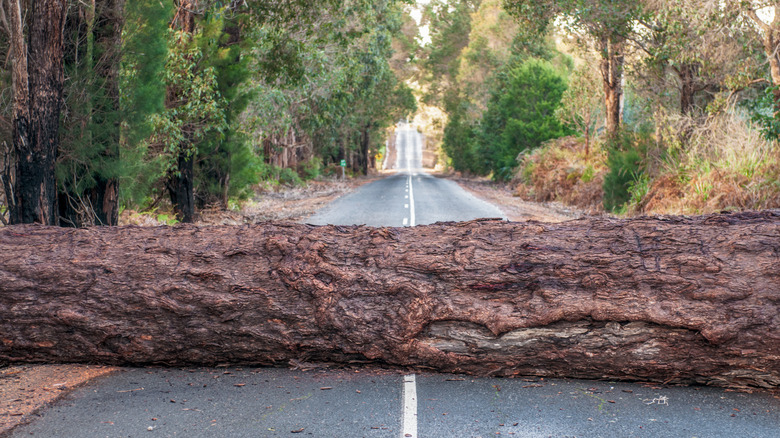
The first thing to realize is that pink road signs are not signs you can put to the back of your mind, or simply leave in your peripheral vision, unlike a brown sign that might only be of interest to tourists, or any other goofy road sign you might not have seen before. Instead, it's important to take careful note of what's being stated by the sign. Like most cautioning signs, these pink signs will typically be diamond in shape, and instead of symbols which could possibly be misconstrued, instructions will be given via clear, black lettering. Slow down, and read the sign carefully. For example, the sign could notify you of a closed lane, closed road, or that you must approach the road ahead with caution and at a reduced speed.
Sometimes these signs are in response to a natural hazard, like a fallen tree in the road, although their presence could also be a warning of a more bizarre incident, such as a biohazard on the road. The risks of ignoring the instructions vary from real safety risks to the driver and those involved in the incident management, to the potential of receiving a traffic violation. Minor traffic violations drive a lot of us crazy, but this is a simple one to avoid — just do as the sign asks.