

Are eBike And Regular Bicycle Tires The Same?
They're the same. No, not actually. Well, it kind of depends. How's that for a non-answer? The reality is that we don't live in Europe. (Though, dear reader, if you do live in Europe, please help us have some regulations around e-bike tires in the United States!) In a more enlightened society, Europe, and it seems, also the U.K., they actually regulate these matters.
There, not here, there are specific codes and requirements for so-called "speed pedelecs," including fitting a speed-compliant tire on what we would call a Class-III e-bike, which is one that is assisted up to 28 mph (or 45 kph elsewhere on this earth).
The code itself is a bit of a hodge-podge. It's derived from laws governing mopeds, so they've glommed those regulations to kinda-sorta fit onto e-bike code, specifically code for faster e-bikes, up to 28 mph. These are split off from e-bikes that only assist up to 25 kph (15.5 mph).
As for the tire part of this, it does make sense. An e-bike that can go faster than you would using a human's average mojo — even if it turns out humans are pretty good at riding bikes — logically is going to endure more torque when you turn. And e-bikes are almost always considerably heavier, because they have to accommodate a battery and a motor. In fact, in Germany, operating a speed pedelec requires a driver's license and insurance. Actually, the same goes in New Jersey, where they recently passed a law governing all e-bike riders, requiring a license, registration, and insurance. (We always knew New Jersey wanted to be New Frankfurt.)
Not all e-bike tires are the same
If you're trying to determine whether your e-bike actually has tires specifically built for the added weight and stress of electrified propulsion, know that the EU regs for faster Class-III rigs require tires rated with what's known as an R75 or ECE-R75 designation. Broadly, that means they're made with reinforced sidewalls and possibly a harder compound for longer wear and puncture resistance.
You can verify that by looking for a few specific markings on the tires. You might see 75R embossed on the tire sidewall, but some brands also use an E-50 designation. By the way, you might find a weight limit designation on an e-bike tire, too, like the numbers on a car tire, and that's important intel. You might be tempted to overload that cargo electric. But don't do it if your tires aren't built to handle the extra heft.
Your e-bike might not be shod with an E-50 or R75 tire. What then? It could be that you have an E-25 tire, and that's okay, too. These are rated for Class-I or Class-II e-bikes limited to 15.5 mph, and many brands offer them. Often, E-25 tires are reinforced city tires built for the added load of an e-bike. Just not the added speed of a faster Class-III model.
What about tires for electric mountain bikes?
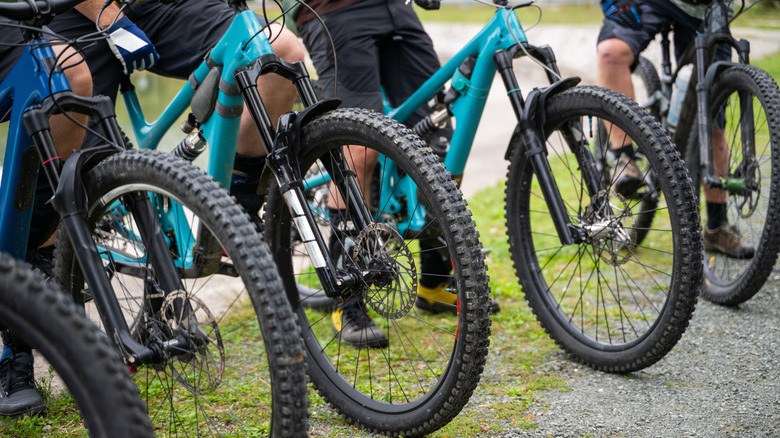
Why, yes, shred-head person, we see you. There are, in fact, e-bike-specific mountain bike tires that comply with E-50 designations. Brands like Kenda, Maxxis, and Schwalbe all feature tires meant to fly at up to 50 kph (31 mph).
And if you're wondering why that high-speed rating might be needed for an off-road tire, even if electric assist cuts off way before that, there's this force called gravity. So if you bike in the mountains, and use a battery and motor to climb up, gravity can tug you downhill much faster, no motor required. And just for context, we are not talking about a mountain bike held together by springs, which is definitely not built to exceed 30 mph.
Don't worry. If you have no intention of flying at 30 mph (or faster), there are also E-25 mountain bike tires meant for pedaling at a saner pace. And there are E-50 tires that aren't slicks meant exclusively for pavement, but that instead have a more traction-focused tread. That makes them grippier for a city commuter who also has to ride some converted rail paths to shortcut their route.
Finally, we know what you're thinking: But do I really need special e-bike tires? Which is sort of like asking if you should use water balloons as tires for your car. Yes, you need the right tire for the more rugged duty of riding a heavier, faster e-bike. And you can bet that the Europeans (if not the Americans) passed these rules to protect people from being dumb. Darwin out.