

Here's What The 70/30 Motorcycle Brake Rule Means
Proper braking technique on a motorcycle is something that even veteran riders can get wrong. And a momentary lapse in judgement or a bit of panic could result in poor technique rearing its ugly head, causing you to lock up a tire. Every road, motorcycle, and rider is slightly different, and there's no universal safe-riding technique, but there are some helpful guidelines.
The 70/30 rule is a strong standard practice for applying motorcycle brakes in regular riding situations. The 70/30 rule states that in every braking scenario, the rider should apply both the front and rear brakes for the sake of stability, and it's best to use the brakes in a way that around 70% of your braking force is applied to the front wheel, with the remaining 30% of braking force being applied to the rear.
Because of weight transfer under braking, more weight will be applied to the front tire. As a result, the front brake will be doing the lion's share of the work. Obviously, if you brake hard enough to get the rear wheel to lift off the pavement (a.k.a. a stoppie or an endo), you're decreasing your rear tire traction to zero, and putting all of the work into the front. Having your rear tire leave the ground is sub-optimal at best, so you want to brake hard enough to maximize the work the front wheel is doing without transferring too much weight.
Feeding in some right foot braking to the rear first helps to both stabilize the bike under braking while helping to haul it down from speed. Ironically, because the rear wheel gets lighter under braking anyway, you have to know how much rear brake you can use without locking up the rear and causing a skid.
Learning the dynamics of your bike
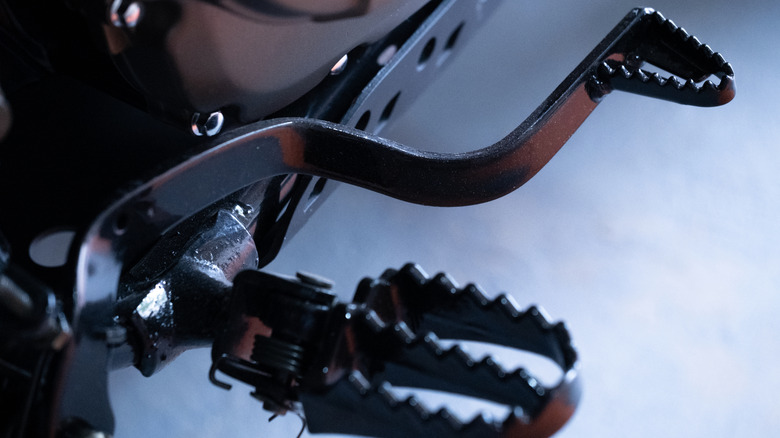
Many riders will eschew the rear brake altogether, arguing that because of weight transfer, it doesn't actually do much. Don't let that squid mentality poison your brain, though, and don't fear using both brakes; they're there for a reason. The rear brake is incredibly important to a proper corner setup and just as important in an emergency stopping situation.
It is necessary to get to know your specific bike, too, and its braking system, and the only way to really learn how it works is to ride a lot and learn how the bike reacts to your inputs. With that experience comes muscle memory, and your body will know what to do in an emergency scenario. The most effective braking happens with a soft initial touch, gradually loading the front tire and modulating pressure on the lever and foot brake to slow the bike down. Apply too much brake, and you could go over the handlebars, apply too much rear brake, and your rear tire could skid out. Knowing how much pressure will cause either scenario will make riding a lot safer.
There are certainly scenarios where the 70/30 rule shouldn't be followed, including low-grip situations like rainy day riding or dirt-strewn roads, or irregularly weighted bikes, like when you're carrying a large load or a passenger. The rear brakes can also be used by themselves, for example, after you've leaned into a corner to correct your line and slow you down (if your bike doesn't have corner-sensitive ABS, use this method with excessive caution). But learning to ride in those situations should come after learning how to safely apply the brakes in a straight line, without overwhelming either the front or rear tire. Practice using both brakes, in wide-open parking lots or in rider training classes first; that way, you learn how to get the maximum effectiveness from your brakes before an emergency pops up.