

How The Two-Door Chevy Tahoe Took The Blazer's Place
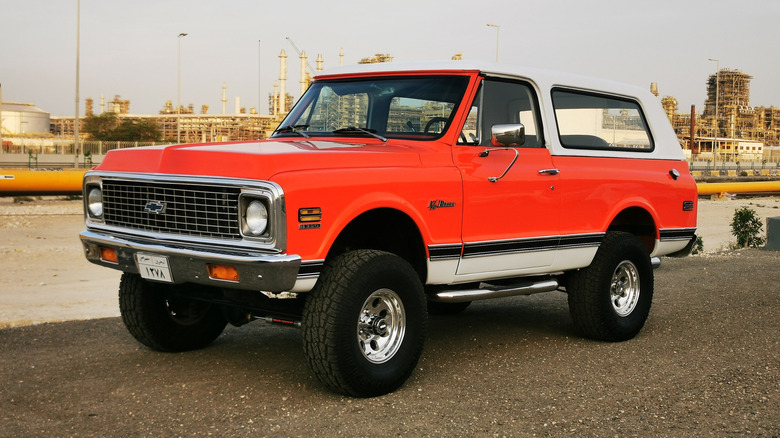
For years, the K5 Blazer was Chevrolet's only full-size two-door SUV. That was until 1994, when GM quietly introduced something new. The Chevrolet Tahoe wasn't a direct successor in name, but its arrival marked a deliberate repositioning of how Chevy organized its SUV lineup and has paid the company dividends.
The body-on-frame K5 Blazer arrived for the 1969 model year to compete with the International Harvester Scout and Ford Bronco. Across two generations, the K5 was offered with a wide range of V8 engines, 4WD and RWD — featuring a solid front axle for 4WD models — and throttle-body injected power by the late 1980s.
After just a decade, the Blazer's sales began to show weaknesses with the 1979 energy crisis dampening desire for big-body, V8 SUVs. By the 1980s and into the early 1990s, the SUV segment had rapidly expanded, and GM needed to clarify its product strategy. In 1994, the full-size K5 Blazer had quietly ended production.
For 1995, Chevrolet introduced the Tahoe on the legendary GMT400 platform — sharing the same underpinnings as the new-gen C/K pickups. Effectively the successor to the K5 Blazer nameplate, the Tahoe was poised as a straightened-out offering for a modern SUV market. It came with a two- or four-door configuration, with the two-door riding a 111.5-inch wheelbase and the four-door stretching six inches longer. The shorter two-door carried on the K5 Blazer's spirit — compact enough to be agile while still capable enough for towing and trails.
Why the Tahoe ultimately won out
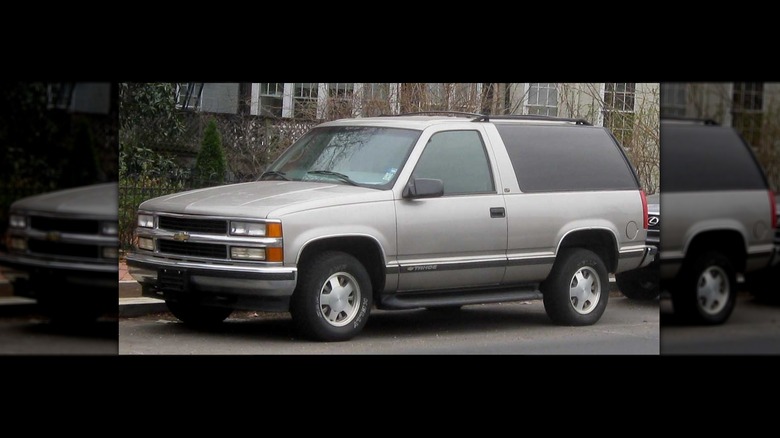
GM had a clear-cut strategy for their lineup, starting with the Tahoe. Their new full-sized SUV would serve the two-row market. At the same time, the long-running Suburban covered three-row buyers while sharing the same drivetrains and chassis. Across the aisle was the GMC Yukon for some added luxury. By splitting the lineup this way, GM addressed what had become a congested product structure with overlapping vehicles.
The Tahoe brought the Blazer's truck DNA forward, but with a more modern presentation. The 1996 upgrade to the well-known Vortec 5.7 V8 — with its sequential fuel injection, roller cam, and high-flow heads — delivered 255 horsepower and 330 lb-ft of torque, a meaningful step up from the outgoing TBI motor producing 200 horsepower and 310 lb-ft of torque. The GMT400 dashboard was more refined, crash protection improved substantially with a standard driver airbag from launch, and OBD-II electronics arrived for 1996.
What the Blazer had been for truck buyers — the capable, full-size two-door SUV — the Tahoe became. The two-door in particular drew a direct line back to the K5: shorter wheelbase, better breakover angle, and the same basic appeal of a truck-derived SUV that didn't require a second row of doors to justify its existence.
The Blazer name didn't disappear all at once. After the K5's departure, Chevrolet would still sell their mid-sized S-10-based Blazer that they rolled out in 1983 until the name entirely went away in 2005. However, the Blazer name continues to show up — most recently as an EV — with its full-size SUV pedigree now in GM's rearview.