

Semi-Truck Vs Full Truck: What's The Difference?
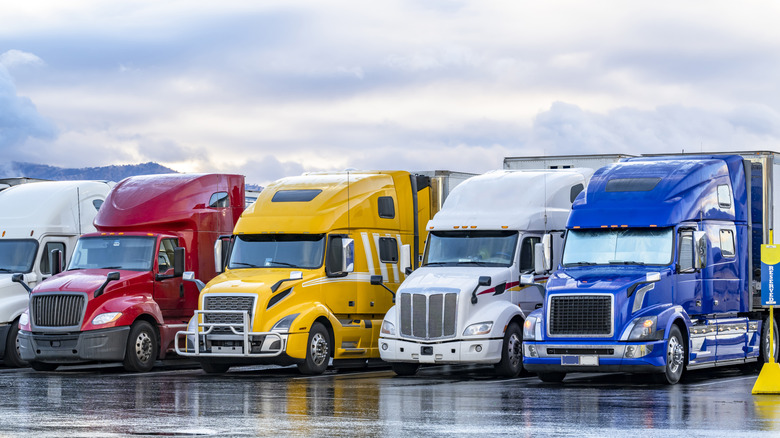
Today's answer is relatively simple, but the reasoning behind it is more complex. After all, the basic differences between semi-trucks and full trucks — aka box trucks or straight trucks — are their cargo-carrying configurations: The former is engineered to pull cargo loaded inside or onto a detachable, completely separate trailer, while the latter is a vehicle with its cargo space integrated onto the same frame as the rest of the truck.
One of the reasons folks can confuse the two is that the word "semi" here doesn't actually apply to the word "truck." The history of the expression is as follows: Alexander Winton, head of the Winton Motor Carriage Company in Cleveland, began selling cars in 1898 — just before basically creating international motorsports. But he quickly ran into a problem in getting the completed vehicles from his factory to his customers without wear and tear. His solution was to develop a two-wheeled trailer he could attach to one of his "regular" cars. It was this two-part invention, attaching the trailer to a tow vehicle, that's considered the world's first semi-truck. It wasn't called that at the time, though.
When August Charles Fruehauf created a similar type of trailer in 1914, for the same kind of use, he coined the term "semi-trailer" because the unit was only partially supported by the towing vehicle. It had two rear wheels but no axle at the front, where it was attached to the tow car. This designation eventually shifted to just "semi-truck," which is how we got to where we are today. Of course, that only semi explains the difference.
Which are better at hauling cargo, semi trucks or full trucks?
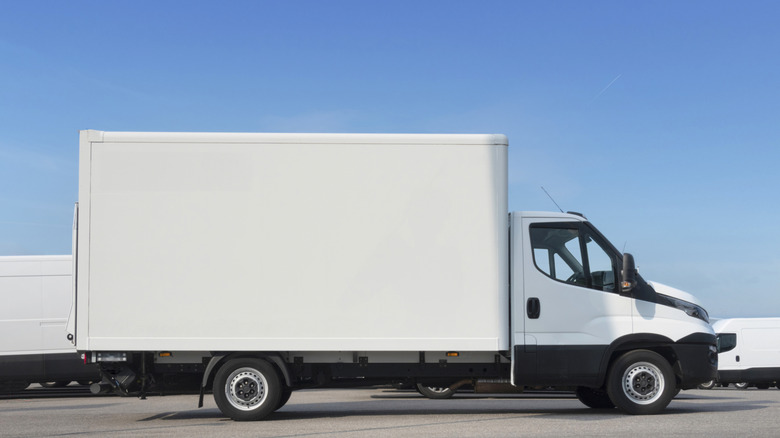
This is where we get to a more practical comparison between the two, starting with the fact that, generally speaking, semis can carry more cargo than box trucks — partly due to their dimensions. Now, the legal length of full trucks is regulated by individual states, but they're generally limited to approximately 40 feet. Moreover, even the biggest are usually categorized only as Class 7 trucks, meaning they have gross vehicle weight ratings (GVWR) that max out at 33,000 pounds. Semis, on the other hand, are allowed to be longer, with states allowing semi-trailers to be in the range of 48 feet to 59 feet and six inches. In contrast, Class 8 machines, which commonly include semi-trucks, allow for a GVWR exceeding 33,000 pounds, and many qualify to carry a gross combined weight rating of up to 80,000 pounds with the trailer included.
Straight trucks can be a better choice where size matters in the opposite direction, like for local deliveries on surface streets where smaller dimensions and tighter turning radius are beneficial. Full trucks can also be less expensive to purchase and maintain than larger, often more complex semis. Further, you don't necessarily need a special license to drive a full truck. Much as with RVs, you can skip getting a CDL provided the truck's GVWR is below 26,000 pounds.