

Ranking All 5 Current Production Minivans According To Which One Is Fastest
There have been some exceptions — from the V10-powered Renault Espace F1 to the various DIY models designed to conquer the quarter-mile — but minivans are not generally known for speed. Yet the rising tide of increasing horsepower over the years has reached the minivan fleet, too. For some context, the 1984 Plymouth Voyager that helped launch the modern minivan segment debuted with two engines: the standard 2.2-liter inline-4 made 101 horsepower and the optional 2.6-liter mill that raised the bar all the way to 104 hp. That upsized engine could propel the Voyager to 94 mph, with a 0-60 mph time of 14 seconds.
Today's fastest minivans can provide more than three times that horsepower and sprint to 60 mph in less than half that time. Top speed tells you how fast it can go, and the short story here is that all five of the minivans currently on sale in the U.S. and globally can reach a higher top speed than the Voyager. These include the new Chrysler Pacifica, Honda Odyssey, Kia Carnival, Toyota Sienna, and Volkswagen ID.Buzz.
A couple of disclaimers before we begin: Technically, Volkswagen doesn't sell the ID.Buzz in America for 2026, but there are still 2025s available, and Volkswagen has confirmed it will bring the electric minivan back this year as a 2027 model. For this comparison, we'll be ranking these new minivans by top speed, from slowest to fastest. And for the sake of consistency, all real-world performance figures were borrowed from Car and Driver testing.
2027 Volkswagen ID.Buzz: 101 mph
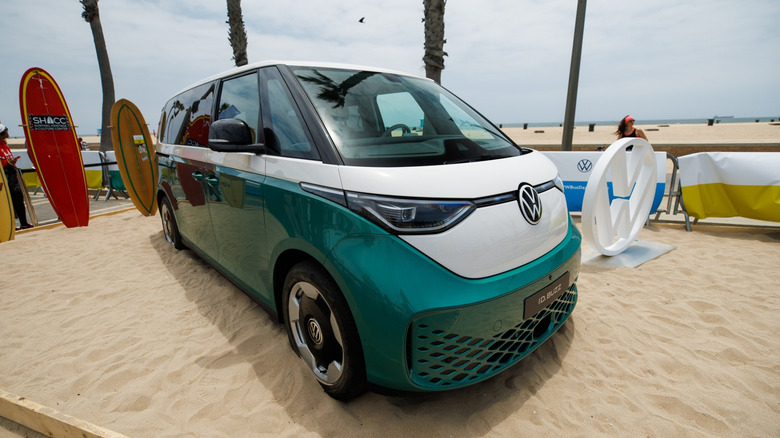
The Volkswagen ID.Buzz has yet to live up to its potential, but VW hasn't entirely given up on selling its all-electric minivan to U.S. buyers. In fact, the automaker has confirmed the 2027 model is on its way with a variety of tech upgrades, including Tesla Supercharger compatibility and ChatGPT integration. Our advice? Don't trust AI for car repair advice, or well, anything. Now, not much is expected to change with the ID.Buzz's powertrain, so it's almost certain to remain the slowest minivan in America. The 2025 version had its maximum speed capped at 101 mph in both rear- (RWD) and all-wheel-drive (AWD) configurations, and that's despite a fairly large difference in the models' output ratings. The single electric motor in the RWD ID.Buzz can belt out 282 hp, with AWD versions raising the bar to 335 horses with some help from their second motor.
Where the extra ponies show their stuff is when the ID.Buzz is galloping to 60 mph. The rear-motor-only edition lowers the benchmark to 6.7 seconds, trailing only the Honda Odyssey and the dual-motor ID.Buzz is legitimately quick — it can race to 60 mph in 5.5 seconds, edging out Volkswagen's GTI hot hatch by 0.1 seconds. Note that Volkswagen has been a little cagey about when the 2027 ID.Buzz will return to our shores. Some members of the 2027 VW family are expected to start reaching dealerships in August, but it could be until early next year before the entire 2027 roster arrives.
2026 Chrysler Pacifica: 111 mph
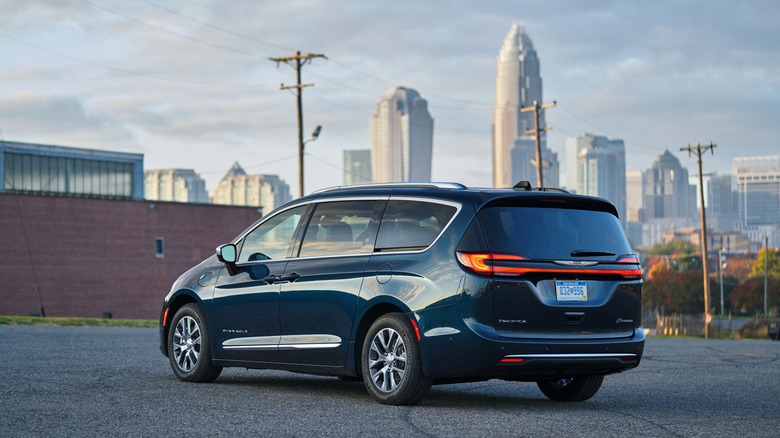
Working our way down the list, we'll kick things off with the slowest gas-powered minivan money can buy: the 2026 Chrysler Pacifica Plug-in Hybrid. It's motivated by a 3.6-liter V6 and a pair of electric motors, and when you put them all together, you get a combined output of 260 hp. Unfortunately, you also get a curb weight north of 5,000 pounds, meaning those ponies have to push a lot of metal around. This no doubt helps explain why Chrysler limited the Pacifica plug-in to a top speed of 106 mph. Besides, the real selling point is the minivan's ability to supply an EPA-certified 32 miles of all-electric, zero-emissions range when fully charged. Use that up, and the Pacifica operates as a traditional hybrid that can score 30 mpg combined.
The plug-in model builds on those benefits by being a tick quicker to 60 than its non-hybrid sibling -– the former gets there in 7.8 seconds, and the latter in 7.9. On the other hand, the non-hybrid does get the edge in top speed. It will reach 111 mph before the engine's governor kicks in –- albeit with EPA fuel-economy grades of 18 mpg city/25 mpg highway/21 mpg combined. And while the Pacifica isn't the freshest face in the segment, it's actually getting a refresh for 2027, even if the core of the van remains pretty much unchanged from its debut a decade ago.
2026 Honda Odyssey: 111 mph
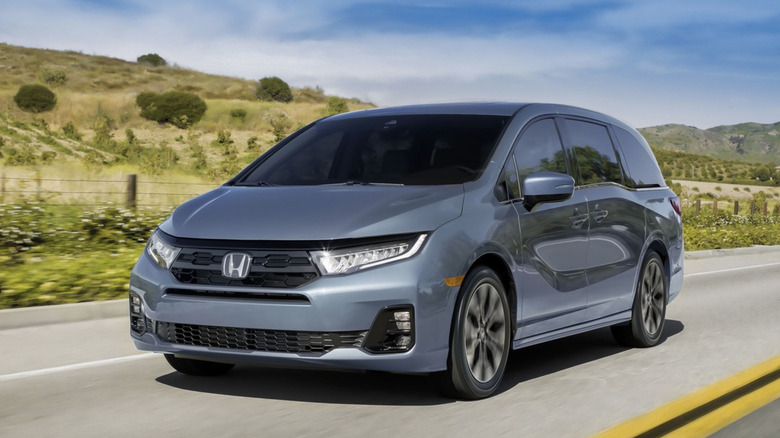
It seems the current Honda Odyssey — part of a generation that premiered for 2018 — will not be getting a redesign until the 2030s. On the other hand, even though Honda isn't exactly rushing the next-gen model to dealerships, the current version takes an impressively brisk approach to reaching 60 mph. The Odyssey can get the job done in 6.4 seconds, backed by a 3.5-liter V6 good for 280 hp, making it quicker than the "sporty" Honda Prelude — which we said felt underbaked anyway — and the Civic Si.
Needless to say, those numbers make the Odyssey by far the quickest gas-powered minivan here. So it may come as a surprise to discover that Honda didn't put quite the same focus on going faster. The top speed of the stylish people mover is capped at 111 mph. Oh, and in case you're curious, the Odyssey's engine does feature one of Honda's legendary VTEC valvetrain setups. That initialism stands for Variable Valve Timing and Lift Electronic Control, and the system essentially allows an engine to enjoy increased power and fuel-efficiency at the same time. Getting down to the nitty-gritty on the efficiency side of the equation, the Odyssey's EPA line of 19/28/22 is comparable to the Chrysler Pacifica's and the 18/25/21 ratings for the Kia Carnival — the only two rival minivans available with V6 engines.
2026 Toyota Sienna: 117 mph
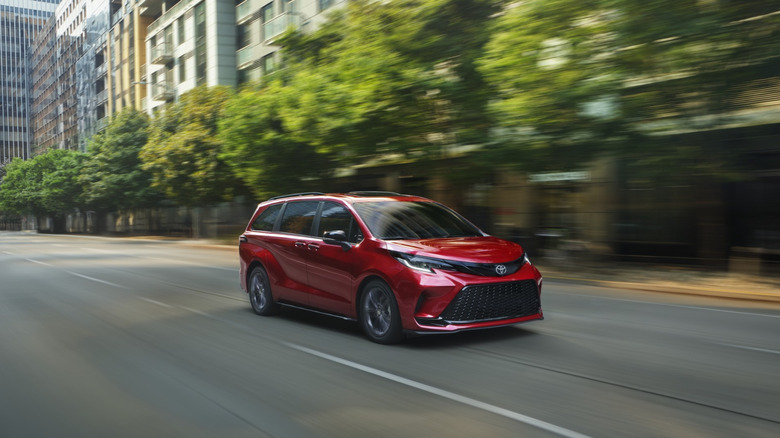
Coming in at No. 2 on the list is the 2026 Toyota Sienna, although it's Japan's fastest hybrid minivan — with its top speed governed at 117 mph. The all-wheel-drive Sienna accomplishes that by relying on a 2.5-liter four-cylinder engine with front and rear electric motors to deliver a combined 245 horsepower. Interestingly, previous-generation models from when the Sienna offered a 296-horsepower 3.5-liter V6 were limited to 114 mph. The 2018 V6 version was quicker, however, posting a 7.0-second sprint time versus 7.5 seconds for the new Sienna hybrid.
Of course, as long as we're on the topic of fuel-saving hybrids, we'll further point out that the Sienna tops today's minivans for fuel economy as well. The front-wheel-drive Swagger Wagon earns EPA ratings of 36 mpg in all three testing categories, while the AWD edition is barely off that pace at 35 mpg city/36 mpg highway/35 mpg combined. By contrast, the FWD-only Kia Carnival Hybrid, as we'll see, trails the Toyota by 2 mpg city/5 mpg highway/4 mpg combined. Beyond that blend of speed and efficiency, the Sienna's Woodland trims prove minivans can be rugged, too.
Also, just to be clear — despite the AI slop you may have seen — Toyota has not revealed any plans to build a high-performance GR Sienna. The company unleashed a SEMA-fied Sienna concept back in 2015. No top speed or 0-60 times were released, but the Sienna R-Tuned's extensively modified suspension and limited-slip differential did help it outrun a contemporary Chevrolet Camaro SS at the Willow Springs circuit near Los Angeles.
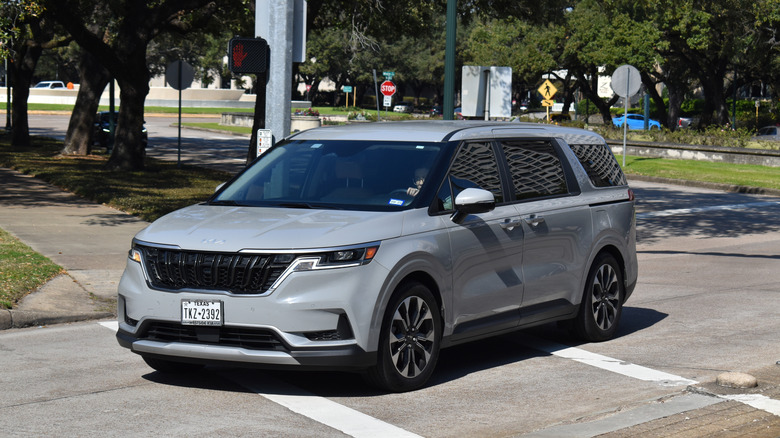
2026 Kia Carnival: 118 mph
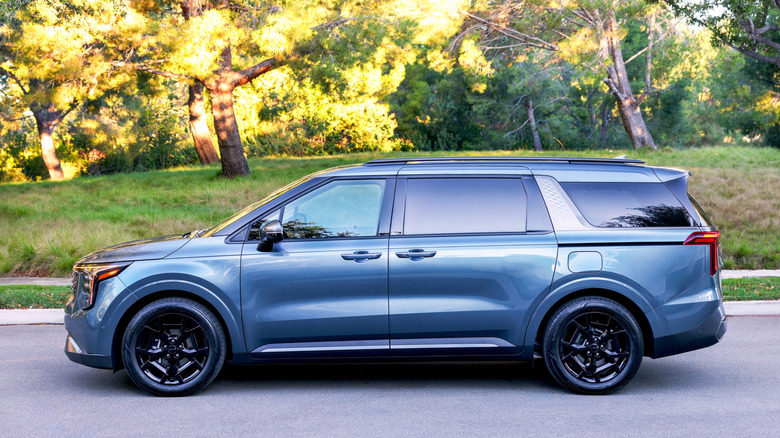
With the Kia Carnival getting a hybrid setup in 2025 — but still keeping its V6 as an option — you've got a pair of powertrain choices for two distinct driving experiences. Fast-moving families are likely to prefer the 3.5-liter V6, since it can serve up 290 horsepower — more than in any other production minivan currently on the market. The engine is paired to an 8-speed automatic for what's also the segment's highest top speed. And while its terminal velocity is again limited by the manufacturer, the Carnival can still hit a respectable 118 mph, and it's quick enough to reach 60 mph in 7.0 seconds on the way there.
That said, you do have to sacrifice some fuel economy to go that fast. After all, the Carnival equipped with the V6 has EPA ratings of 18 mpg city/25 mpg highway/21 mpg combined, while the Carnival hybrid has a fuel-economy line of 34/31/32, respectively. That comes from complementing a turbocharged 1.6-liter 4-cylinder engine with an AC electric motor for a combined 242 horses. When you consider that lowered output versus the non-hybrid Carnival, and the fact that the hybrid is carrying around an extra 300 pounds, the result is unsurprising. With that extra weight, the hybrid Carnival's top speed slips to an estimated 115 mph, and it takes an additional 0.8 seconds to reach 60 mph. As a bonus, the 2026 Kia Carnival hybrid was the top-scoring minivan of the year in Consumer Reports testing.