

The Reason Power Lines Have Orange Balls Is Almost As Interesting As How They Get There
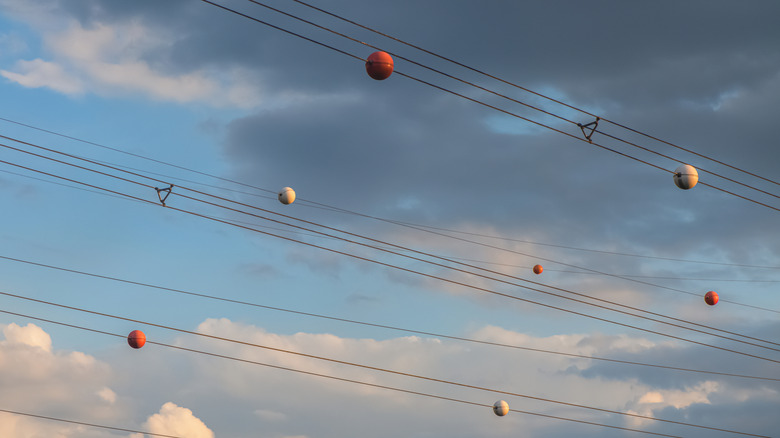
The sun is shining and the open road beckons. So, you pack up your car for a road trip and leave your day-to-day behind in favor of miles of highways, despite expensive fuel prices. Unlike the urban jungle you're accustomed to, your path is lined with soaring towers connected by endless runs of power lines and telecommunications cables. But on certain stretches of your journey, a series of brightly colored balls breaks up the monotony of these gravity-defying lines, turning snaking cables into something of a candied necklace featuring huge, nearly fluorescent spheres.
So, what are these high-voltage kickballs doing suspended on potentially dangerous cables? Well, they're not just there to add a little whimsy to the cold appearance of ceaseless cable arrays. In fact, the way those huge, clamped-on balls find their long-term spots on power lines and communication cables is directly related to why they're up there in the first place. It's all about aviation and safety.
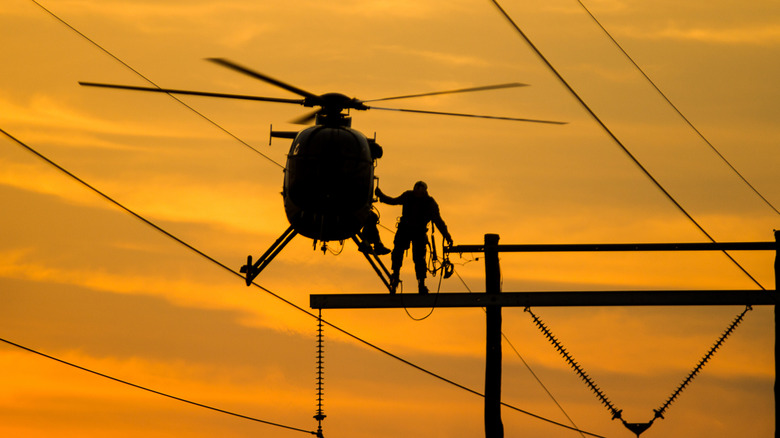
Aviation marker balls are installed by helicopters, for helicopters
Those large beads, clamped onto miles of power and transmission lines, are called aviation marker balls or spherical markers. That said, it's unlikely someone wouldn't understand you when you call it a power line ball. Hopefully, you're observant enough to have spotted them once or twice before — they're typically an eye-catching hue of aviation yellow, orange, or white. Orange is most common because it provides a stark contrast to most natural landscapes. Oh, and they're huge. On average, an aerial marker ball is up to 36 inches in diameter and often weighs between 10 and 25 pounds. They're definitely not for beachball or basketball.
Their purpose? As the name suggests, an aviation marker ball is there to warn small aircraft, such as airplanes and helicopters, of lines in places where pilots may fly low enough to be in danger, like mountain passes and freeways close to airports and airfields. See, power lines may be nearly invisible against terrain from the perspective of a pilot, and, needless to say, a collision with a conductor crossing is a bad day for any size of aircraft. Certainly bad enough to register among the worst air travel experiences.
Here's the thing, though: The transmission structures (the towers) that support the high-voltage lines and telecommunications cables can be 200 feet tall and aren't always easily accessible. You're not likely to use a cherry picker truck to clamp one of these huge markers in place. So, aside from the balls that crews affix as part of the original line installation, the markers often (ironically enough) require a helicopter to install on existing lines. And getting them up there requires some creative flying and handiwork.
A long-lasting (and pricey) warning to pilots
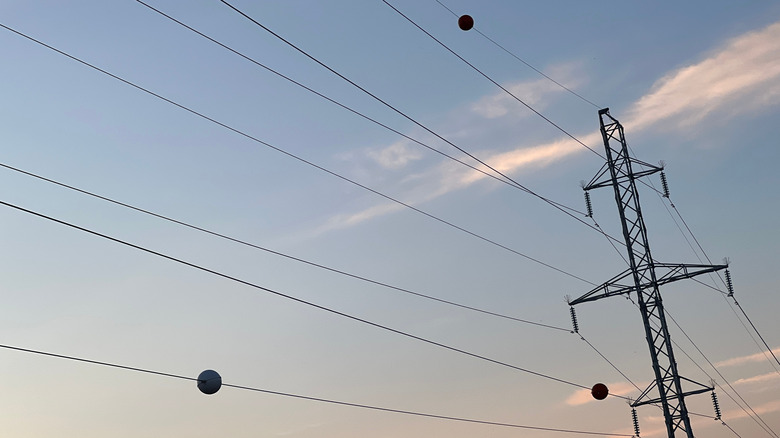
Though it involves a helicopter, qualified installers make it look easy. Each ball is separated into two halves and clamps over a power line at an FAA-mandated interval of around 200 feet. Depending on the application, the installer will use a magnetized drill or wrench to bolt the hinged shell together and wrap spiral wire ties around the conductor without damaging the line. Of course, no one is in the business of precariously flying a helicopter near power lines to install markers more than necessary, so these things need to last.
To make them last, manufacturers keep things simple and weather-resistant. As for materials, most balls are typically stout plastic or fiberglass. You know, the stuff that Corvettes' body panels used to be built of before SMC replaced it. As a result, each ball can last 10 to 15 years. And, thanks to the simple, two-half design, aviation marker balls don't require much maintenance, save for an eventuality where they fade too much to be effective. Still, even with straightforward, no-frills construction, the power line markers aren't cheap. A 24-inch Flight Light JX model in orange, for instance, will set you back $358. That said, you can't really put a price on safe flying.