

According To This Survey, More Americans Need To Learn How To Escape A Sinking Car
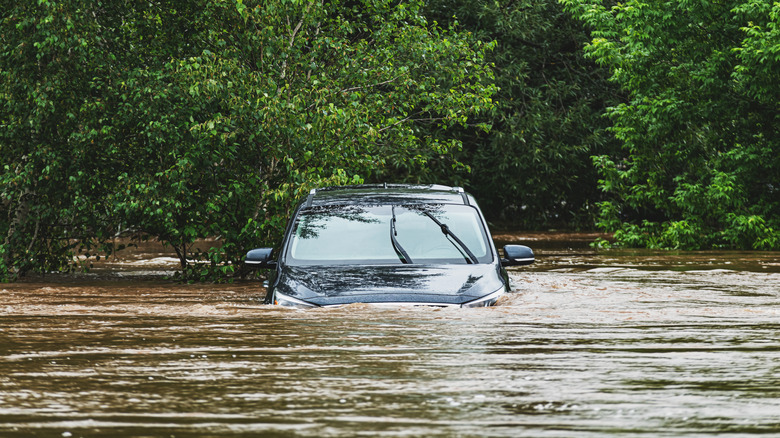
You've seen it in the movies: a car goes careening off a road, cliff, or bridge, and plunges into the water, trapping everyone inside as they desperately try to escape. Do you remember how action stars get out of sinking cars? And do you know how you'd go about escaping if you found yourself in the same situation? According to a 2024 survey by the Cooperative Election Study (CCES), the chances are good that you don't know the safest way of escaping a sinking car — most Americans don't.
The survey asked 1,000 adults nationwide to rate their method of egress and their confidence in their answer and found that only 3% of respondents were both confident and correct. Less than half of those surveyed identified the correct method of escape: through a rear side window. And almost two-thirds of people thought they had more time to figure the problem out than they realistically would.
This indicates a major hole in the country's collective knowledge of how to get out of this dangerous situation. While it might seem like a far-flung occurrence that could never happen to you, it's nevertheless better to be armed with the knowledge of how to successfully escape. After all, one report from the National Highway Traffic Safety Administration (NHTSA) found that 1% of all traffic fatalities in the United States were the result of drownings, and if your Tesla Autopilot can crash into a pond, you should know how to make a hasty exit.
How to successfully escape a sinking car

According to the child vehicle safety advocacy group Kids and Car Safety, deaths from vehicle submersion occur both when a car crashes into a body of water and when one is swept up in flood waters. Vehicular drowning deaths happen quickly, too. From the time a car hits the water, you usually have one minute to act before it's fully submerged. If you're lucky, you'll get just a few more seconds.
Kids and Car Safety recommends using the SWOC method for a successful escape. That acronym stands for: Seat belts off, Window open, Out immediately, Children first. As soon as you can after hitting the water, take your seat belt off and open a rear side window. The rear side window is important because most cars begin sinking nose first thanks to the extra weight from the engine at the front of the car. Opening rear side windows gives you the most time to organize your escape. Ensure that all other passengers have successfully removed their seat belts, and then help any children escape first, from oldest to youngest. This allows older children to assist in getting younger children to safety.
This method of escape is both simple and effective, but the survey conducted by CCES shows that adults are not widely informed about its efficacy. Many respondents still believed the old, deadly myth that you should wait for the car to fill with water before attempting to escape. Do not wait for the car to fill with water then try to open the door. This is imperative. Differential pressure makes car doors nearly impossible to open underwater, but once the pressure has equalized, there's likely not enough time or air to escape.
Wait, didn't Mythbusters cover this?
If you're a Mythbusters fan, maybe you've seen the episode where Adam and Jamie repeatedly submerge themselves inside a car in a pool. If not, it's worth a watch to see exactly how hard it is to open a car door that's even partially submerged. They show that it's possible to wait for pressure to equalize, but it requires being calm and having taken a deep enough breath to wait out the water. That's not really viable if you're caught off-guard or have kids in the car.
The episode also demonstrates that automatic windows continue to function for a surprisingly long time after being submerged, so the SWOC method is reliable even on newer cars. Just don't try to test this out by driving a Cybertruck into a lake, or you might end up in jail. The big takeaway from the episode is that, while the crew were able to escape under controlled circumstances, their methods involved a lot of preparation, forethought, and wherewithal. They might work in a pinch, but it seems much less reliable than the SWOC method that Kids and Car Safety, as well as professional rescue crews, recommend.
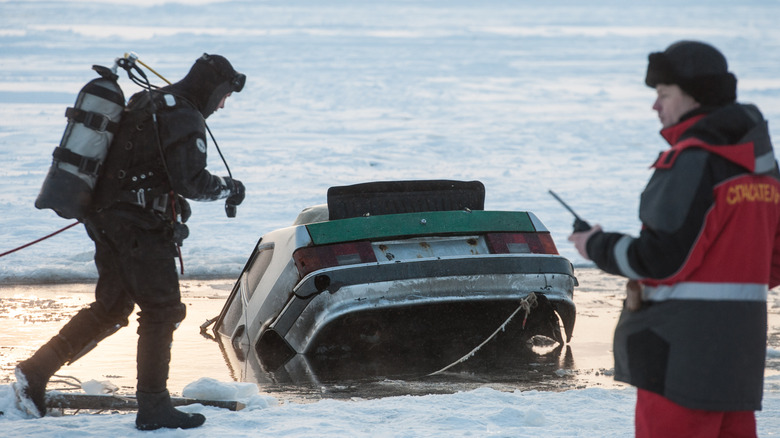
As Amber Rollins points out in the Kids and Car Safety SWOC demonstration, vehicle submersion deaths are devastating. It often takes weeks or months to find sunken vehicles. Sometimes, it takes years, like in the case of the 70s Camaro Z28 found by an underwater drone at the bottom of a Main lake. The best way to avoid this tragedy and all the suffering and uncertainty that comes with it is to prepare yourself with the knowledge of how to escape safely.