

A Guy In Sweden Built An Inline-16 Out Of Volvo Engines And It Sounds Awesome
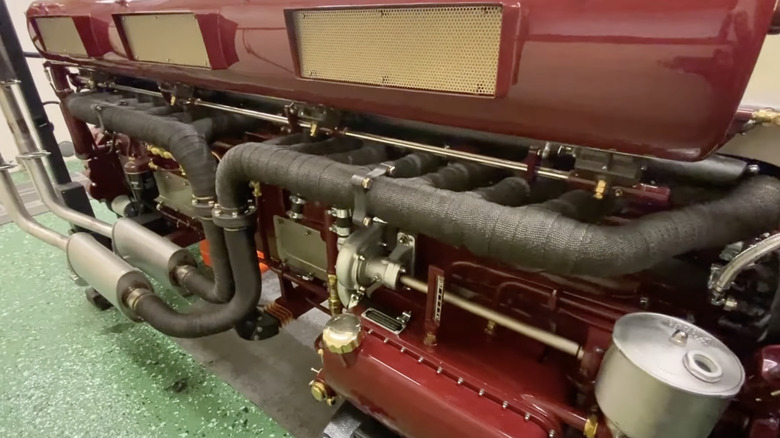
With the Veyron, Bugatti introduced us to the roaring sounds of a quad-turbo W16. Around the time when the Veyron Super Sport was added to the automotive lexicon, somewhere in Sweden, Pelle Söderström decided the world needed another 16-cylinder engine — not in a V or W configuration — but a one-of-a-kind inline-16 with a crank that he jokingly described as a "två meter lång grunka" — Swedish for a "two-meter-long contraption."
What's even more fascinating is that at its core, this 8.1-liter engine — christened the Herkules 1934 — is a clever combination of four Volvo 2.0-liter B20 engines. But before you dismiss this as optimism running on hopes and prayers, realize that Söderström has put a lot of effort into building this engine. It's a well-documented piece of work with a proper workshop manual, albeit in Swedish.
In terms of its engine note, this inline-16 sounds as if several horses are stampeding inside the engine block. There's nothing exotic about the sound, much like the Veyron's, to be fair. Maybe it's the closed space, but from listening to the attached video, you can tell the engine has a loud, industrial tone to it, just like the unrefined sounds of a 90-degree V14.
In hopes of a better sound clip, we've rummaged through Pelle Söderström's YouTube channel and managed to unearth another video of the engine's start-up. Our optimism quickly fizzled out, as the video shows the straight-16 firing away in what can only be described as a lot of noise. Perhaps it's the audio quality that's to blame. In another 54-second clip, however, you can hear the exhaust a bit more and sort of make out the engine's deep and bass-y tone.
An impressive undertaking
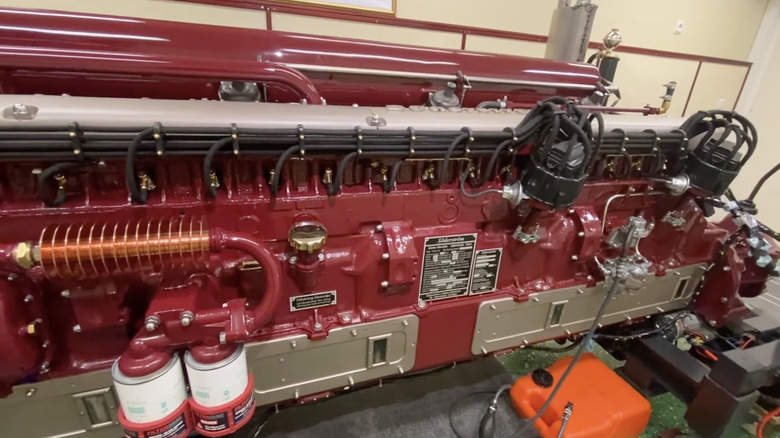
If you're wondering why the engine has 1934 in its name, Söderström believes the idea of an inline-16 would be a very 1930s thing, and it's supposed to sound like a model year. For those interested in following Söderström's footsteps, here's the workshop manual translated to English, albeit with a few missing pages near the end because Google Translate won't do its thing when there are more than 300 pages.
Anyway, going through the many pages, you can tell why building the engine took 13,000 hours. Complexity aside, you might assume having 16 cylinders will lead to eye-popping horsepower figures, and though the early Volvo B20A engines were rated at 90 hp, the math of multiplying it by four is not how things work here. Because of the engine's configuration and the ridiculously long crank, Söderström limits the engine speed to just 3,000 rpm to protect the Triplex chain drives that transmit power to the Muncie SM465 four-speed gearbox. So the Herkules 1934, according to his calculations, puts out 264 horsepower and roughly 500 pound-feet of torque at 2,800 rpm.
In terms of the hardware, all 16 connecting rods are made from forged steel, as is the crankshaft. Pistons are sourced from Mahle, while the camshaft is made of a special cast iron alloy. All the Volvo-sourced blocks and cylinder heads are made of cast iron. Judging by the depth of information and the many calculations involved, it's fair to conclude that the Herkules 1934 is more than a cut-and-shut engine exercise, and the man himself is one talented engineer.