

This Tractor Engine Company Once Powered A Norwegian Racer To 180 MPH Speed Record
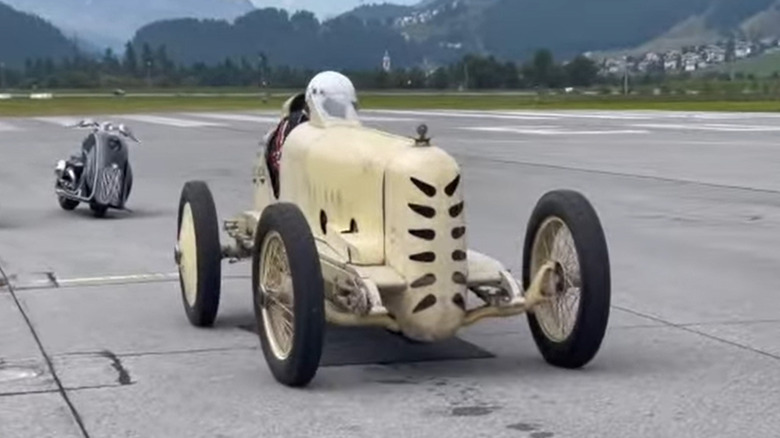
Wisconsin was once the unequivocal home of engine manufacturing, as Milwaukee-built workhorses used to power everything from lawnmowers and go-karts to marine and industrial equipment — all hailing from the cheese-head state. Wisconsin Motor, Kohler, Briggs & Stratton, Case, Allis-Chalmers, Eagle, and over a hundred more hailed from the western shores of Lake Michigan. And while Wisconsin Motor is historically known for its tiny air-cooled single-cylinder engines making under 10 horsepower, the company made its name building big stuff. The Wisconsin T-Head, available in both four- and six-cylinder layouts, was used in a variety of Stutz and Pierce-Arrow cars, heavy-duty trucks, and even aircraft. One such engine found its way into Sig Haughdahl's 1922 Wisconsin Special race car.
Between the World Wars, dozens of speed-obsessed engineers found themselves shoving ever larger engines into touring car chassis, for the express pursuit of speed. Norwegian-born Haughdahl began racing in America around 1912 when he equipped an Indian Motorcycle for ice races in Minnesota. He transferred his sliding skills to four wheels at the tail end of the decade, eventually becoming IMCA dirt track champion six years in a row between 1927 and 1932. As an up-and-comer before his champion status, Haughdahl built the big white monster you see here in an effort to take top speed glory.
According to an account of the car from 2004, the massive 836-cubic-inch inline six was one of just three such engines built by Wisconsin Motor. With a single overhead camshaft and an exposed valvetrain, the engine is certainly a unique one. The alloy cylinders are cast in pairs with cast iron cylinder liners. Each of the cylinders spits its exhaust gases directly out the side through massive four-inch-diameter exhaust tubes. It looks like a demon, goes like the possessed, and sounds like hellfire.
Breaking the land speed record
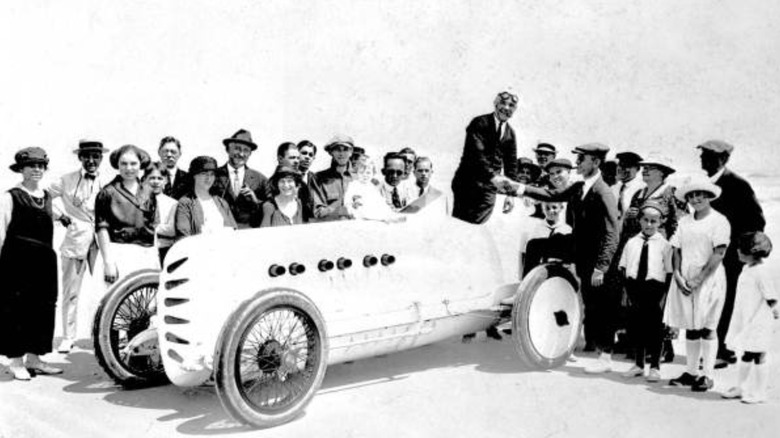
In the early 1920s, the official FIA (then known as the Association Internationale des Automobile Clubs Reconnus) world land speed record was already practically ancient, having been set in 1914 by Lydston Hornsted in the iconic and seemingly unbeatable Blitzen Benz and its enormous 4-cylinder. Hornsted had managed to push the big 200-horsepower machine to 124.09 mph. With backing from promoter J. Alex Sloan, Haughdahl built the Wisconsin Special for the express purpose of taking that record.
The car was named after its most important feature: the 13.7-liter aluminum Wisconsin Airplane six-cylinder engine. It made an incredible 250 hp under the center-hinged hood. Reports indicate the engine was mounted directly to the rear axle, sans transmission. With teardrop openings for a front radiator grille opening and just his head sticking out the top of the driver compartment, Sig set off at Daytona Beach in April of 1922.
Reports of the day say Wisconsin Special tripped the clocks at an incredible 180 mph, smashing the 8-year-old record by over 55 mph. In the above photo, you can see Haughdahl shaking hands with the mayor of Daytona following his successful attempt. From then on, he would call the car the "three miles per minute special."
Not so fast! Because Haughdahl wasn't a member of the AAA, the club of record with the international sanctioning body, his record attempt was disallowed. Just a month later, Kenelm Lee Guinness set the official number at 129.17 mph aboard the massive aerodynamic Sunbeam 350HP at Brooklands in the UK. Guinness and the Sunbeam were recognized by the record books, and history will remember the car that would become the first in a series of land speed racing Blue Birds.
After the record attempt
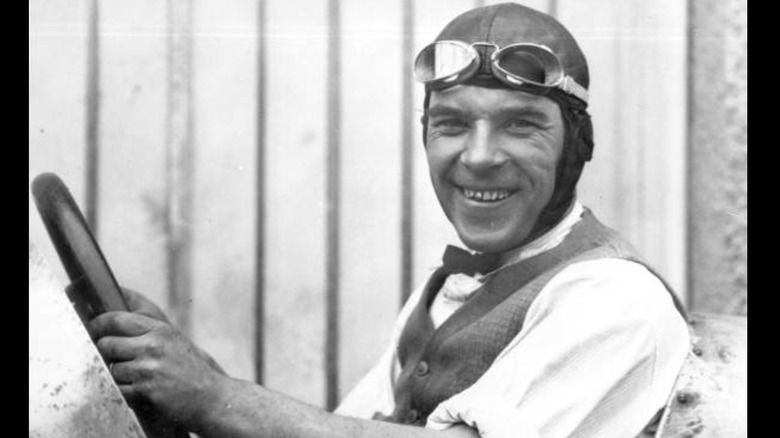
Ever the self-promoter, the "flying Norwegian" became known for his motorsports-themed attractions. After winning his aforementioned "Big Car" (now known as sprint car racing) championships with IMCA, Sig built a rocket-powered car of his own design and travelled the country, showing it off in feats of speed. In the mid-1930s, Haughdahl moved to Florida to live out his post-racing career retirement, and apparently took a serious shine to golf, thanks in part to his love of the Daytona Beach.
While much of North America's speed record community had already begun its mass migration out to the Bonneville Salt Flats where conditions were much more consistent and longer courses could be smoothed out, Sig stuck it out in Florida. The city of Daytona, looking to get the motorsports crowds to return to the beaches, asked Haughdahl to help promote a new endurance race in the city. Teamed up with Millard Conklin and Bill France, Sr., the trio developed a 3.2-mile oval course connecting the beach itself with State Road A1A, drawing thousands of fans. The experience inspired Mr. France to keep promoting racing and eventually found NASCAR.
Over the course of 30 years, Haughdahl was involved in some of the wildest and most impressive automotive feats of the early 20th century. A Norwegian immigrant with motorcycle ice racing, dirt track, and land speed records is rare enough, but to have played a key role in the founding of NASCAR is icing on the cake. When I wish for an interesting life, this is the kind of thing I'm talking about.