

The 4-Gallon Minimum Rule Isn't A Federal Law, But It Still Exists For A Good Reason
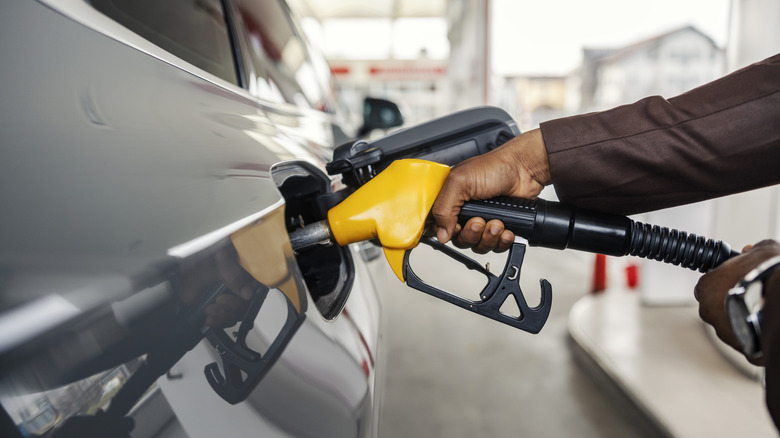
On some gas pumps, you'll find a sticker stating that you must fill up at least 4 gallons of fuel. No, this isn't a scheme to make you buy more fuel than you need. There's actually a very sound reason behind it. The rule only applies to "blender pumps," or pumps that dispense both E10 and E15 fuel. The gas in your car almost always contains ethanol. E10 consists of 90% gasoline and 10% ethanol and is very likely the type of fuel sitting inside your car right now. E15 is — you guessed it — fuel that's 85% gasoline and 15% ethanol. It's typically cheaper than regular E10, but E15 fuel can damage older vehicles featuring fuel systems that weren't designed for it. The Environmental Protection Agency (EPA) states that E15 can only be used in cars from model year 2001 onward.
That right there is also why the four-gallon minimum rule exists. While it's technically not a federal law, it's an EPA safety guideline that says that a customer buying E10 at a blender pump must purchase, at a minimum, 4 gallons. This is so that any residual E15 that was left inside the hose beforehand is diluted and dispensed, reducing the ethanol level in the vehicle and protecting it from damage. Drivers filling up on E15, however, aren't subject to any purchase minimums, and neither are those filling up on E10 with a pump that only dispenses E10.
What's ethanol?
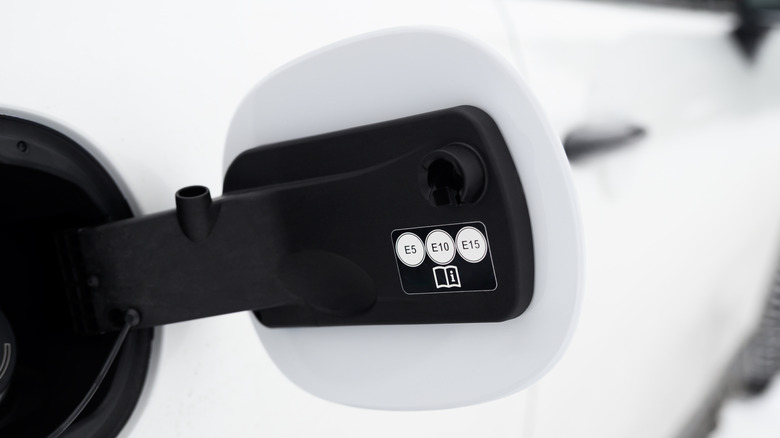
That's most pumps, by the way, and E15 remains a fairly uncommon sight today. According to Newsweek, it's only sold at about 3% of the country's gas stations, and only a subset of those do so with blender pumps — most dispense E15 with its own hose or a whole different pump entirely. So, realistically, many Americans may never even encounter the "four-gallon minimum" rule at all. But why is this even a thing? And what the heck is even ethanol?
Ethanol is a clear, colorless alcohol primarily produced from corn grain. It's higher octane than regular gasoline and is mixed in with 83- and 90-octane gas to produce the 87- and 93-octane stuff we put in our cars. If you put fuel in your car without a high-enough octane rating, it may cause engine knock, damage, and reduce its fuel efficiency. Originally sold as something that would make gas more environmentally friendly and less expensive, Ethanol's presence in America's fuel in any capacity is a bit controversial.
Ethanol is also a powerful solvent that can cause serious damage to the rubber, plastic, and aluminum inside the wrong engine. The EPA, by the way, strictly prohibits the use of E15 in all motorcycles, heavy-duty vehicles such as buses and delivery trucks, boats, snowmobiles, chainsaws, and lawn mowers.
The fuel also made headlines recently after House Republicans pushed to expand E15 sales in response to rising gas prices — despite E15 generally being less efficient. What's more, ethanol's alleged environmental benefits are questionable at best, and having to buy at least 4 gallons of fuel, whether you need it or not, is not a great side effect either. Just watch John Oliver explain how ethanol fuel is a total fraud.