

How Did One Diesel Engine Turn Dodge Trucks Into A Tuning Phenomenon?

The year was 1989. Dodge made a deal with an Indiana-based heavy-duty engine manufacturer named Cummins. They took an engine designed for farm equipment, marine, and commercial machinery and crammed it under the hoods of the Ram light-duty trucks. The engine was the Cummins 5.9-liter inline-six turbo diesel. This engine didn't just save Dodge trucks; it gave birth to an aftermarket tuning subculture. The secret to the 5.9-liter Cummins engine's legendary tuning legacy is simple – it was overbuilt for a pickup truck.
Originally designed as a medium-duty commercial and agricultural powerplant, the 5.9L 6BT arrived in 1989 at Dodge Ram with a massive cast-iron engine block and cylinder head, along with seven main bearings. The Cummins block set a new baseline for diesel longevity, with many engines effortlessly crossing 200,000 miles . In fact, the 5.9L 6BT was part of the Cummins B-Series engine family, which has been around for 40-plus years. The aftermarket quickly caught on that you could push up to 700 horsepower from this engine family without opening the bottom end.
Easy tuning and massive gains
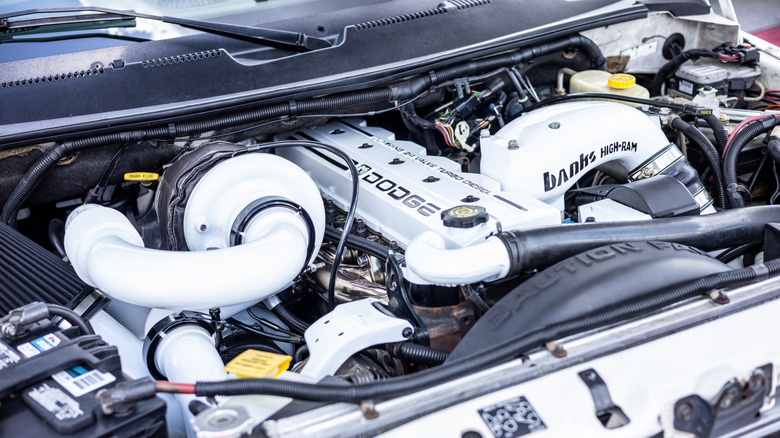
When it debuted, the 5.9 Cummins made modest horsepower at 160 and 400 foot-pounds of torque. However, because it was over-engineered, those stock numbers barely scratched the surface of its structural capability. The factory internals, like the forged steel crankshaft, thick connecting rods, and cast aluminum pistons, were barely fazed by the 160 horsepower output.
Besides robustness, early 12-valve Cummins engines (1989 to 1998) were also easy to tune thanks to the Bosch P7100 fuel injection pump, revered by grease monkeys as the "P-pump". It was a mechanical pump, requiring zero electricity to run. Because it was completely mechanical, you didn't require a laptop, a software license, or an engineering degree to tune it. Just basic hand tools.
Enthusiasts figured out that by pulling the factory fuel plate out of the pump, you could dump massive amounts of fuel into the cylinders. For more revs, install a set of 4,000 rpm governor springs (with recommended heavy-duty 60-lb valve springs) to override the conservative factory redline. Throw in a set of oversized (5×0.016) injectors and a larger aftermarket turbocharger like a BorgWarner S364.5, and you could push a lot of horsepower.
This mechanical simplicity created a culture where you could tune a truck in your driveway without spending a lot on parts. It proved to be so potent that even today, people revere dedicated "P-Pumped" drift trucks, lightweight analog tire slayers that could give a lowered Volvo or a JDM missile a run for its money. This engine also became the foundation for one of the wildest Cummins swaps we've seen.
The digital takeover: electronic common rail and 1,000 horsepower

By mid-1998, tighter emissions laws forced Cummins to leave the purely mechanical way of engine building behind. The 5.9L 6BT engine evolved into a 24-valve ISB5.9, which introduced an electronically controlled fuel injection pump and a four-valve per cylinder head that massively improved air flow and combustion efficiency. The real digital transformation, however, arrived in 2003 with the introduction of a high-pressure common rail fuel system. Instead of a mechanical pump timing each pulse, an incredibly high-pressure stream of diesel (up to 160 MPa or 23,000 PSI) sat in a common rail waiting for the computer-controlled injectors to fire it in the cylinders.
This move also shifted the tuning process from wrenches to keyboards and platforms like EFILive, which opened up a new avenue of tuning precision. Tuners realized that by dividing the tuning process into four key sections – timing, duration, fuel rail pressure, and – they could build trucks that went from being a docile daily to pushing 1,000 horsepower on weekends.
When the 5.9 finally grew into the 6.7 Cummins in mid-2007 to satisfy modern emissions, it brought a 13% increase in displacement, factory common rail pressures up to 180 MPa (or 26,000 PSI), and up to 650 pound-feet of torque in stock trim. However, it was the foundation laid by the 5.9L that led to this. By combining an unkillable heavy-duty industrial block with a fuel system that was shockingly easy to modify, first with hand tools, then with laptops – Cummins accidentally built the ultimate hot-rod engine, and transformed the Dodge Ram from a blue-collar workhorse into a legendary performance platform. Overall, the 5.9 Cummins Dodge Ram is quite a desirable truck, but if you are in the market for one, avoid these years.