

Aston Martin Recalls 7 Valkyries For Rear Brakes That Can Cause A Fire
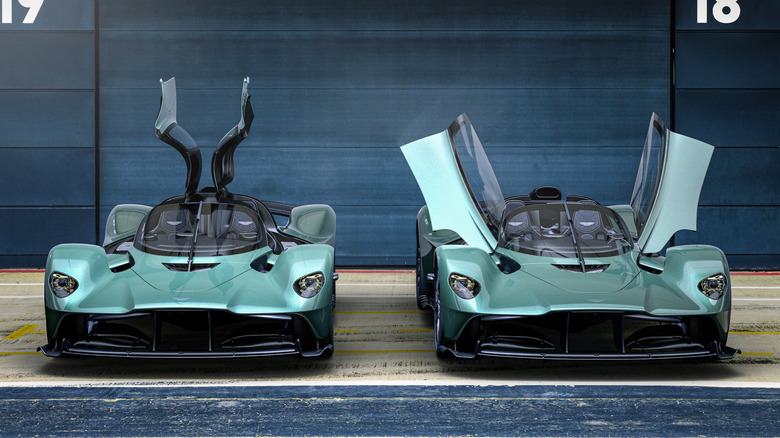
British exotic car manufacturer Aston Martin is voluntarily recalling seven of the 51 Valkyrie hypercars sold in the United States in 2024. It's a complicated issue that originates with the seal of the master brake cylinder, which ultimately could cause the rear brakes to drag and reach a temperature high enough to ignite the resin in the carbon fiber brake cooling duct. That's undoubtedly bad, but the recall specifies that the issue only seems to exist in Valkyries built with the track suspension, and under very, very specific conditions.
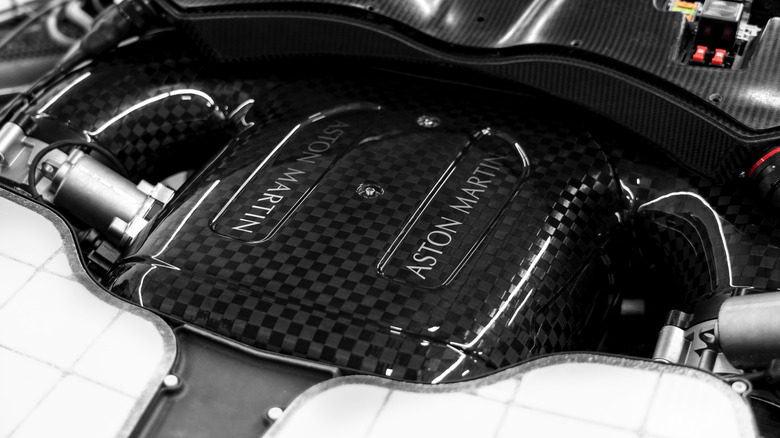
The Valkyrie hybrid hypercar had a base price around $3 million when new, and they're powered by a Cosworth 6.5-liter V12 that makes 1,001 horsepower and 575 lb-ft of torque, paired with a hybrid e-motor that produces 141 hp and 207 lb-ft of torque. Combined, the full powertrain produces 1,139 hp and 682 lb-ft. The issue, as described in the NHTSA Recall Report, states that the fire risk only comes after a series of specific conditions, but these conditions include being "...driven in an aggressive manner...," so if you own one of the seven Valkyries, maybe don't use its entire 1,139-horsepower potential until you've had it checked out by a dealer.
A lot needs to go wrong in order for a fire to occur, but it's not impossible
According to the recall report, the "conditions for this fault will only be met in a track environment and cannot be met when the vehicle is used on the public road due to the body slip angle and speeds required," which is somewhat positive. But that doesn't make the danger of a fire any less intimidating. Gird your loins; there are a lot of specific conditions that need to be met in order to create the fire hazard:
• "The vehicle must be driven in a track environment with the track suspension pack installed • ESP must be set to ESP Sport, ESP Track, or ESP Off.
• The vehicle needs to be in an oversteer "slide" or "drift" state, where it has exceeded a yaw rate and body slip angle threshold.
• The driver needs to be counter steering against the vehicle oversteer condition enough that the ESP has intervened to apply the brake on the front inside wheel. At the same time the front outside brake will build up brake fluid pressure.
• The vehicle needs to be in a state of high lateral acceleration
• The driver must be using the throttle either during or just before brake application so that ESP intervenes on the rear inside wheel.
• As Valkyrie does not have an eDiff or a limited slip differential, brake pressure will be built up to prevent the rear inside wheel from spinning.
• The driver must heavily apply the brake pedal (such as an emergency stop) at the exact moment when both the front and rear brakes of a diagonal brake circuit have been pre-filled due to the ESP interventions. Brake pressure will build when the brakes in a brake circuit are filled by both pedal activation and ESP intervention. The root cause of the fault is that when the brake system was originally designed for Valkyrie, it was not intended to be used with an Electronic Stability Program (ESP) and adjustable Traction Control (TC). As such, the seal design does not allow for controlling the fluid in both an ESP intervention and a brake pedal application at the same time.
If the brake disc temperature is already elevated when the combination of conditions is met and the vehicle is driven in an aggressive manner, this can cause the brake discs to reach a temperature where there is a risk that the resin within the carbon fibre rear brake cooling duct can reach ignition point."
 Aston Martin
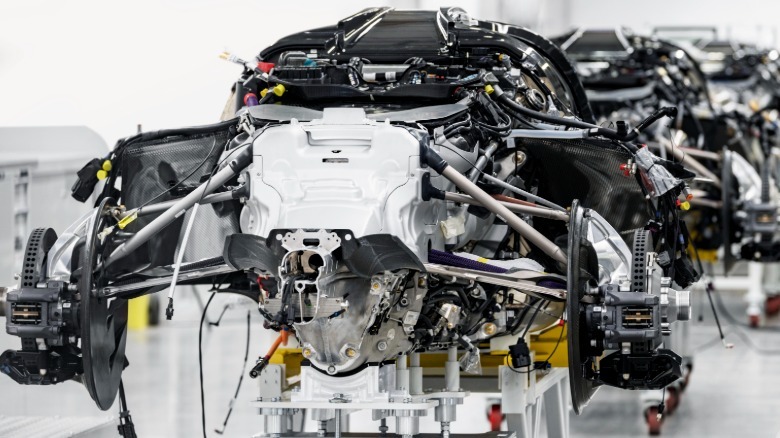
Aston first became aware of this issue in November of 2022, when a prototype Valkyrie experienced the issue, and the root cause was discovered to be the brake master cylinder design's incompatibility with an ESP application, so a new one was designed last year.
In order to correct the problem, Aston will recall all Valkyries with the track suspension and replace the brake master cylinders with a revised design. It will also be included as part of the track suspension pack for owners who want to retrofit their cars. Dealers will be notified by July 23, and owners will be notified in November, but the VINs of affected vehicles should be searchable by June 17.