

TVR's Speed Six Made Almost 100 HP Per Liter (And Was Half Of The Speed Twelve)
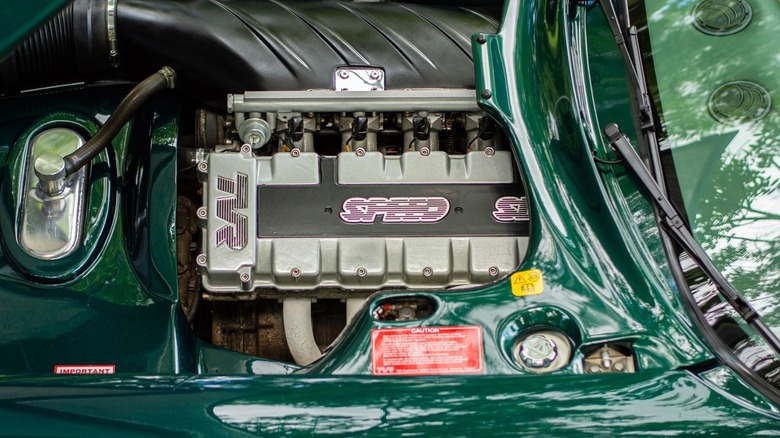
Hailing from Britain, TVR has routinely delivered some of the most visceral sports cars that disregard the status quo for driver assistance and safety. Founded in 1947 by Trevor Wilkinson, TVR spent decades using Rover and Ford engines in its sports cars. TVR was handed off to Peter Wheeler in 1981, and Wheeler eventually wanted the company to pursue something most boutique manufacturers never attempted — building a motor in-house.
TVR's Speed Six is a 24-valve twin-cam inline-six available in 4.0 and later 3.6-liter displacements, using the same piston size across both versions with differing stroke lengths. Each cylinder gets its own throttle body and fuel injector fed through equal-length tubular exhaust manifolds as you'd find in a performance-oriented design. Furthering its race car-for-the-street identity, the Speed Six had an aluminum block with a dry-sump lubrication system, which allowed the engine to be mounted lower in the chassis for improved center of gravity and handling.
In 3.6-liter form, the Speed Six produced 350 horsepower and 290 pound-feet of torque. The 4.0-liter S variant — as fitted to the Tuscan Speed Six S — pushed that to 390 horsepower at 7,000 rpm and 310 lb-ft at 5,250 rpm. Later Mark I Tuscans reached up to 400 horsepower and 315 lb-ft before the facelifted Tuscan Mark II. At 400 hp from 4.0 liters, the engine was producing 100 horsepower per liter — naturally aspirated, without direct injection, in a road car that weighed approximately 2,425 pounds. No ABS. No traction control. Just 400 horsepower in a car as light as Mazda's Miata.
So what happens when you double it
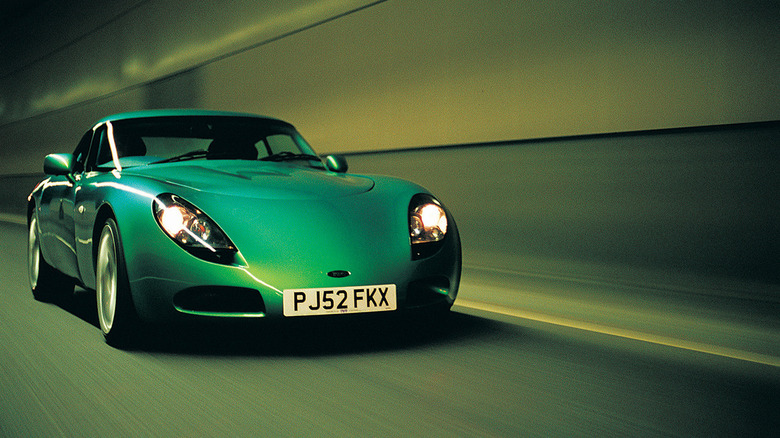
Under Peter Wheeler's leadership, TVR had a strong presence through the 1990s and 2000s. Wheeler wanted to stir TVR into the already diverse Le Mans grid, and his plan required an engine the GT1 class would fear. TVR would develop the Speed Twelve as a 7.7-liter V12 based on Speed Six architecture, effectively combining two six-cylinder designs.
The resulting TVR Speed Twelve was so powerful that it snapped the input shaft on TVR's in-house dynamometer. There's never been a true factory output figure for the Speed 12 since the dyno — rated to handle 1,000 horsepower — was destroyed. Regardless, the Speed 12 had to be limited to 660 horsepower because of class regulations. The Speed Twelve ultimately never made Le Mans. Rule changes rendered it ineligible before it could compete. Nevertheless, TVR attempted to go forward with a production model. Key word attempted.
A popular tale claims that Wheeler drove the road prototype home one evening and returned to the factory sufficiently shaken that he declared it unfit for public sale. This was a man who made a name for himself in creating frighteningly uncontrollable roasters — not to mention he raced in the Tuscan Challenge series.
The remaining road prototype Cerbera Speed 12s would be parted out for racing, with a single, de-tuned road car making its way into a customer's hands. The main culprit behind the Speed 12's concern on the road wasn't the lack of ABS, traction control or even stability control — it was the tires' inability to transfer the engine's power into grip.The high-revving Speed Six, which stayed in production until TVR's closure in 2006, will most likely go down as the greatest engine the company ever produced.