

Is It Dangerous To Drink Water From A Plastic Bottle Left In A Hot Car?
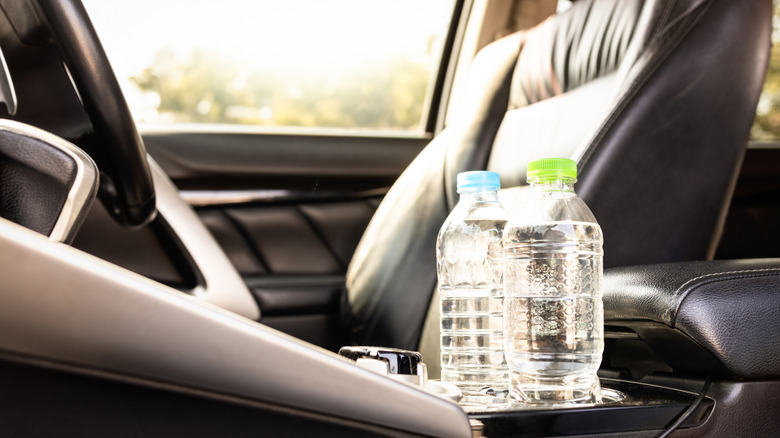
Summertime has come, and with it the need for greater hydration. If you're good at staying hydrated, you're probably accustomed to carrying bottles of water everywhere you go (even though water bottles can start a fire in your car). Drink up — it's good for you. Single-use plastic bottles might not be the best thing for the planet, but as long as people are thirsty there's going to be a company looking to capitalize on that thirst by charging you $1.98 for the privilege.
That bottle of water was nice and cold when you bought it, full to the brim with nice refreshing H2O. Oops, you left it in your car during a hike on an 85-degree day, and now that water is 110 degrees Fahrenheit. You're thirsty from your hike, so maybe it'll be okay to just drink it anyway?
According to the National Weather Service, it doesn't take long for a car interior to tip into dangerously hot territory. On a 90-degree day a car interior can see temperatures over 120 degrees in minutes, and 150 degrees soon afterward. Your bottle of water won't take long to get uncomfortably hot. We've all enjoyed hot water from time to time, usually imbued with a stat-buffing potion derived from tea leaves or coffee bean dust, but should you drink a hot bottle of water that has been left out in the sun? As you might imagine, it depends who you ask.
According to NBC's Today show, the International Bottled Water Association says it's totally fine to drink hot water from a plastic bottle. But plastic waste researchers say heat can help chemicals leach from the plastic into the water, and in turn consume them into your body.
Chemicals in your water: more likely than you think.
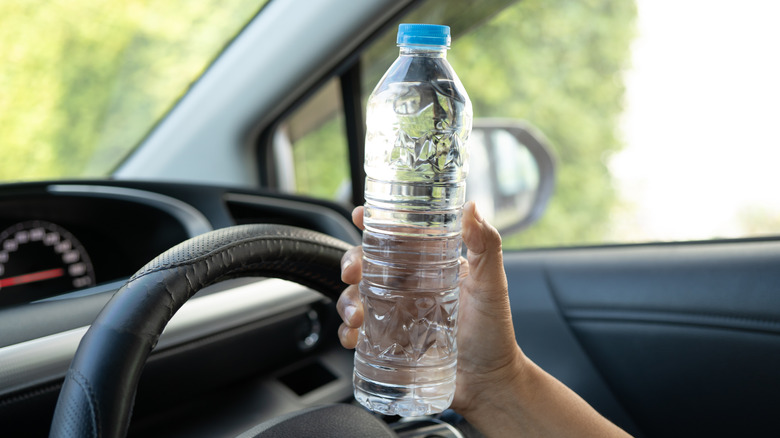
Okay, so what kinds of chemicals are we talking about, and how harmful are they actually? Research has proven that hot plastics can release bisphenol-A (BPA) and antimony.
The biggest cause for concern when it comes to hot plastics leaching chemicals is BPA, a compound used in the creation of plastics and resins since the 1950s. Exposure to it is a concern largely because of the potential for long-term effects in the developing brains and prostate glands of fetuses, infants, and children. BPA has also been linked to behavioral disorders in children, increased blood pressure, type 2 diabetes, and cardiovascular disease. BPA is typically found in polycarbonate or polyvinyl chloride plastic containers (recycling code #7 and #3 respectively).
Fortunately, most water bottles have migrated to polythylene terephthalate (PET, recycling code #1), which is now the global standard for single-use water bottles, and does not contain any BPA. Unfortunately, the potentially carcinogenic chemical antimony can be found in extremely hot bottles of water packaged in PET, according to a 2008 study conducted by Arizona State University.
Experts do emphasize, however, that the trace levels of antimony found in plastic bottles are not cause for concern. Likewise, the U.S. Food and Drug Administration has found the levels of BPA in the American food supply to be well below ones that would raise concerns. Still, it's best to avoid them when you can, particularly if you're pregnant, nursing, or have young children. (And don't use your water bottle to steer your car, or pour that hot water on your frozen windshield.)
How to avoid BPA and antimony in your water completely
Jill Culora, a spokesperson for the International Bottled Water Association, said in a statement reported by the "Today" show:
"Bottled water products that are packaged in PET plastic containers do not contain ingredients capable of producing dangerous substances under conditions of normal use. Claims that plastic bottled water containers stored in warm environments — for example, a hot vehicle — 'leach' unnamed chemicals that cause breast cancer or other maladies are not based in science and are unsubstantiated."
If you're looking to avoid the conversation of BPA and antimony altogether, however, you can switch away from single-use plastics for your hydration needs. Reusable insulated bottles, particularly stainless steel double-walled versions, hold up much better than plastic in hot environments. These still are not invulnerable to adverse health issues, though. Heat creates a great environment for bacteria from your mouth to spread into your water bottle, and when the water sits warm for hours at a time, they can multiply. Drinking that water later could cause you to become ill.
So if you're looking to stay safe, avoid leaving water in a hot car altogether. That said, if you are using an insulated bottle that you thoroughly clean regularly, that's where you're most likely to be in the clear. Glass bottles also don't leach anything into your water, and are infinitely recyclable.
There you have it. Buy glass bottles, use a clean stainless steel bottle, drink your plastic water bottles cold, or drink your BPA and antimony anyway because the FDA says it's probably fine. Whatever method works for you.