

Tiny Engines Require Tiny Turbos, And This Turbo Might Be The Tiniest
We may receive a commission on purchases made from links.
One of the coolest things about internal combustion is it can be scaled up or down. The basics are the same, as long as all specifications match each other, including the correct air/fuel ratio to make the engine run properly. The same methods of boosting horsepower apply, too.
Turbocharging and supercharging can be added to engines that are significantly smaller than those found in conventional passenger vehicles, as long as ignition timing is good and the correct amount of fueling makes it run properly (meaning, not too lean). There are pros and cons to both turbocharging and supercharging, and whether either ends up stressing your engine is another discussion.
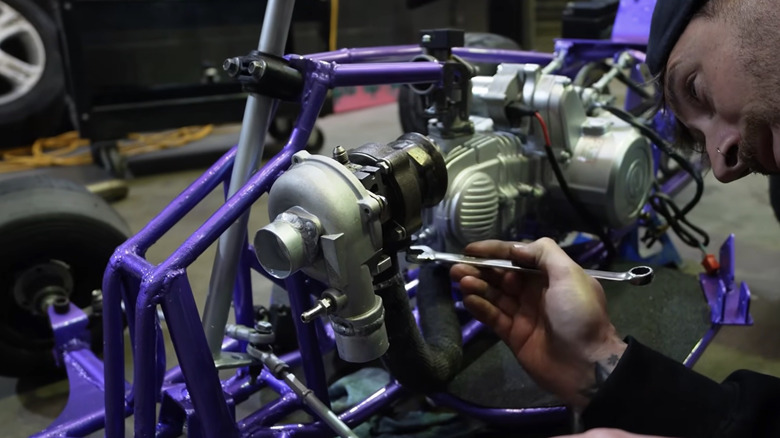
Let's focus particularly on exhaust-driven power increase. Because of scalability, tiny engines require tiny turbos, and this Maxspeedingrods turbo might be the tiniest. For a pretty low cost of entry, it's definitely a prime candidate for anyone's home-brewed forced induction foray. What member of Jalopnik's readership wouldn't be keen on building a turbocharged go-kart?
The tiniest snail
This all came about because we happened upon this cute little turbocharger while surfing the World Wide Web. It's also featured in a hilarious YouTube video.
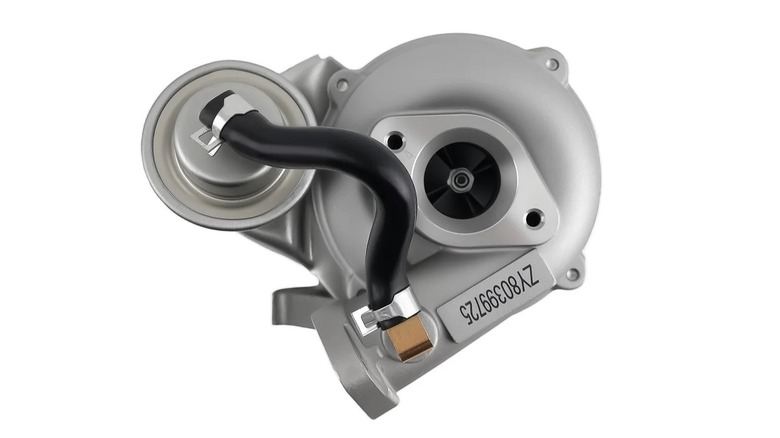
The turbo itself is quite tiny and rated for 500-1000cc engines. It looks to be the same model as a few listed on eBay, and the measurements are, well, cute: 3,400 grams (7.5 pounds) package weight, and the compressor's inducer and exducer (where air first makes contact and then exits through) measure out to 1 and 1.5 inches, respectively. This snail could enable a 23 to 100 horsepower bump, which ain't nothing on a small displacement engine.
It's also oil- and water-cooled, and it features a minuscule wastegate with a vacuum feed plumbed to the cold side outlet. It's good that this feature is present, otherwise it would be much easier to blow up any engine it's fitted to. Once enough boost is present, the turbo wastegate directs exhaust gases away from the exhaust turbine, thus cutting/controlling boost pressure once enough vacuum is present.
This unit is also listed as a replacement for the Suzuki F6A's turbocharger, an engine prominently known as the heart of the Suzuki Cappuccino Kei car. Given the displacement range, this certainly tracks.
But wait, what about boost threshold?
You might've seen the video and read the specs above and thought: wait, isn't that turbo too big for 150 cubic centimeters of displacement?
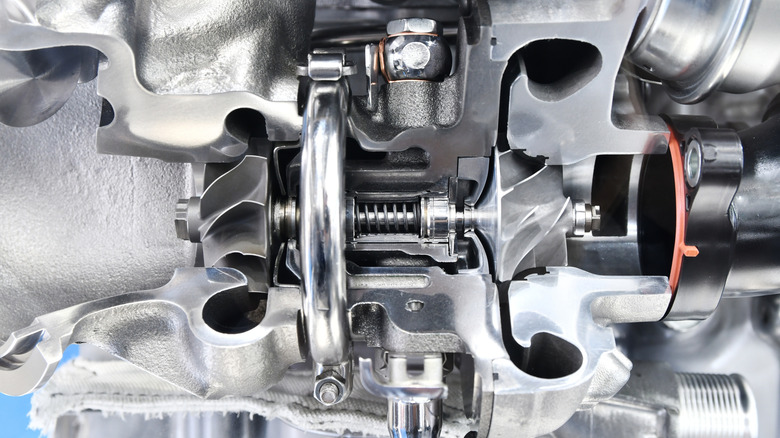
It appears to do the job just fine in the video above. Or maybe YouTuber Mike Lake is just feeling the sole fury of 150 cubic centimeters, and the turbo is solely there as an aural accompaniment. That's because you can't take just any turbocharger and strap it on to any engine. If the turbo is too big, the engine's exhaust flow may not spin (or spool) it fast enough to create boost pressure, as pointed out by Engineering Explained. It may never reach boost threshold. Sorry, it's probably not worth pulling a Borg Warner K03 turbocharger off of a junkyard early 2000s Audi A4 and bolting it up to a Predator engine from Harbor Freight.
Now, an intricate system of having a K03 feed, like, several Predator engines at once... that's worth some mad scientist's attempt. Regardless, any instance of putting tiny turbos on tiny engines is fun to think about, and this lil' scaled down turbo might be the tiniest.