

How Drag Racers Are Running In The Sixes With Manual Transmissions
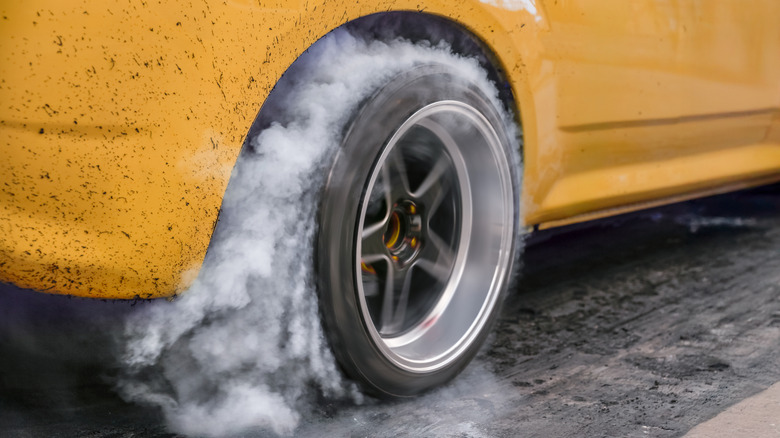
At first glance, going fast in a straight line seems easy — hold the wheel at 12 o'clock and floor it — but professional drag racing is anything but simple, especially in a car equipped with a manual transmission. With an automatic, you simply focus on keeping the car straight while the transmission handles everything, whereas in a stick, torque management and mistimed shifts are no small matter. Scale that up to cars pushing 1,000-plus horsepower on sticky rubber, and what would otherwise be small mishaps can destroy a transmission. So, how are drag racers running in the sixes with a manual? It all comes down to skill, experience, and a few key tricks.
The foundation is controlled clutch slip. Instead of dumping the clutch the moment they leave the start line — one of the easiest ways to damage a manual transmission – this principle allows high-horsepower dragsters to roll onto power as they accelerate. The clutch is designed to slip, absorbing energy and converting it to heat as a means of managing the force applied to the tire. In basic terms, this works as a torque delivery control system. On top of that, drag cars use multi-plate slipper clutches to control the rate of power transfer to the wheels from a standing start, progressively spreading the load from the engine for both durability and precision.
Clutch slips and six-second drag runs
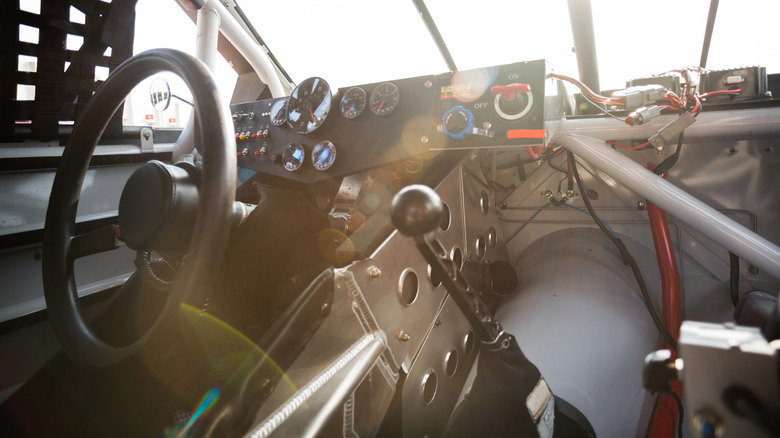
When Joel Grannas of Grannas Racing spoke with Tremec, he noted that his standard diaphragm clutch " caused us a lot of consistency issues," and that after switching to an adjustable clutch, he went from 7.68 to 7.20, 7.00, and 6.90 seconds in under a year in his Tremec-equipped MkIV Supra — the first H-pattern manual car ever to break into the sixes. Jonathan Atkins later set an even more impressive 6.61 at 216 mph, driving the stick shift 'Grubbworm' 1997 Camaro also with an adjustable clutch.
An adjustable clutch allows drag racers to dial in the slip rate between the disc and the flywheel during acceleration, essentially tuning the clutch to deliver power progressively rather than hammering the drivetrain all at once. More RPM leads to weighted clutch components gradually increasing pressure on the discs. The higher the engine is in the rev band, the closer the clutch is to a full lock during the pass. So, when a 2,000-horsepower drag racer launches, it does not push all of its power to the wheels immediately. Instead, with the clutch slipping, the car can leave the line with less than half of that.
With consistent traction, higher RPMs, and more control, the clutch gradually unleashes full engine power to the wheels. On the other hand, since all of that energy isn't able to reach the wheels momentarily, it converts into heat and increases clutch plate wear. It's similar to how a slipper clutch works on a motorcycle, where controlled slip protects the drivetrain on aggressive downshifts.
Different clutch slipping solutions for manual transmission drag cars
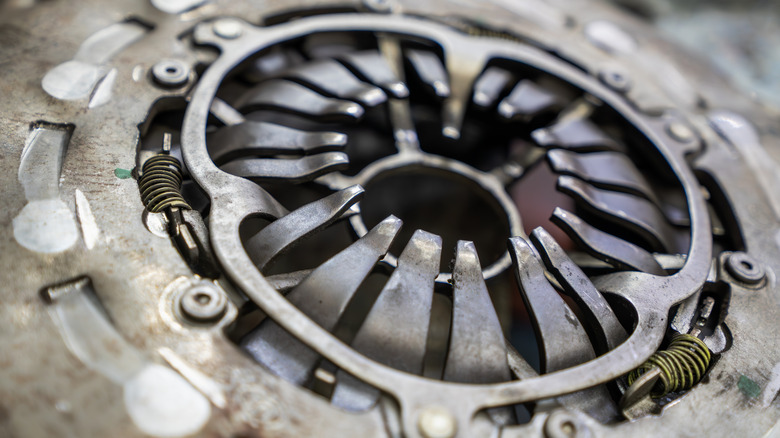
All slipper clutches are designed to slip the clutch. What differs is the method. The most basic is using your left foot to manually modulate the clutch pedal release. It takes practice and plenty of broken drivetrain components along the way. The second is the adjustable clutch covered above. It takes time to dial in the pressure and counterweight settings, but once sorted, it delivers a consistent slip rate every pass.
Many adjustable drag racing clutches also use centrifugal counterweights to progressively increase clamp load as RPM rises. However, unlike conventional centrifugal clutches you can find in a moped, drag racing slipper clutches use a manual clutch assembly with counterweighted pressure plate levers rather than automatic expanding clutch shoes. Finally, the third option includes dedicated slipping devices (slider clutches) that achieve the same result, but without the adjustable element.
Regardless of the mechanical underpinnings, the idea is largely the same — regulating the amount of torque that is being sent to the driven wheels to make sure power is distributed as efficiently as possible. With a greater level of control and a sticky drag strip road surface, this allows stick shift drag racers to be as quick as their automatic counterparts.