

Do You Legally Need To Replace Your Third Brake Light If It Goes Out?

You're cruising home, someone tailgates you at a stoplight, and you think nothing of it. However, somewhere in the back of your mind, a nagging thought creeps in — wasn't there a strange warning light on the dash recently? Something about the rear? Oh! The third brake light is out. You've had two perfectly functional brake lights your whole life, so how important can one extra bulb really be?
It's pretty important, as it turns out — legally speaking. According to the NHTSA, "all passenger cars manufactured on or after September 1, 1985 must be equipped with a center high-mounted stop lamp as original equipment." It is the federal law that made it a requirement for automakers. It is state law that governs the operational aspect when cars are on the road.
In most states, it is required that if a vehicle was originally equipped with a third brake light, it must remain functional and compliant. So, yes, the short answer is: Fix it, or replace it. And with car repairs becoming a lot more expensive, even a simple bulb replacement can sting more than expected. Still, for the rest of us, let's break down exactly what the law actually requires and what to do when your third brake light decides to give up.
Your state, your rule
If your car is registered in Virginia, your third brake light must be mounted as near the vertical centerline of the vehicle as possible, it must meet DOT standards, and it must be activated only in conjunction with the vehicle's brake lights and hazard lights. What's interesting, however, is that police cannot stop you solely for a violation of this section — and if they do, any evidence obtained is inadmissible in court.
In Texas, a broken third brake light can justify a traffic stop. While some legal arguments have claimed the state only requires two functioning brake lights, some Texas courts have upheld stops involving non-working center brake lamps. In practice, cops can and will pull drivers over for a dead third brake light, especially during DWI enforcement, as outlined by the Texas District & County Attorneys Association.
California has been enforcing federal brake light compliance standards for supplemental lamps since 1987. However, California has no mandatory annual vehicle inspection — enforcement is based on officer discretion, and a non-functional third brake light can get you a fix-it ticket. In Pennsylvania, an annual safety inspection is mandatory, and a dead third brake light is grounds for rejection if the car left the factory with one.
According to the NHTSA, "Federal safety standards regulate the manufacture and sale of new motor vehicles" — not what happens after. What happens when the light goes out is your state's problem, and yours — and with not every U.S. state requiring an annual vehicle inspection, enforcement of brake light compliance can vary wildly depending on where you live.
How to replace or repair the third brake light?
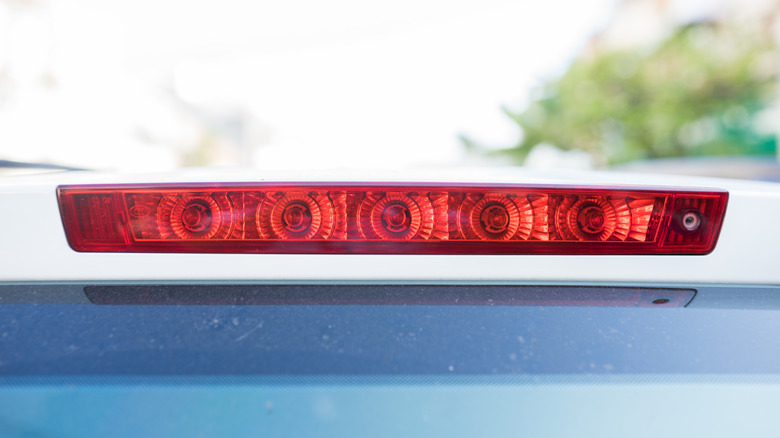
When your third brake light goes out, it isn't just about repairing or replacing it. Since this part of the car is regulated by federal and state law, there are a few things you must keep in mind. First of all, whatever replacement you do end up with, it must be compliant with federal law. You also shouldn't replace it or code it to change its lighting frequencies, meaning that a flashing third brake light could negatively impact other drivers and cause trouble with law enforcement.
You also cannot change the color to any color other than red. In older vehicles with a standard bulb setup, the repair is one of the simpler car maintenance skills that every adult should know, requiring nothing more than a screwdriver and the owner's manual. However, many newer cars use integrated LED modules, meaning the entire assembly must be replaced instead of a simple bulb. Costs can, therefore, vary dramatically, from roughly $5 to $20 for just a bulb or more than $45 for a full LED assembly.
Using non-compliant aftermarket replacements may also create warranty concerns. So, if your car is still under warranty, it's best to skip anything DIY-related and take the car to the dealer. Either way, whenever a federally regulated component needs servicing, leaving it to a professional is the safest way to ensure the job is done correctly and keeps you compliant.