

How AAA's Glidden Tours Proved Early American Cars Could Survive Bad Roads
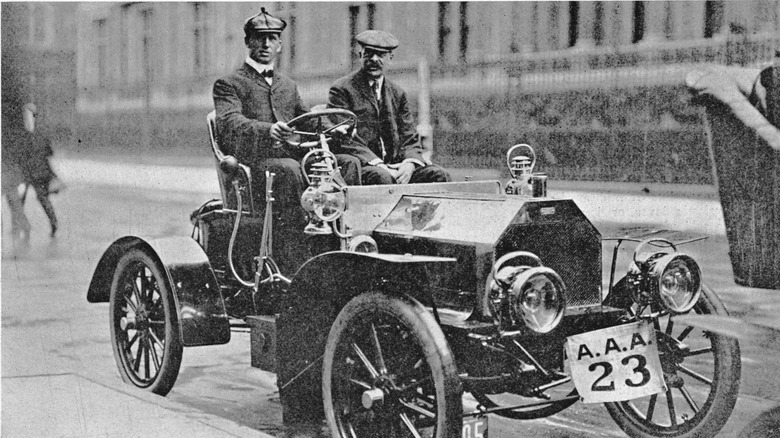
We look at cars today as passion projects or daily drivers, but things were different in the early days. Before Henry Ford became the fastest man on four wheels and went on to revolutionize auto manufacturing with the assembly line, the masses were skeptical about whether the motorized carriage could genuinely replace horses and mules as a primary means of transport.
In 1902, the American Automobile Association (AAA) hatched a plan to promote the reliability of motor cars while showing off their practical benefits over four-legged steeds. But instead of racing, the tour would impose a 20-mph speed limit on open roads, while participants were limited to 15 mph in residential areas.
Remember, this was before many of the oldest highways in America were paved, which also meant the surface was a varied mix of mud, gravel, cobblestones, and dirt. With that said, the tour would also be an opportunity for the AAA to highlight the need for paved roads. The inaugural AAA Tour of 1904 would become a 1,350-mile run from New York to the World's Fair in St. Louis, Missouri. The event took 18 days to complete, with 66 vehicles crossing the finish line out of an original lineup of 77, proving to spectators across the country that motor cars could survive bad roads and were faster, more efficient, and more practical than horses.
The 1904 AAA Tour was supposed to be a one-time event, but Charles J. Glidden begged to differ. Glidden participated in the 1904 race and lobbied the AAA to make it an annual tour. He proposed a $2,000 grand prize for the next event, and the AAA eventually renamed it the Glidden Tour in his honor.
The Glidden Tour became a passion project
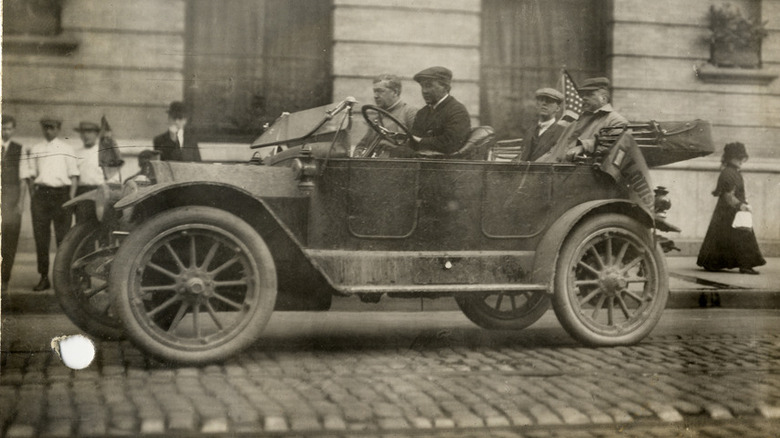
Finishing the event was a huge deal for early automakers like Chalmers-Detroit, Maxwell, Cadillac, Metz, Pierce, and Stevens-Duryea, who would go on to advertise their exploits to sell more cars. But for Charles Glidden, the tour was about highlighting the motor car's potential. He became enamored with cars after amassing wealth in the early telecommunications industry and retiring at 43 years old. Glidden took his car and his wife to the Arctic Circle in 1901, and they went on to repeat that feat while also managing to circumnavigate the globe in 1902. Glidden not only became the first to travel the world in a motor car, but he did it again, all for the love of the automobile.
More than offering a $2,000 grand prize and a trophy to the winner, Glidden did what was expected of a millionaire sponsor. In some cases, he personally paid for road construction and shouldered the toll fees, and he also paid for the farm animals that were unfortunately hit and killed by drivers and participants. The Glidden Tour went on until 1913, having proven to the world that motorized automobiles were as tough, durable, and reliable as the working animals that preceded them.
How Glidden Tour participants made their way around the country
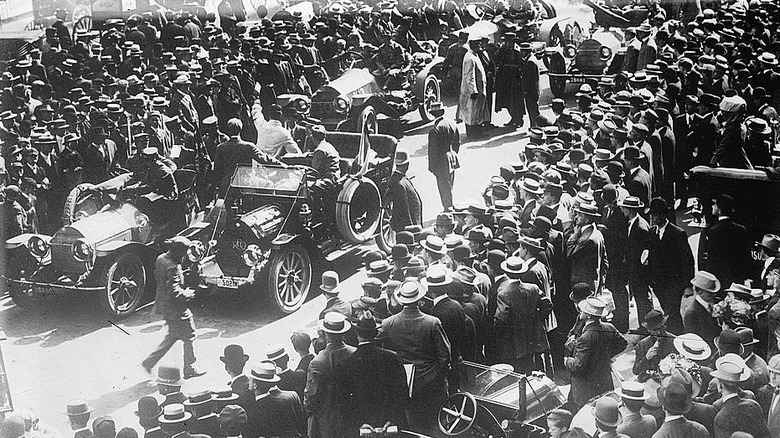
With no highways, exit junctions, signage, or maps to know where you were and where you were heading, the Glidden Tour must have been a fun yet perilous challenge. However, the AAA knew this and had the prerogative to send out pilot cars before the event, marking the routes with confetti and encouraging locals to check out the cars and meet the drivers. The AAA also provided drivers with hotel listings, meal arrangements, entertainment, and overnight lodging for the participating automobiles.
For all intents and purposes, the AAA Glidden Tour was a resounding success, but it didn't go off without a hitch. For instance, according to Moving North Carolina, there were reports of motorists being "held at gunpoint" in Virginia for speeding and killing dogs during the 1911 Glidden Tour. Meanwhile some drivers slept in jail cells during the 1906 event due to the lack of hotels, spending the night with a supposed murderer and a man who beat his wife.
The AAA has since revived the Glidden Tour and has aptly renamed it the Revival AAA Glidden Tour, together with the Vintage Motor Car Club of America (VMCCA) and the Antique Auto Club of America (AACA). Before the inaugural AAA Tour of 1904, it was estimated that only 1 in every 1,000 Americans had a car. But after the tour ended in 1913, the statistics were 1 car for every 35 Americans, which proved that the annual event did its job of showcasing the reliability and roadworthiness of the automobile.