

Here's Why Rocket Launch Trajectories Are Curved Like Bananas
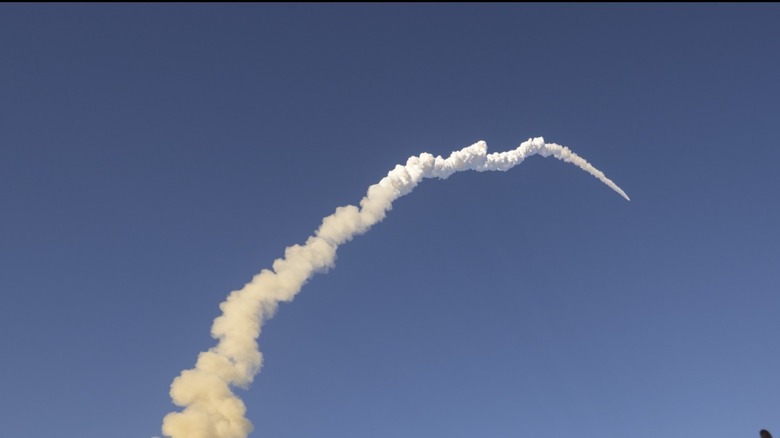
With high-profile orbit launches like the Artemis II mission on everyone's mind and in the news, it's hard not to have caught at least a glimpse of one of these illustrious launches. Curious viewers might notice something unexpected about how these launches are conducted, and those who did will naturally have some questions. Namely, in almost every rocket launch you watch, you'll eventually see a strange bend in the trajectory, as the rocket begins flying sideways.
It's not quite a parabola (remember those from school?) and honestly looks more like... a banana. This odd shape is known as a brachistochrone curve, and it's the most fuel-efficient path to orbit, allowing rockets to load less fuel and achieve a better payload-to-fuel ratio.
If the goal of a rocket launch is simply to put a rocket into space and let it fall back down, then launching the rocket on a linear trajectory is a perfectly fine strategy. In fact, when you see news about billionaires going to space (and littering orbit with space junk), they're usually following a similar flight path, going up and coming right back down again, experiencing a few minutes of weightlessness but never achieving orbit. This is called a suborbital mission.
However, if you're shooting satellites into geosynchronous orbit or sending astronauts to the International Space Station, you need to achieve a stable orbit, which is less about staying still in zero gravity and much more about perpetually falling at just the right angle and matching Earth's gravity. To achieve a stable orbit, a rocket needs to be moving downrange away from Earth at the same rate Earth's gravity pulls it back in.
How rocket trajectories actually work
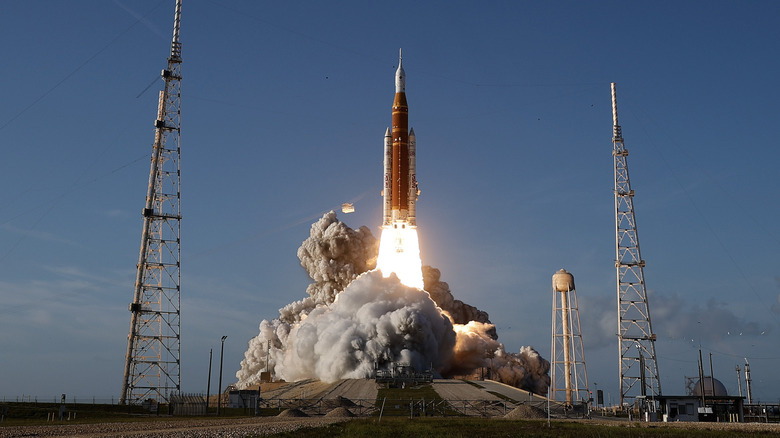
When you see a rocket noticeably begin bending, it's executing what's known as a gravity turn. A gravity turn effectively helps the rocket gain acceleration without using fuel by falling back toward Earth at an angle that keeps it from hitting the ground. The acceleration due to gravity, combined with the acceleration provided by the rocket propellant, helps the rocket reach escape velocity, break through the atmosphere, and enter a stable orbit. It's complicated stuff, but then, space is always complicated. Even making babies in space is going to be hard, someday.
Most orbital launches make a gravity turn toward the east to take advantage of Earth's rotational speed and get a little boost. Earth is always rotating around its axis from west to east at a rate of about 1,037 miles per hour at the equator. Turning in another direction involves overcoming that inertia and expending extra fuel, but gravity-induced turning toward the east allows a rocket to maintain its rotational speed.
The successful launch of NASA's Artemis II mission wasn't conducted from Kennedy Space Center in Cape Canaveral, Florida, just because of history or convenience. NASA launches from Cape Canaveral because it's one of the closest points to the equator in the country. Other major launch sites around the world, such as Starbase in Texas and the Xichang Satellite Launch Center in China, are also closer to the equator, where Earth's rotational speed is the highest. To eke out as much of that 1,000-mph speed boost as possible, a launch needs to take place as close to the equator as possible.