

Here's Why Designing Hybrid Motorcycles Is So Tough
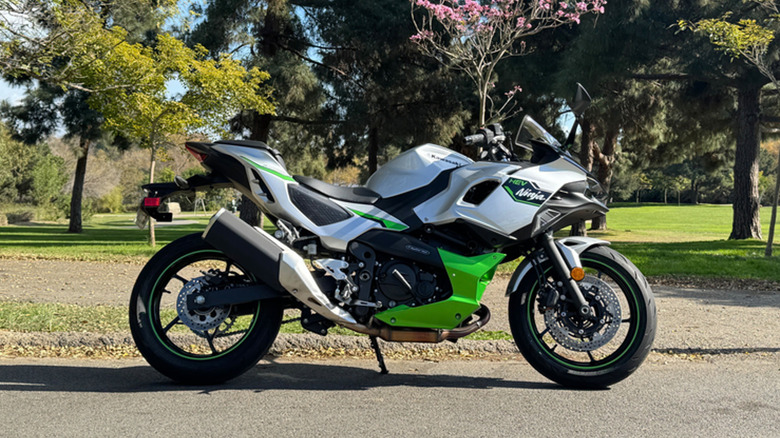
At its core, the concept of a hybrid motorcycle is certainly a compelling one. Motorcycle engines are typically small-displacement, high-revving affairs, which is great for making power in a small package, but they tend to lack the down-low stump-pulling torque you want for off-the-line acceleration. Pairing that high-revving, low-torque, gasoline engine with a compact and efficient electric motor, notorious for making all of its torque from zero RPM, seems like it would make a great combination, and possibly power a bike that brings together the best of both worlds.
Not only could a hybrid motorcycle be potentially easier to launch, but you could also see better fuel economy, improved tailpipe emissions, and longer engine life. Depending on how you deployed the power, a manufacturer could even build a bike with the ability to silently ride through your neighborhood, preventing nasty letters from the HOA and avoiding the ire of neighbors. So why isn't every motorcycle manufacturer on the planet building one?
As it stands, there is really only one mass-produced hybrid motorcycle (not including scooters) on the market in the United States: Kawasaki's Ninja 7 Hybrid (and its naked Z7 Hybrid sibling). When I tested that bike in 2025, I believed that it was really close to being an all-time great motorcycle. It was billed as sipping fuel like a 250cc bike with the acceleration of a liter-bike, and it definitely fit that bill, but it was held back by size, cost, and weight. It featured six extra inches of length and weighted about 120 pounds more than the non-hybrid Ninja 500. It also carried a staggering $6,100 price premium.
So why can't it be done?
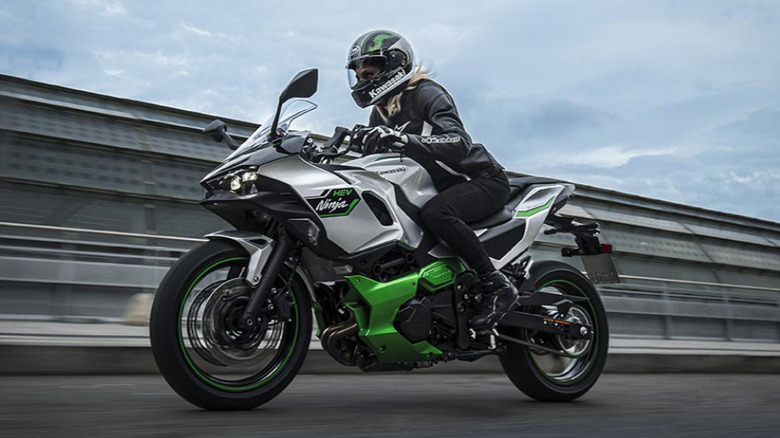
There are three major factors preventing hybrid motorcycles from taking off. The first, and most important, is cost. That six-grand price increase over a Ninja 500 is a hard pill to swallow. There's a benefit to spending it, but most riders would rather buy a second two-wheeler, perhaps even an electric scooter, for around-town commuter riding.
Secondly, most motorcyclists aren't jumping on two wheels for economic or environmental reasons, but even those who are see massive fuel economy jumps compared to cars as is. Pretty much any motorcycle is going to deliver better fuel economy than the average four-wheeled vehicle — even performance motorcycles are often capable of cracking the 50 mph mark.
Third, the added weight and size of the bike certainly make it less appealing than its gas-only counterpart. The extra inches of wheelbase made room for the electric motor to slot in between the engine and the transmission, but it made the bike a little more reticent to carve up a mountain road. Unlike cars, which can take a bit of added mass without completely disrupting the dynamics, motorcycles are much more sensitive to added mass. At 502 pounds, the Ninja 7 just isn't a featherweight sport bike anymore.
There aren't any hybrid motorcycles on the immediate horizon. There are a few designs being teased, and a few more in the works, but so far Kawasaki is the only brand that's made the leap. Without further advancements in battery energy density and compact electric motor design, these machines will likely continue to be tech-focused early-adopter models. With some further development, however, we could see hybrid bikes become the norm in the near future. Toyota's first-generation Prius was a compromised penalty box that required you to prostrate yourself at the altar of green, but a couple of decades later, and the Prius has become pretty much the best car on the market. Maybe soon the Ninja 7 Hybrid will be your next favorite bike, but that likely won't happen until they figure out the pricing, packaging, efficiency, and weight issues.