

This Four-Cylinder Engine Won The Indy 500 27 Times Between 1935 And 1976
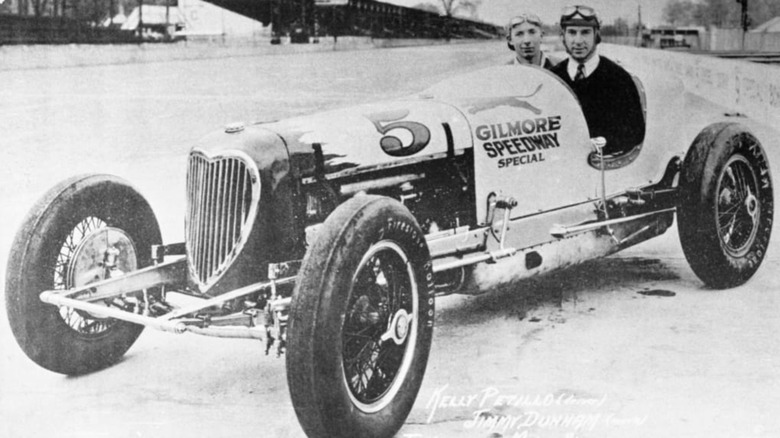
Winning once at the Indy 500, whether as a driver, team owner, machinist, or engineer, is no small feat. It was just the beginning for some of the biggest names in motorsports. Four drivers have won the race four times — A.J. Foyt, Al Unser, Rick Mears, and Helio Castroneves. Roger Penske has 21 victories to his credit, albeit as a team owner who was caught cheating at Le Mans. Penske still has six to go before he catches Fred Offenhauser. Machinist and self-taught engineer, Offenhauser lent his name to a fantastic four-cylinder engine that took the checkered flag 27 times at the greatest spectacle in racing, spanning 1935 to 1976.
Offenhauser started out working for another early performance icon, Harry Miller, sometime in the 1910s, and he was still there when Miller made his own mark at Indy — where cars he designed won five times in the 1920s. Those racers ran with Miller straight-eight engines, but he basically cut one in half to create a powerplant for the American Power Boat Association in the mid-1920s. It was that 151-cubic-inch engine that was the genesis for what is now known as the "Offy."
Miller made several bad business decisions and was forced to liquidate his company in 1933. Offenhauser and a second former Miller employee, Leo Goossen, snapped up both the designs and the tooling for Miller's motors. Offenhauser would put his name on the company in 1934, win his first Indy 500 in 1935, and continue tinkering with the engine design until it displaced a whopping 270 cubic inches in 1937. Offenhauser's motor would make its second trip to Indy's winner's circle the same year.
What made the Offenhauser engine so special?
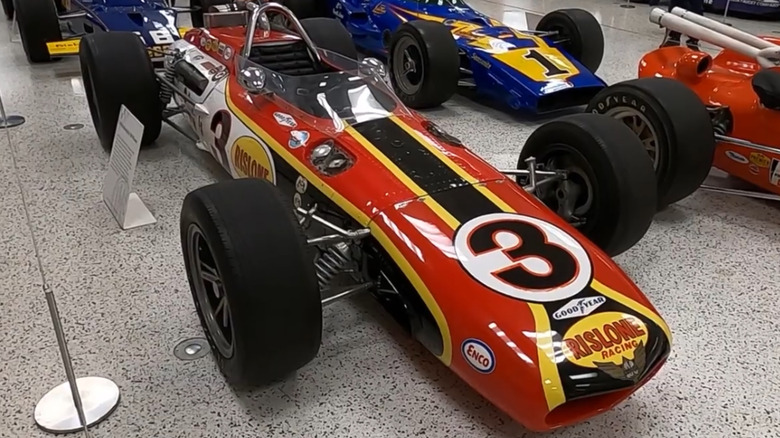
Highlights of the engine's design include its double overhead cam setup, which was still relatively rare when the Offenhauser debuted. The first-ever DOHC engine was in a 1912 Peugeot, and it was considered "exotic" right up through the late 1960s. As you might remember from our discussion of the differences between SOHC, DOHC, and OHV engines, twin-cam motors are known for their higher-revving, higher-performing operating characteristics.
Another key advantage was that the Offy's cylinder heads and block were cast as a single unit, eliminating the need for head gaskets, which can be a common pain point for forced-induction engines. That's important because subsequent Indy 500 rule changes led to the premiere of turbocharged Offenhauser engines in 1966. By 1968, without having to worry about blowing a head gasket, Offenhauser boosted a 168-cubic-inch mill to 625 horsepower in Bobby Unser's race-winner. When Jerry Grant became the first Indy-car driver to break the 200-mph barrier in qualifying in 1972, he tapped into 1,100 horsepower from an Offenhauser.
Another Offenhauser-powered car won the Indy 500 the same year — at the hands of Mark Donohue — and would also earn victories from 1973 through 1976. It was the end of an era, too, as that was also the last time any four-cylinder motor won the event. The current engine of record for Indy cars, like the one in Felix Rosenqvist's thrill ride to Indy 500 history this year, is a 2.2-liter twin-turbo V6 that's available from Honda or Chevrolet, and good for more than 700 horsepower.