

This 3D-Printed Exhaust Delivers More Engine Horsepower Than X-Pipes, But At A Cost
Decisions, decisions. When it comes to buying a new-to-you performance car, you've got no shortage of bolt-on upgrades you can throw into the mix. And one of the first things many enthusiasts reach for first is an exhaust upgrade. That said, it's more complicated (and expensive) than some simple stainless steel tubing sending exhaust gases away in the final stroke of your car's four-stroke operation. Your exhaust system is broken up into a front, rear, and mid-pipe section. Often, an owner will first look at the prospect of a cat-back or axle-back exhaust system. Both options are more affordable than springing for a full system with headers.
It's up to you to decide which option better suits your build. Typically, an axle-back system is just that: it starts around the rear axle of the car and often replaces the muffler and tailpipe without changing much else. A cat-back option includes everything from the catalytic converter back, including the mid-pipe. To further complicate things, there's an alphabet of mid-pipe options for your aftermarket exhaust application. Enter the performance-gaining H-pipe and X-pipe. Those two are common mid-pipe upgrades. But now, there's yet another option: the Formula Z Performance Z-pipe. It's wild, 3D-printed, and puts up better numbers than an aftermarket X-pipe. Trouble is, it comes at a hefty price.
Could a 3D-printed Z-pipe make the traditional X-pipe obsolete?
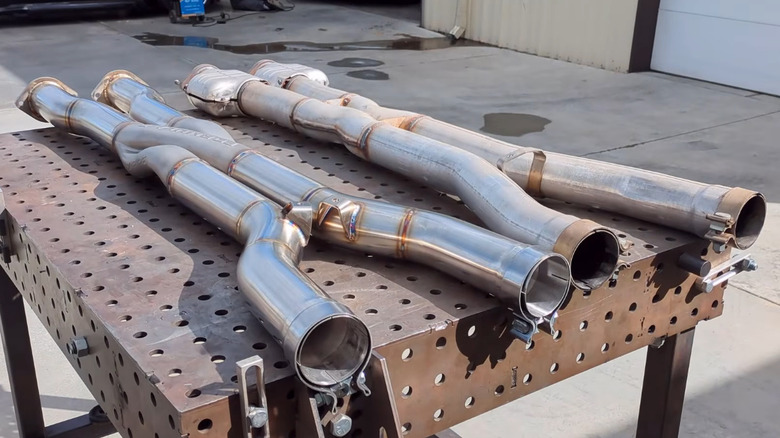
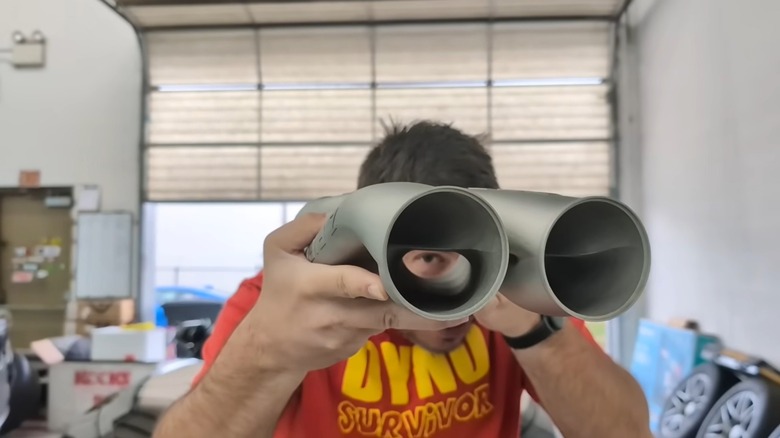
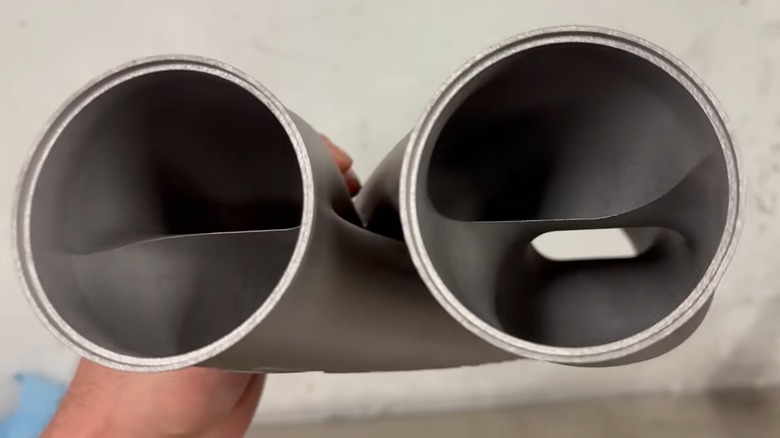
Let's start with the H-pipe and X-pipe. Both options connect each pipe coming off the headers or manifold at the mid-pipe. The H-pipe does so via a small, straight pipe, creating an "H" shape. An X-pipe also connects the lengths of exhaust at the mid-pipe by crossing over and forming an "X." Sensing a pattern here? Continuing the trend of letter-shaped mid-pipe options, the minds over at Formula Z Performance have a new option: a mazy, zigzagging Z-pipe. Each Z-pipe is 3D-printed using 316L stainless steel, selective laser melting, and direct metal laser sintering techniques.
The result? The Z-pipe is compact and creates a unique sound as it connects the two exhaust banks downstream of emissions hardware. As for performance improvements, Formula Z Performance claims the Z-pipe increases exhaust scavenging, or the vacuum effect created by the low pressure following the exhaust stroke's pulse. As such, the Z-pipe promises modest horsepower gains and an increase in throttle responsiveness through the boosted volumetric efficiency.
It's not just for frequently modified front-engine applications like the V8-powered Ford Mustang, either. The Z-pipe is — in addition to its "classic" Z-shaped mid-pipe design – available as an opposing variant for rear-engine Porsches (think 911), a "supercar" style for mid-engine applications, and a center-exit variant exclusively for Porsche GT3 and GT4 cars. Here's the thing, though: the 3D-printed Z-pipe is pricey. Really pricey. The classic Z-pipe starts at just over $1,000 and goes up from there. And these gains might not be worth the swelteringly spendy price tag for many car builders.
Pricey power gains
YouTuber CMbuildz added a Formula Z Performance Z-pipe to a Dodge Challenger SRT Hellcat to see just how much the labyrinthine exhaust component would invigorate the big cat. So, how did it do on the dyno? In testing, the Z-pipe-equipped Hellcat jumped from a mean horsepower output of 798.24 to 804.5. That's a total average gain of around 6.3 horsepower over the first tests. It's up to you whether the 0.79% increase in power is worthy of the Z-pipe's four-figure price tag. Now, the Z-pipe did alter the Hellcat's exhaust tone, and for some enthusiasts, that's enough.
In another battery of tests, YouTubers Fluid MotorUnion installed a 3.0-inch Z-pipe in a Shelby GT350 replacing an FMU X-pipe. The Shelby packs a screaming, flat-plane 5.2-liter "Voodoo" V8, meaning an entirely different soundtrack than the supercharged 6.2-liter V8 in the SRT Hellcat. So, part of Fluid MotorUnion's goals for the Z-pipe was to unlock more exoticness from the Shelby's shrieking flat-plane application. Of course, even the addition of stepped headers and the Z-pipe didn't make the GT350 sound like something from the Ferrari orchestra section. It did, however, result in a small power bump.
In testing, the Shelby GT350 was rated at 463 horsepower on the dyno with the FMU X-Pipe installed. Even with stock headers, replacing the X-pipe with a Z-pipe produced a noticeable shift in sound. But, after adding stainless steel stepped headers and a Z-pipe, the maximum dyno power showed 473.8 horsepower. So, all said and done, the Z-Pipe averaged a 3 horsepower gain over the FMU X-pipe, headers notwithstanding. Worth a thousand bucks? Maybe. Maybe not.