

Here's What Happens When You Blueprint An Engine
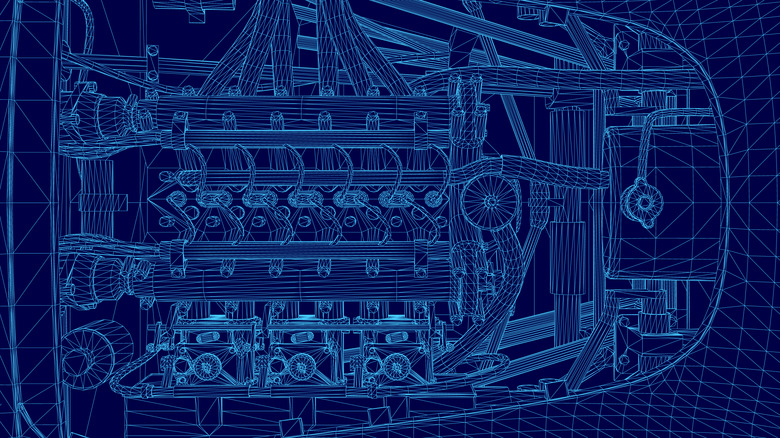
You have probably heard the term "blueprinted" at car meets and drag strips. What exactly is it, though, and what does it entail? Blueprinting is the art of engine building that goes way beyond reconditioning. It's a meticulous approach towards engine building that yields a motor that's even better than when it came off an assembly line. Here's why:
When an automotive engineer designs a new engine, the digital creation is flawless, with every cylinder bore a perfect geometrical cylinder, crank journal rounded to the atomic level, and the deck height at the same flatness front to back. This ideal digital or printed form of the motor is called the blueprint.
However, once the blueprint leaves the design department, and the manufacturer gets to building the motor, reality hits. As compared to a drawing, a casted component will have ridges and slightly misshapen ports. As giant robotic cutters grind through a cast engine block at blistering pace, hundreds of these engines are churned out daily. This pace creates a deviation from the perfect dimensions of the blueprint, which we call acceptable tolerances. In a mass-produced car, these subtle variations are perfectly acceptable. However, when stacked together, these add up and manifest themselves in the form of a small bit of wasted potential energy through heat, internal friction, and vibration.
Blueprinting is the radical process of taking those production parts and reworking them to conform exactly to the engineer's original specification. Blueprinting is not just limited to hot rods, it can also save a classic Jaguar motor.
The art of absolute balance
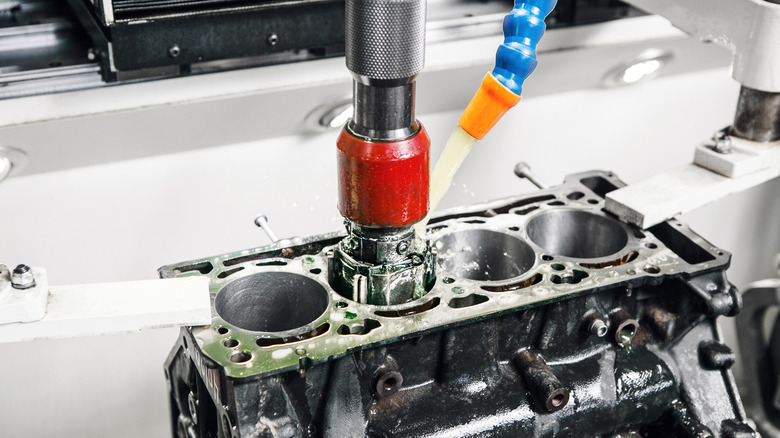
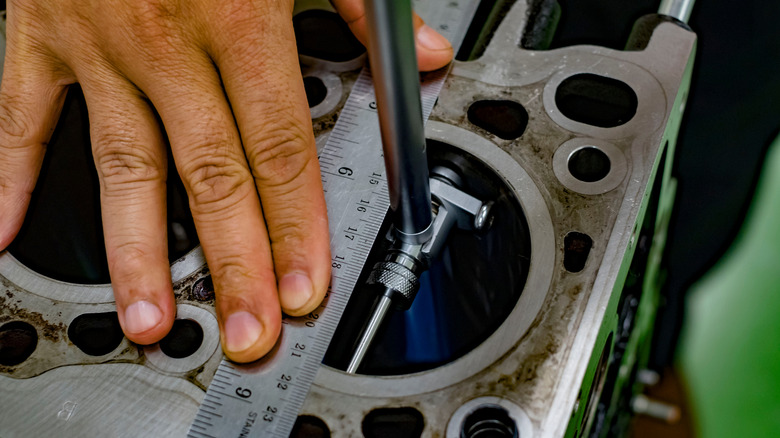
Blueprinting means picking up the micrometers, dial indicators, and bore gauges to measure every single parameter. You are ensuring all the cylinders are experiencing the same mechanical tolerances as the others. Blueprinting is quite useful especially when you have the oldest engine still being produced today.
To truly understand the madness of blue printing, you need to watch a soul-calming stop-motion engine build. Then you need to understand what happens to the OEM rotating assembly. When you pick up a fresh set of pistons and connecting rods from an OEM box, they look identical to the naked eye. However, put them on a digital scale and chances are, one piston may weigh 450 grams, while the other weighs 454 grams. A four-gram difference does not sound like much, but when that piston changes direction 7,000 times a minute at 3,500 rpm, the vibrations scale exponentially with speed. A tiny variation in mass creates a massive kinetic disharmony at high RPM. A four-gram error at idle can become a noticeable shudder at high RPMs, over time damaging the crankshaft and bearings. In a blueprinted engine, this variance is completely flattened. Every piston, pin, ring, and rod is weighed on a hyper-sensitive scale. The lightest piston is selected, and tiny metal bits are shaved off the remaining pistons to match them together.
The crankshaft is mounted on a dynamic balancing machine and spun to analyze its heavy or light spots. Material is either drilled out of the counterweights or heavy tungsten "Mallory metal" is welded on until you have a perfectly balanced crankshaft. The deck is machined flat while cylinders are bored and honed.
Free horsepower and incredible efficiency
What do you get for all this highly expensive measuring and machining? According to old-school hotrodders, blueprinting unlocks "free horsepower". Blueprinting unlocks the hidden horsepower that your engine was already capable of producing but was losing to internal mechanical friction and thermal efficiency gaps.
Back in the halcyon days of the 1960s muscle car, you had that one factory fresh roadster that could run a 14.5-second quarter mile, while other identical cars coming off the same assembly line struggled to break into the 15-second mark. These fast anomalies were called "ringers'. They were simply cars where the components happened to line up perfectly. Blueprinting intentionally manufactures that ringer engine. By achieving a perfect finish on the cylinder walls and bringing bearing clearances into the exact sweet spot, oil pressure stabilizes, and parasitic friction drops. The engine spins more freely, revs faster, and runs noticeably cooler.
The real reward of a blueprinted engine isn't a healthy dyno graph. It's the sheer longevity and smoothness. When internal components aren't constantly vibrating and fighting against mismatched clearances, stress loads on the bearings drop. An engine that runs in absolute balance is an engine that survives under extreme stress. Blueprinting turns the chaotic reality of mass production into a precise engineering masterpiece.